

Trade
Basic
Futures
Futures
Hundreds of contracts settled in USDT or BTC
Options
HOT
Trade European-style vanilla options
Unified Account
Maximize your capital efficiency
Demo Trading
Futures Kickoff
Get prepared for your futures trading
Futures Events
Participate in events to win generous rewards
Demo Trading
Use virtual funds to experience risk-free trading
Earn
Launch
CandyDrop
Collect candies to earn airdrops
Launchpool
Quick staking, earn potential new tokens
HODLer Airdrop
Hold GT and get massive airdrops for free
Launchpad
Be early to the next big token project
Alpha Points
NEW
Trade on-chain assets and enjoy airdrop rewards!
Futures Points
NEW
Earn futures points and claim airdrop rewards
Investment
Simple Earn
Earn interests with idle tokens
Auto-Invest
Auto-invest on a regular basis
Dual Investment
Buy low and sell high to take profits from price fluctuations
Soft Staking
Earn rewards with flexible staking
Crypto Loan
0 Fees
Pledge one crypto to borrow another
Lending Center
One-stop lending hub
VIP Wealth Hub
Customized wealth management empowers your assets growth
Private Wealth Management
Customized asset management to grow your digital assets
Quant Fund
Top asset management team helps you profit without hassle
Staking
Stake cryptos to earn in PoS products
Smart Leverage
NEW
No forced liquidation before maturity, worry-free leveraged gains
GUSD Minting
Use USDT/USDC to mint GUSD for treasury-level yields

More


Institutional giants "defensive reduction"? US Bitcoin and Ethereum ETF lose nearly $1 billion in a single day
1h ago
The whole world is celebrating, so why is only the crypto industry "wintering"?
1h ago
Trending Topics
View More57.14K Popularity
36.93K Popularity
21.53K Popularity
66.45K Popularity
347.32K Popularity





Pin
Tiger Research: Policy catalysts, liquidity expansion, Bitcoin Q1 target price $185,000
This report is authored by Tiger Research and presents our market outlook for Bitcoin in Q1 2026, with a target price set at $185,500. Key Highlights
Macro easing persists, growth momentum wanes Bitcoin is currently trading near $96,000. Since our previous report published on October 23, 2025, the price has declined by 12%. Despite recent pullbacks, the macro environment supporting Bitcoin remains solid. Fed path remains dovish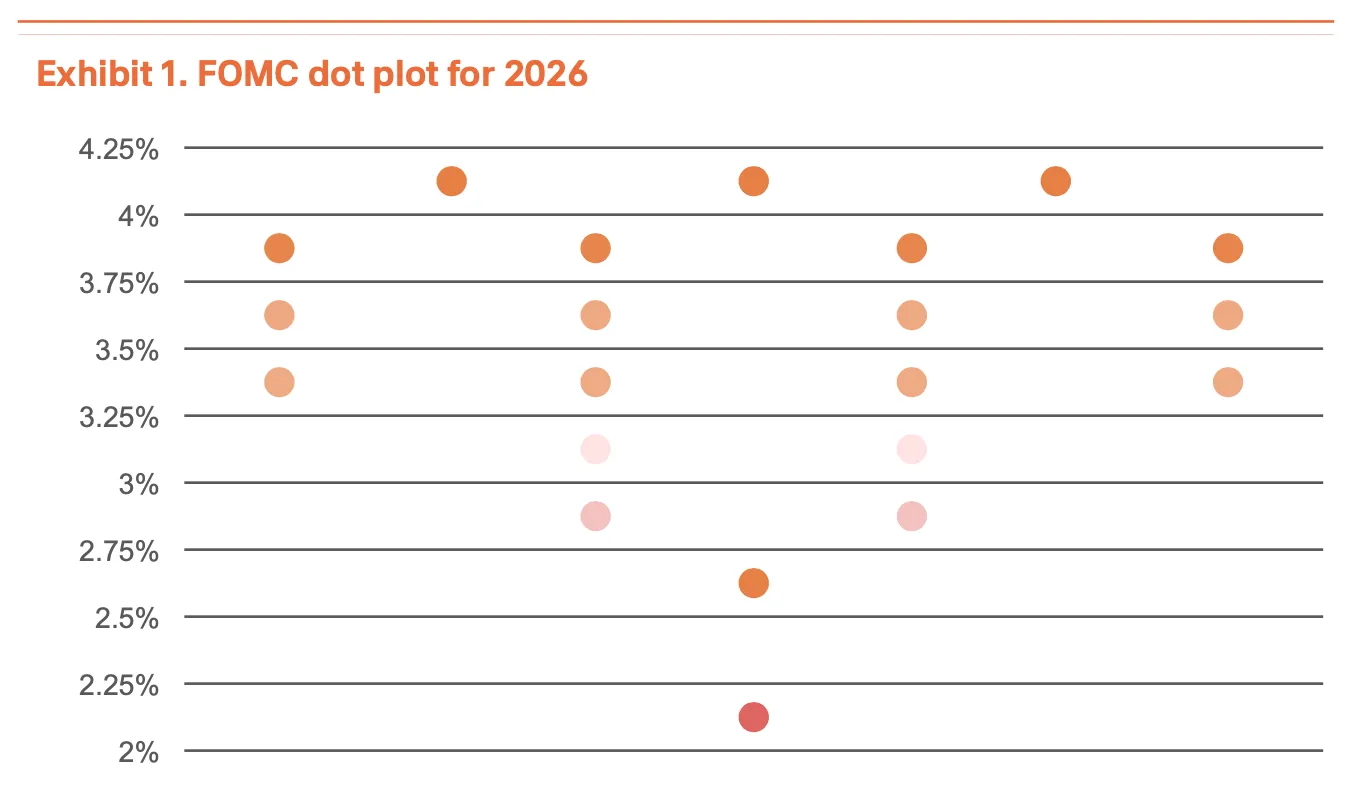 Source: Tiger Research
The Federal Reserve has cut interest rates three consecutive times from September to December 2025, totaling a 75 basis point decrease, with current rates in the 3.50%–3.75% range. The December dot plot projects the rate will fall to 3.4% by the end of 2026. While a 50 basis point or larger single rate cut this year is unlikely, with Powell’s term ending in May, the Trump administration may appoint a more dovish successor, ensuring the continuation of monetary easing.
Institutional outflows and corporate accumulation
Source: Tiger Research
The Federal Reserve has cut interest rates three consecutive times from September to December 2025, totaling a 75 basis point decrease, with current rates in the 3.50%–3.75% range. The December dot plot projects the rate will fall to 3.4% by the end of 2026. While a 50 basis point or larger single rate cut this year is unlikely, with Powell’s term ending in May, the Trump administration may appoint a more dovish successor, ensuring the continuation of monetary easing.
Institutional outflows and corporate accumulation
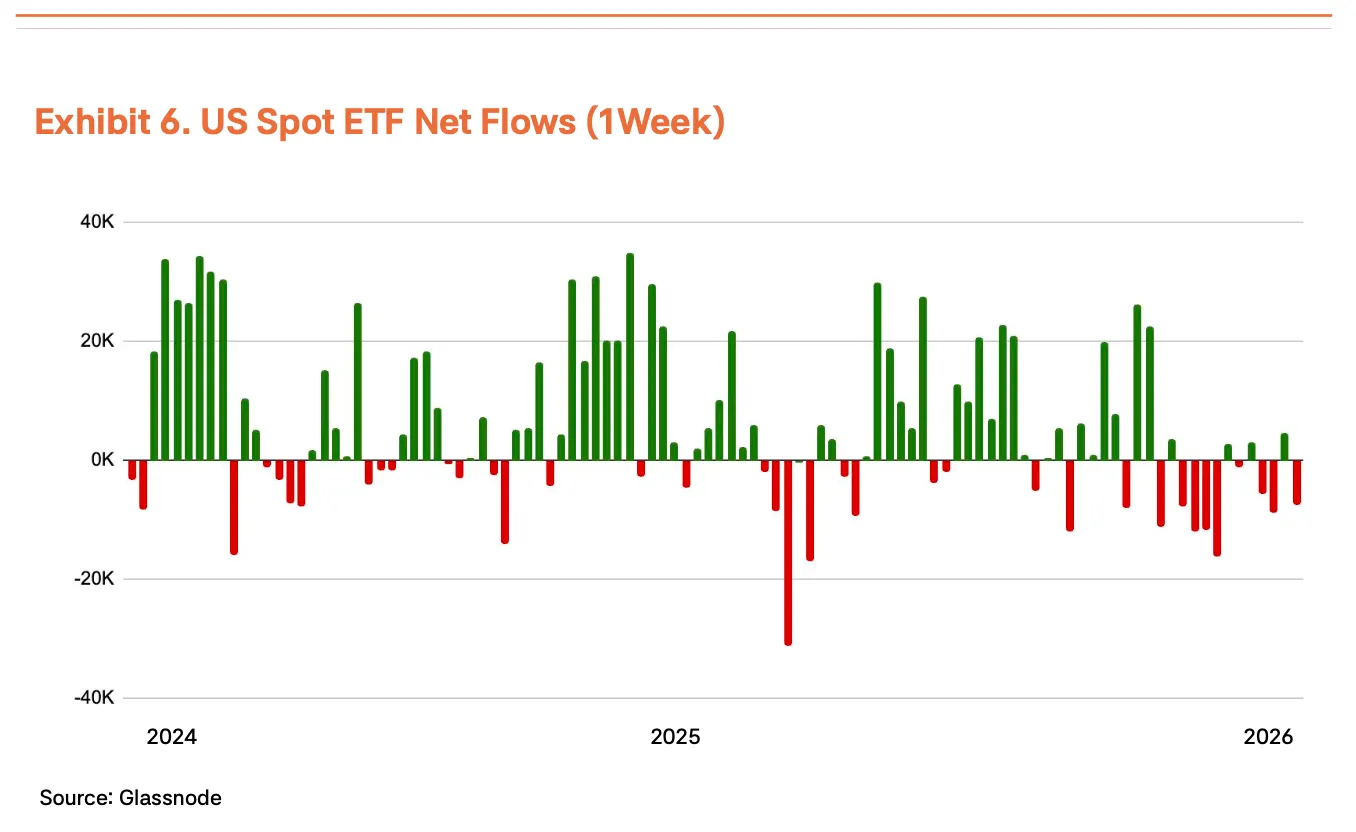 Despite a favorable macro environment, institutional demand has recently been subdued. Spot ETF funds saw outflows of $4.57 billion in November and December, the largest since product launch. The annual net inflow was $21.4 billion, down 39% from last year’s $35.2 billion. Although asset rebalancing in January brought some inflows, the sustainability of the rebound remains uncertain. Meanwhile, companies like MicroStrategy (holding 673,783 BTC, about 3.2% of total supply), Metaplanet, and Mara continue to increase their holdings.
CLARITY Act as a policy catalyst
Amidst stagnant institutional demand, regulatory progress is becoming a potential driver. The House-passed CLARITY Act clarifies jurisdictional boundaries between the SEC and CFTC and allows banks to provide digital asset custody and staking services. Additionally, the bill grants CFTC regulatory authority over the spot digital commodities market, providing a clear legal framework for exchanges and brokers. The Senate Banking Committee is scheduled to review on January 15, and if approved, it could prompt long-term traditional financial institutions to enter the market.
Ample liquidity, Bitcoin lagging
Liquidity is another key variable besides regulation. The global M2 supply hit a record high in Q4 2024 and continues to grow. Historically, Bitcoin tends to lead the liquidity cycle, often rising before M2 peaks and consolidating during the peak phase. Current signs indicate further liquidity expansion, suggesting Bitcoin still has upside potential. If stock market valuations appear excessive, capital is likely to rotate into Bitcoin.
Macro factors lowered to +25%, outlook remains robust
Overall, the macro trend of rate cuts and liquidity expansion remains unchanged. However, due to slowing institutional inflows, leadership changes at the Fed, and rising geopolitical risks, we have adjusted the macro factor from +35% down to +25%. Despite the reduction, this weight remains in the positive range, and we believe regulatory progress and ongoing M2 expansion will provide core support for medium- to long-term growth.
$84,000 support and $98,000 resistance levels
On-chain indicators provide auxiliary signals for macro analysis. During the November 2025 correction, buy-the-dip funds concentrated around $84,000, forming a clear support zone. Bitcoin has now broken through this zone. The $98,000 level corresponds to the average cost basis of short-term holders and acts as a recent psychological and technical resistance.
Despite a favorable macro environment, institutional demand has recently been subdued. Spot ETF funds saw outflows of $4.57 billion in November and December, the largest since product launch. The annual net inflow was $21.4 billion, down 39% from last year’s $35.2 billion. Although asset rebalancing in January brought some inflows, the sustainability of the rebound remains uncertain. Meanwhile, companies like MicroStrategy (holding 673,783 BTC, about 3.2% of total supply), Metaplanet, and Mara continue to increase their holdings.
CLARITY Act as a policy catalyst
Amidst stagnant institutional demand, regulatory progress is becoming a potential driver. The House-passed CLARITY Act clarifies jurisdictional boundaries between the SEC and CFTC and allows banks to provide digital asset custody and staking services. Additionally, the bill grants CFTC regulatory authority over the spot digital commodities market, providing a clear legal framework for exchanges and brokers. The Senate Banking Committee is scheduled to review on January 15, and if approved, it could prompt long-term traditional financial institutions to enter the market.
Ample liquidity, Bitcoin lagging
Liquidity is another key variable besides regulation. The global M2 supply hit a record high in Q4 2024 and continues to grow. Historically, Bitcoin tends to lead the liquidity cycle, often rising before M2 peaks and consolidating during the peak phase. Current signs indicate further liquidity expansion, suggesting Bitcoin still has upside potential. If stock market valuations appear excessive, capital is likely to rotate into Bitcoin.
Macro factors lowered to +25%, outlook remains robust
Overall, the macro trend of rate cuts and liquidity expansion remains unchanged. However, due to slowing institutional inflows, leadership changes at the Fed, and rising geopolitical risks, we have adjusted the macro factor from +35% down to +25%. Despite the reduction, this weight remains in the positive range, and we believe regulatory progress and ongoing M2 expansion will provide core support for medium- to long-term growth.
$84,000 support and $98,000 resistance levels
On-chain indicators provide auxiliary signals for macro analysis. During the November 2025 correction, buy-the-dip funds concentrated around $84,000, forming a clear support zone. Bitcoin has now broken through this zone. The $98,000 level corresponds to the average cost basis of short-term holders and acts as a recent psychological and technical resistance.
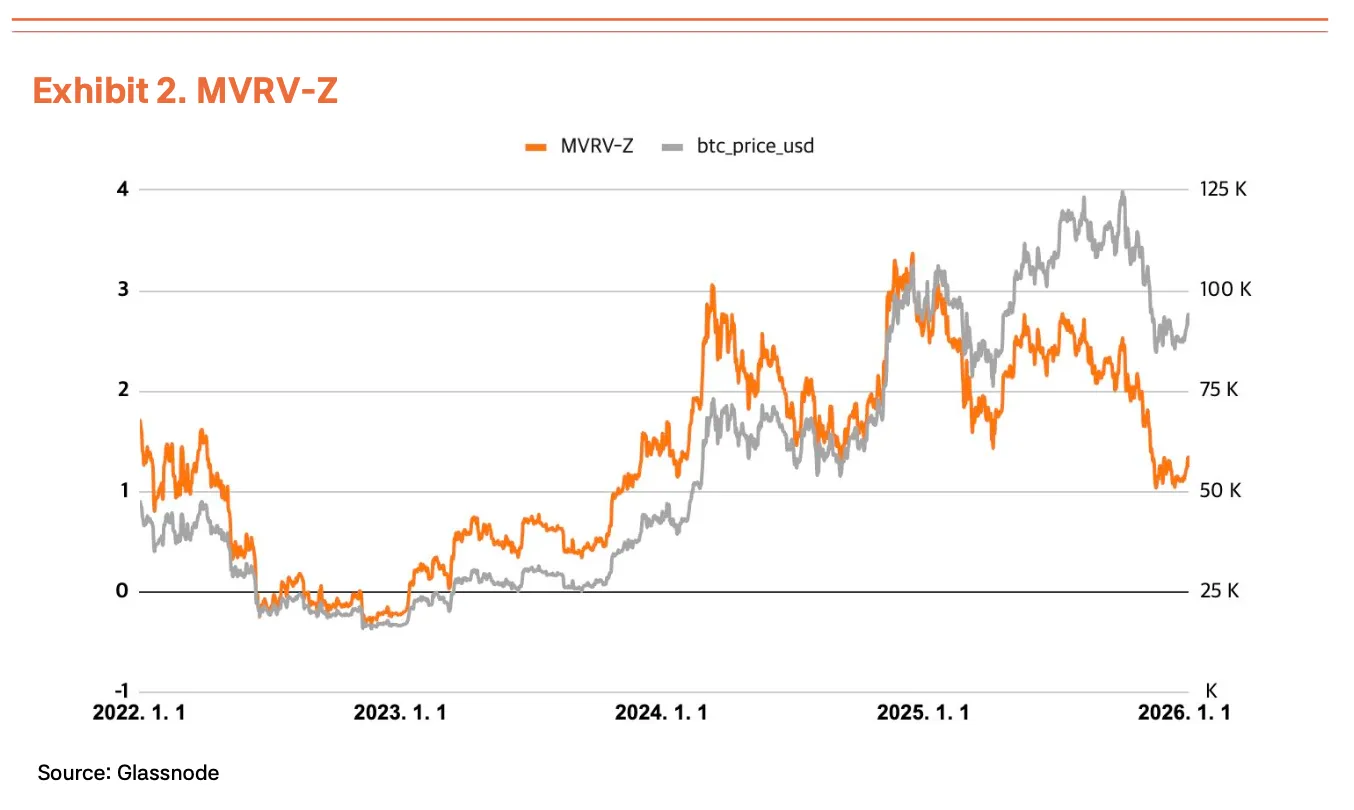 On-chain data shows market sentiment shifting from short-term panic to neutrality. Key indicators like MVRV-Z (1.25), NUPL (0.39), and aSOPR (1.00) have exited the undervalued zone and entered the equilibrium zone. This suggests that while the likelihood of panic-driven explosive rallies has decreased, the market structure remains healthy. Combined with macro and regulatory backgrounds, the statistical basis for medium- to long-term price appreciation remains strong.
It is noteworthy that the current market structure differs significantly from previous cycles. The increased share of institutional and long-term capital reduces the probability of panic sell-offs driven by retail investors. Recent pullbacks are more of a gradual rebalancing. Although short-term volatility is inevitable, the overall upward structure remains intact.
Target price revised to $185,500, bullish outlook remains firm
Using the TVM valuation framework, we derive a neutral baseline valuation of $145,000 for Q1 2026 (slightly below the previous report’s $154,000). Combining a 0% fundamental adjustment and a +25% macro adjustment, we set the revised target price at $185,500.
We have increased the fundamental adjustment factor from -2% to 0%. While network activity changes are minimal, renewed market attention to the BTCFi ecosystem has offset some bearish signals. Additionally, due to the aforementioned slowdown in institutional inflows and geopolitical factors, we have lowered the macro adjustment factor from +35% to +25%.
This downward revision of the target price should not be seen as a bearish signal. Even after adjustment, the model still indicates about 100% upside potential. The lower baseline price mainly reflects recent volatility, while Bitcoin’s intrinsic value is expected to continue rising in the medium to long term. We believe that recent pullbacks are part of a healthy rebalancing process, and the medium- to long-term bullish outlook remains unchanged.
On-chain data shows market sentiment shifting from short-term panic to neutrality. Key indicators like MVRV-Z (1.25), NUPL (0.39), and aSOPR (1.00) have exited the undervalued zone and entered the equilibrium zone. This suggests that while the likelihood of panic-driven explosive rallies has decreased, the market structure remains healthy. Combined with macro and regulatory backgrounds, the statistical basis for medium- to long-term price appreciation remains strong.
It is noteworthy that the current market structure differs significantly from previous cycles. The increased share of institutional and long-term capital reduces the probability of panic sell-offs driven by retail investors. Recent pullbacks are more of a gradual rebalancing. Although short-term volatility is inevitable, the overall upward structure remains intact.
Target price revised to $185,500, bullish outlook remains firm
Using the TVM valuation framework, we derive a neutral baseline valuation of $145,000 for Q1 2026 (slightly below the previous report’s $154,000). Combining a 0% fundamental adjustment and a +25% macro adjustment, we set the revised target price at $185,500.
We have increased the fundamental adjustment factor from -2% to 0%. While network activity changes are minimal, renewed market attention to the BTCFi ecosystem has offset some bearish signals. Additionally, due to the aforementioned slowdown in institutional inflows and geopolitical factors, we have lowered the macro adjustment factor from +35% to +25%.
This downward revision of the target price should not be seen as a bearish signal. Even after adjustment, the model still indicates about 100% upside potential. The lower baseline price mainly reflects recent volatility, while Bitcoin’s intrinsic value is expected to continue rising in the medium to long term. We believe that recent pullbacks are part of a healthy rebalancing process, and the medium- to long-term bullish outlook remains unchanged.