

Trade
Basic
Futures
Futures
Hundreds of contracts settled in USDT or BTC
Options
HOT
Trade European-style vanilla options
Unified Account
Maximize your capital efficiency
Demo Trading
Futures Kickoff
Get prepared for your futures trading
Futures Events
Participate in events to win generous rewards
Demo Trading
Use virtual funds to experience risk-free trading
Earn
Launch
CandyDrop
Collect candies to earn airdrops
Launchpool
Quick staking, earn potential new tokens
HODLer Airdrop
Hold GT and get massive airdrops for free
Launchpad
Be early to the next big token project
Alpha Points
NEW
Trade on-chain assets and enjoy airdrop rewards!
Futures Points
NEW
Earn futures points and claim airdrop rewards
Investment
Simple Earn
Earn interests with idle tokens
Auto-Invest
Auto-invest on a regular basis
Dual Investment
Buy low and sell high to take profits from price fluctuations
Soft Staking
Earn rewards with flexible staking
Crypto Loan
0 Fees
Pledge one crypto to borrow another
Lending Center
One-stop lending hub
VIP Wealth Hub
Customized wealth management empowers your assets growth
Private Wealth Management
Customized asset management to grow your digital assets
Quant Fund
Top asset management team helps you profit without hassle
Staking
Stake cryptos to earn in PoS products
Smart Leverage
NEW
No forced liquidation before maturity, worry-free leveraged gains
GUSD Minting
Use USDT/USDC to mint GUSD for treasury-level yields

More


Tax Resident Must-Read: Do You Have to Pay Taxes on Profits from Crypto Assets?
2h ago
To the founders: Electric Capital has released 26 "bounties" to find the next user sovereignty unicorn
4h ago
Trending Topics
View More57.14K Popularity
36.93K Popularity
21.53K Popularity
66.45K Popularity
347.32K Popularity





Pin
One Year in Office for Trump: Memorable Moments and Disasters
Text | Lin Wanwan @linwanwan823, DongchaBeating
January 20, 2026 marks the one-year anniversary of Trump’s official inauguration.
Looking back a year ago, 72 hours before his inauguration, a crypto wallet with the code name 6QSc2Cx began大量 buying a new token, priced at 18 cents each. This token was created just a few hours earlier, with no public promotion.
A few hours later, Trump announced on social media: he had issued a cryptocurrency named after himself, $TRUMP.
Following the announcement, the token’s price skyrocketed from under $1 to $75 within 48 hours. The wallet that entered early cashed out at the peak, making a profit of $109 million.
Chainalysis, an on-chain analysis firm commissioned by The New York Times, found that there was more than one such “mysterious prophet.”
On the same day, an American truck driver with the online name Mike invested his daughter’s entire college fund into TRUMP tokens. He posted on overseas media: “The President won’t let us lose money.”
Three weeks later, he lost $47,000.
Six months later, the team behind the token’s issuance had cashed out over $1 billion.
Six years ago, Trump said: “Cryptocurrencies are entirely based on air.” He was right. But he didn’t tell the full story: how much the air is worth depends on who is selling it.
Appetizer
No one knows who they are on the other end of the wallet. Nor does anyone know how they knew in advance. But one thing is certain: when these people exit, another group is entering.
Chainalysis data shows that 810,000 wallets lost money on TRUMP tokens, totaling over $2 billion. The average loss per person is $2,500.
Nearly half of these are newcomers who created their crypto wallets for the first time on the day of the token launch. They saw the news of “the President issuing coins,” downloaded the app, and transferred their savings.
Further analysis by Chainalysis shows that the average holding time for these new wallets is 47 hours. They bought near the peak and sold after their holdings were halved. On-chain data reconstructs a typical path: download app → deposit funds → buy → bullish → add to position → crash → cut losses → uninstall app. The entire process takes less than a week.
Someone posted on Reddit: “I used my daughter’s college fund.” The most upvoted reply was: “Bro, the President won’t let you lose money.”
The President didn’t make everyone lose money, after all, many people made life-changing gains from this day. But most did not.
Someone posted a rocket emoji on Twitter with the caption “TRUMP to the moon.” Eleven days later, he posted again: “Fed up with this TRUMP garbage, selling everything.”
When he sold, the token price was between $24 and $27. If he had held on for a few more months, he would have seen the price drop below $5, a decline of over 90% from the peak.
Meanwhile, the issuers of $TRUMP tokens, two companies associated with the Trump family, earned over $320 million in trading fees in the first year. Not to mention the 8 billion tokens they hold locked up, worth hundreds of billions of dollars at issuance price.
Interestingly, there are purchase terms for the tokens. A small print states: “Buyers agree to waive the right to participate in any class action.”
Another line states: “This token is ‘not an investment opportunity,’ and is ‘not related to any political activity or government position.’”
To put it simply: you buy and lose, and can’t sue me. The money I make has nothing to do with me being President.
Main Course
$TRUMP Just the appetizer.
The real main course is called World Liberty Financial. It is a “decentralized finance platform” founded in September 2024 by the Trump family and several partners. The platform issued a governance token called WLFI and a stablecoin called USD1.
The ownership structure is as follows: the Trump family holds 60%. 75% of the net proceeds from token sales belong to the family. The reserves of USD1 are invested in U.S. Treasury bonds, generating about $80 million in interest annually, with 75% also belonging to the family.
In other words, this is not a project supported or endorsed by Trump. It is a project directly owned by the Trump family, from which they profit.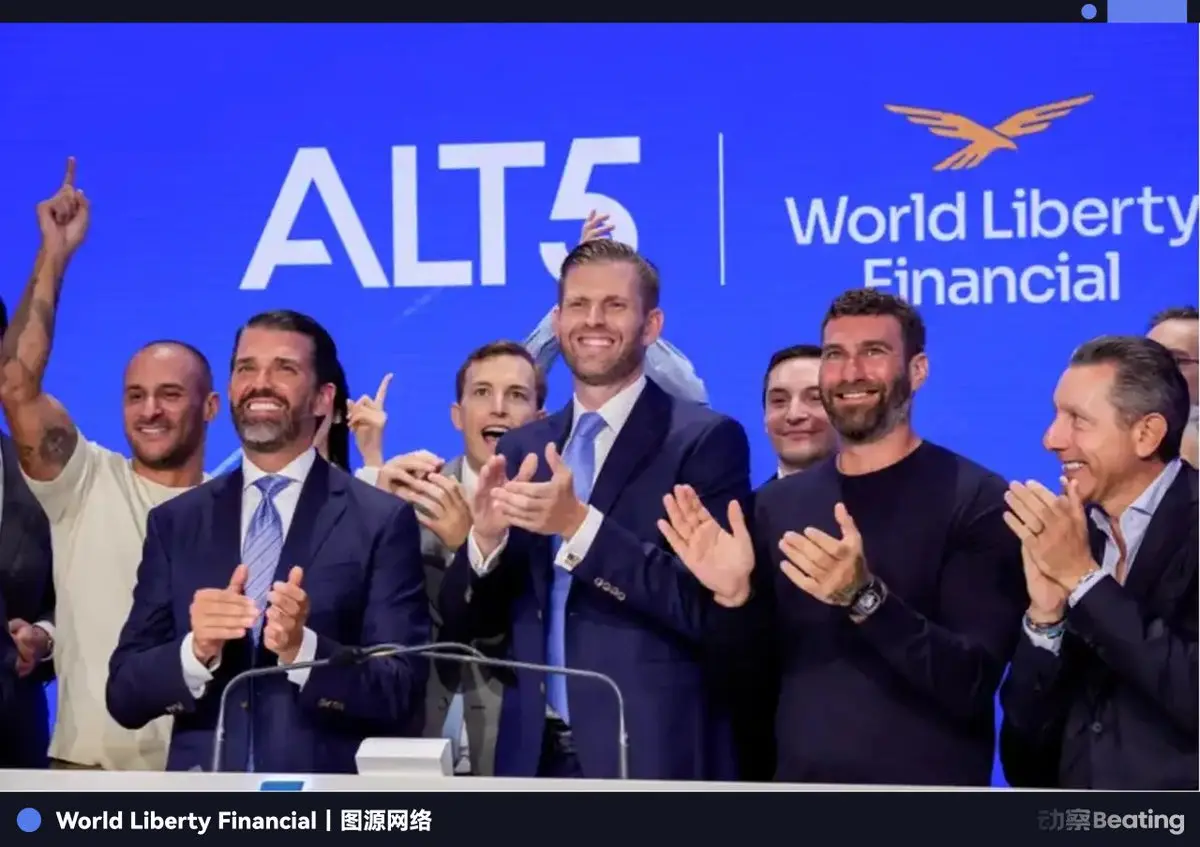
By the end of 2025, World Liberty had raised over $550 million. The list of investors reads like an INTERPOL watchlist:
MGX, an Abu Dhabi sovereign fund led by a member of the UAE royal family. In May 2025, it invested $2 billion in Binance using USD1 stablecoins, meaning UAE government funds flowed into the world’s largest crypto exchange via the stablecoin issued by the Trump family.
Why would these people invest in a crypto project linked to an American President’s family?
Reuters interviewed multiple investors, and the answers were surprisingly consistent: “Close to the President.”
There is an old joke on Wall Street: How much is it worth to play golf with the President?
Answer: It depends whether you’re playing golf or paying a lawyer.
World Liberty rewrote that joke’s punchline. Now there’s a clear price: WLFI tokens start at $250,000. “Platinum seat” costs $1 million. “Founding partner” costs $20 million.
You’re not buying tokens. You’re buying a photo, a dinner, a memorable name.
In political science, this is called “access capitalism.” It used to hide in super PACs, charity dinners, and lobbying bills. Now it’s written into smart contracts, traded 24/7, accessible worldwide.
Corruption democratized.
A financial commentator put it more bluntly: “Eric Trump is selling $20 million token packages in Dubai while his father is shaping U.S. crypto policy. You call that a business model? I call it a paid channel.”
Clearing the field
But this paid channel has one prerequisite: no one can investigate.
So, the first thing Trump did after taking office was to purge anyone who might investigate him. The speed and efficiency were almost artistic.
First, personnel purges.
On Inauguration Day, SEC Chairman Gary Gensler resigned. This “cryptocurrency hunter” had sued nearly all major exchanges during his tenure. His successor, Paul Atkins, had served as an advisor to the crypto industry association.
The newly formed SEC “Crypto Special Task Force” was led by Hester Peirce, known in the industry as “Crypto Mom,” who has long opposed regulation.
Next, case dismissals.
Cases from the Gensler era were withdrawn one after another. Coinbase case, withdrawn. Ripple case, withdrawn. Kraken case, withdrawn. OpenSea investigation, terminated. Uniswap investigation, terminated. Robinhood investigation, terminated.
The New York Times reports: SEC’s case withdrawal rate for crypto is 33%, compared to 4% for other cases. This gap has never appeared in SEC history.
Finally, organizational disbandment.
On April 7, 2025, Deputy Attorney General Todd Blanche signed a memo announcing the dissolution of the “National Cryptocurrency Enforcement Team.” This team was established in 2021 to investigate crypto money laundering, hacking, and fraud.
In the memo, Blanche wrote: “The Department of Justice is not a digital asset regulator.”
What he didn’t write: at the time of signing, he personally held over $150,000 in crypto assets. Later, when testifying before Congress, he was asked about this. He said: “My crypto holdings are ‘disclosed in compliance.’”
He was right. Disclosed, and thus compliant. Compliant, and no longer a conflict of interest.
This is the cleverness of this approach: it doesn’t need to hide conflicts of interest, only turn conflicts into a spreadsheet.
Within three months, people changed, cases were withdrawn, and investigating agencies disbanded.
The referee doesn’t go onto the field to kick the ball; the referee directly dismantles the field.
Pardon Price List
This business still lacks one final component: trust.
To attract global funds, Trump’s crypto empire needs to make those “criminal record” bigwigs look respectable again. They have money, resources, and connections, but their status is “confessed criminals” or “accused defendants.”
What to do?
Pardon.
On January 21, 2025, the day after Trump took office, he signed his first crypto-related pardon. The person pardoned was Ross Ulbricht, founder of the Silk Road dark web marketplace, originally sentenced to two life terms plus 40 years for running a platform facilitating $1 billion in drug transactions. Court records show at least six people died from buying drugs on that platform.
Trump wrote on Truth Social: “Those prosecuting him are scum.”
After release, Ulbricht appeared on stage at the 2025 Bitcoin conference and told the cheering crowd: “A few months ago I was in prison, now I am free. Thank you, thank you Trump.”
In March, four BitMEX founders were pardoned; they had pleaded guilty to violating anti-money laundering laws and were called “operators of a money laundering platform” by prosecutors. In October, Binance founder Zhao Changpeng was pardoned; he had pleaded guilty in 2023 for allowing the platform to be used for money laundering.
Three pardons, six people in total, spanning dark web drug trade, money laundering, and illegal operations. All cleared within ten months.
But what’s more interesting are those who were not pardoned.
Sam Bankman-Fried, founder of FTX, was sentenced to 25 years in 2024 for fraud, causing $8 billion in customer losses. He donated $5.2 million to Biden’s campaign in 2020.
No pardon.
Do Kwon, founder of Terra/Luna, was sentenced to 15 years in December 2025; his algorithmic stablecoin collapse caused investors to lose $40 billion.
No pardon.
In terms of severity, SBF and Do Kwon caused far greater losses than those who were pardoned. Legally, the FTX case is a clear case of customer fund fraud.
What’s the difference?
Those pardoned: either invested in Trump projects, or their companies have business dealings with Trump, or they have significant influence in the crypto community to help promote.
Those not pardoned: donated to the Democratic Party, or have no business relationship with Trump.
This is a pardon price list.
It’s not written on paper but in court rulings, pardon orders, and on the prison walls of those still serving sentences.
The true function of pardons is not to exempt from punishment. The punishment is already over. Ross Ulbricht served 11 years, Zhao Changpeng served 4 months, and the founders of BitMEX paid a $100 million fine.
The function of pardons is to send signals.
Signal one: those who cooperate with me, I will protect. Signal two: those who don’t, look at Sam Bankman-Fried. Signal three: the rules are set by me, and I can change them.
If you follow the organization, the organization will shield you.
Trump included this in the Federal Register.
The Corruption Conveyor Belt
Is this corruption?
Of course not. Corruption is sneaky, hidden, and subject to investigation.
This is a well-designed system. Every part is legal, every transaction is recorded on the blockchain, every disclosure is written into government documents. It doesn’t need to hide. It’s designed not to hide.
Traditional corruption is a manual workshop. You need middlemen, money laundering, worry about recordings, worry about witnesses turning. Every transaction is risky.
This setup is a pipeline. Token contracts automatically split accounts, blockchain automatically records, disclosures automatically comply. No middlemen, no cash, no witnesses. Only code.
Code doesn’t turn against you. Code doesn’t lie. Code only runs as designed.
And those who designed it are the same people who set the rules.
Genius
Trump’s genius isn’t in corruption. Anyone can be corrupt.
His genius is turning corruption into a product.
Bribery becomes “investment.” Kickbacks become “dividends.” Pardons become “judicial reform.” Deregulation becomes “support for innovation.”
Everything is written into clauses, recorded on the blockchain, legal, compliant, transparent.
In 2019, Trump said: “Cryptocurrency is completely based on air.”
He was right.
But he omitted the second half: air can also be sold for money, as long as the seller can decide what is legal.
This system is still running. Tokens are still trading, stablecoins are still earning interest, and money from around the world continues to flow into those wallets bearing Trump’s name.
And those 810,000 retail investors who lost money, the newcomers who rushed in upon hearing “the President issues coins,” those who think buying TRUMP coins is patriotic.
They are not investors. They are fuel.
Casinos don’t thank gamblers. Casinos only squeeze them dry.
Someone might ask: Is this legal? That question itself is already outdated.
In this game, “legality” isn’t just a description; it’s a product feature. Just like the iPhone has waterproofing, this system has a “legality” feature.
It’s designed to be legal, just as it’s designed to make money.
The real question isn’t “Is this legal?”
The real question is: when the person defining what’s legal and the person profiting from it are the same, what does the word “legal” even mean?
In 2019, Trump said cryptocurrency is based on air. In 2025, he proved himself right: air can be priced, traded, and can make a President a billionaire.
The only precondition is: you must be the one who can decide what “air” is.