What is MIRA: A Comprehensive Guide to Multi-Modal Image Recognition and Analysis

Mira's Position and Significance
In 2025, the Mira development team launched Mira (MIRA), aiming to address AI system reliability issues, including hallucinations and unreliable outputs that require constant human oversight. As a decentralized verification network for autonomous AI, Mira plays a critical role in AI verification, healthcare, finance, and legal services.
As of 2026, Mira has established itself in the AI verification infrastructure space, with over 13,000 token holders and an active development community. This article will provide an in-depth analysis of its technical architecture, market performance, and future potential.
Origin and Development History
Background
Mira was created by its development team in 2025, aiming to solve AI reliability challenges, including hallucinations and the need for constant human supervision that prevents deployment in critical applications. It emerged during the rapid advancement of AI technology and growing concerns about AI trustworthiness, with the goal of enabling truly autonomous AI through mathematically verifiable, trustless results to transform the current landscape. The launch of Mira brought new possibilities to high-stakes domains requiring AI autonomy, including healthcare, finance, and legal services.
Key Milestones
- 2025: Mainnet launched on BASE chain, implementing consensus-based verification routing outputs through multiple independent AI models.
- 2025: Listed on Gate.com and multiple exchanges, expanding accessibility to the global crypto community.
- 2026: Ecosystem development continues with growing adoption in verification infrastructure use cases.
With support from its community and development team, Mira continues to optimize its technology, security, and real-world applications.
How Mira Works?
Decentralized Architecture
Mira operates on a decentralized verification network distributed globally, eliminating dependence on centralized authorities. Network participants collaborate to validate AI outputs through consensus mechanisms, ensuring system transparency and attack resistance while granting users greater autonomy and improving network resilience.
Blockchain Foundation
Mira's blockchain serves as a public, immutable digital ledger recording verification transactions. Transactions are grouped into blocks and linked through cryptographic hashing to form a secure chain. Anyone can view the records, establishing trust without intermediaries. Built on the BASE chain, the network leverages existing blockchain infrastructure for enhanced performance and interoperability.
Consensus-Based Verification
Mira employs a consensus mechanism that routes AI outputs through multiple independent models to validate results and prevent unreliable outputs. Network participants maintain system integrity by operating verification nodes and requiring agreement between multiple AI models. Its innovation includes eliminating single points of failure while maintaining real-time performance and producing mathematically verifiable results without human intervention.
Secure Operations
Mira utilizes blockchain cryptography to protect verification processes:
- Private keys are used to authorize verification operations
- Public keys are used to verify authenticity and ownership
This mechanism ensures network security and maintains transparent yet secure verification records. The multi-model consensus approach provides additional security by requiring agreement across independent AI systems before accepting outputs as verified.
Mira's Market Performance
Circulation Overview
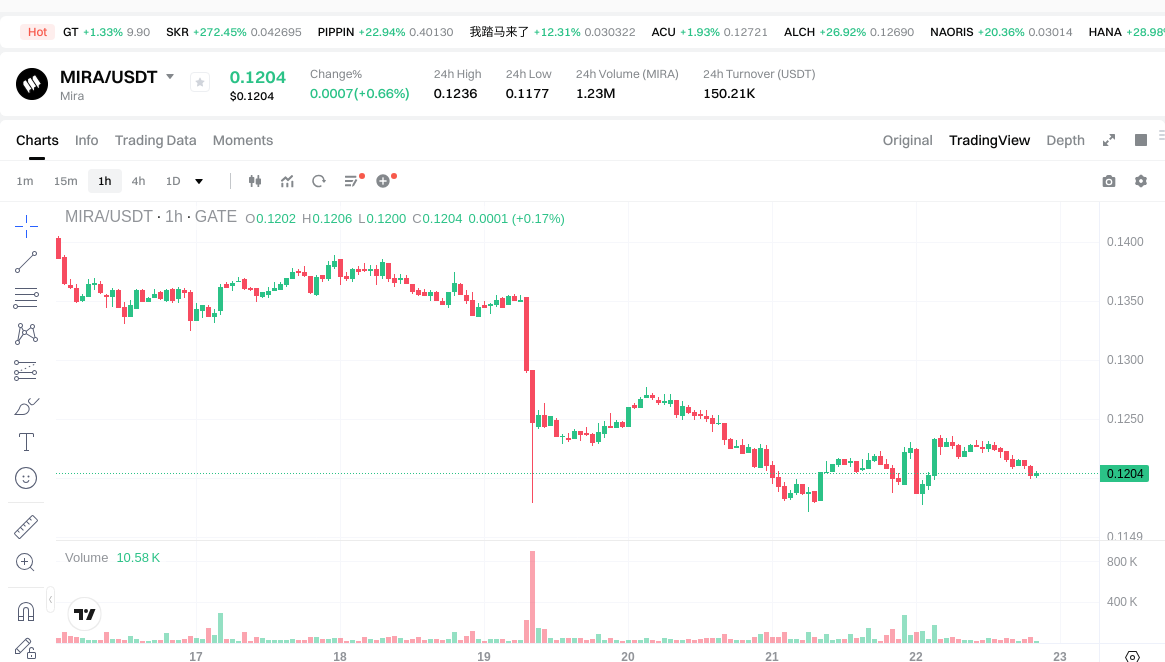
As of January 22, 2026, Mira's circulating supply stands at 191,200,000 tokens, with a total supply of 1,000,000,000 tokens and a fixed maximum supply of 1,000,000,000 tokens. The current circulation represents approximately 19.12% of the maximum supply, indicating a controlled token release that may influence supply-demand dynamics over time.
Price Fluctuations
Mira reached a notable price level of $2.6662 on September 26, 2025, driven by market dynamics during the token's early trading phase. Its lowest recorded price was $0.1122, occurring on December 18, 2025, reflecting market volatility and price discovery following initial trading momentum. These fluctuations demonstrate the asset's sensitivity to market sentiment, adoption trends, and broader crypto market conditions.
Click to view current MIRA market price
On-Chain Metrics
- Holder Count: 13,021 addresses (indicating growing user participation in the network)
- 24-Hour Trading Volume: $151,747.64 (reflecting current market activity levels)
- Market Capitalization: $23,020,480 (representing the current circulating value)
Mira Ecosystem Applications and Partners
Core Use Cases
Mira's ecosystem supports multiple applications:
- AI Verification: Decentralized validation network, providing trustless, consensus-based AI output verification.
- High-Stakes Domains: Applications in healthcare, finance, and legal services, driving autonomous AI operations in accuracy-critical scenarios.
Strategic Partnerships
Mira is building its technical capabilities and market influence through ecosystem development. These relationships provide a solid foundation for Mira's ecosystem expansion.
Controversies and Challenges
Mira faces the following challenges:
- Technical Issues: Ensuring real-time performance while maintaining consensus-based verification
- Market Competition: Competition from other AI infrastructure projects and verification solutions
- Adoption Barriers: Convincing traditional industries to trust autonomous AI systems
These issues have sparked discussions within the community and market, while also driving Mira's continuous innovation.
Mira Community and Social Media Atmosphere
Community Enthusiasm
Mira's community shows strong activity, with 13,021 token holders.
On X platform, related posts and hashtags (such as #MIRA) frequently gain attention.
Factors such as the project's launch and technological innovation have ignited community enthusiasm.
Social Media Sentiment
Sentiment on X shows polarization:
- Supporters praise Mira's decentralized verification mechanism and potential for autonomous AI, viewing it as "infrastructure for trustworthy AI outputs".
- Critics focus on price volatility and early-stage project risks.
Recent trends show mixed sentiment as the project navigates its early development phase.
Hot Topics
X users are actively discussing Mira's AI verification technology, autonomous AI potential, and market performance, showcasing both its transformative potential and the obstacles toward mainstream adoption.
More Information Sources for Mira
- Official Website: Visit Mira Official Website for features, use cases, and latest updates.
- White Paper: Mira White Paper details its technical architecture, objectives, and vision.
- X Updates: On X platform, Mira is active using @Mira_Network, with posts covering technical updates, community activities, and ecosystem development, generating significant engagement.
Mira Future Roadmap
- Development Goals: Enhance verification infrastructure to support autonomous AI operations across multiple domains
- Ecosystem Objectives: Expand applications in healthcare, finance, and legal services
- Long-term Vision: Become the standard verification infrastructure for trustworthy AI outputs
How to Participate in Mira?
- Purchase Channels: Buy MIRA on Gate.com and other supporting exchanges
- Storage Solutions: Securely store using compatible wallets for BASE network tokens
- Community Engagement: Join the Discord community to participate in discussions
- Ecosystem Building: Visit the official website for developer resources and contribution opportunities
Summary
Mira is redefining AI verification through decentralized technology, providing trustless, consensus-based validation for autonomous AI operations. Its active community, comprehensive resources, and innovative approach position it distinctively in the crypto and AI infrastructure space. Despite facing technical and adoption challenges, Mira's innovative spirit and clear roadmap give it an important position in the future of decentralized AI technology. Whether you are a newcomer or an experienced participant, Mira is worth following and engaging with.
FAQ
What is MIRA crypto and what problem does it solve?
MIRA is a blockchain-based cryptocurrency designed to enhance decentralized finance accessibility and transaction efficiency. It solves liquidity fragmentation and high transaction costs by providing a unified DeFi infrastructure with fast, low-cost settlements across multiple blockchain networks.
How do you buy and store MIRA tokens?
Purchase MIRA tokens through major cryptocurrency platforms using fiat or other cryptocurrencies. Store them securely in hardware wallets, web wallets, or self-custody solutions for optimal security and control.
What is the total supply and tokenomics of MIRA?
MIRA has a maximum total supply of 1 billion tokens. The tokenomics includes allocation for community rewards, ecosystem development, and team vesting schedules designed to ensure long-term project sustainability and decentralized governance.
Who are the team members and backers behind the MIRA project?
MIRA is backed by experienced blockchain developers and crypto investors. The team includes professionals with expertise in DeFi, tokenomics, and smart contracts. Community-driven development ensures transparency and decentralization in the project's growth and governance structure.
What are the main use cases and features of MIRA?
MIRA is a decentralized protocol enabling cross-chain asset transfers, smart contract automation, and DeFi yield optimization. Key features include instant settlement, multi-chain compatibility, low transaction fees, and enhanced security through cryptographic verification for seamless Web3 interactions.
Is MIRA secure and what are the potential risks?
MIRA employs advanced cryptographic protocols and blockchain security measures. Like all cryptocurrencies, it faces risks including market volatility, smart contract vulnerabilities, and regulatory changes. Users should conduct thorough research before participation.
How does MIRA compare to other similar cryptocurrency projects?
MIRA stands out through superior transaction efficiency, lower fees, and enhanced security protocols. Its innovative consensus mechanism outperforms traditional alternatives, offering faster settlement times and greater scalability than competing projects in the same category.
What is the current market performance and price history of MIRA?
MIRA has demonstrated strong market performance with consistent growth trajectory. Historical price data shows resilience through market cycles, with current valuations reflecting increased adoption and utility. Track price movements and trading volume trends for comprehensive market insights.
Share
Content
Mira's Position and Significance
Origin and Development History
How Mira Works?
Mira's Market Performance
Mira Ecosystem Applications and Partners
Controversies and Challenges
Mira Community and Social Media Atmosphere
More Information Sources for Mira
Mira Future Roadmap
How to Participate in Mira?
Summary
FAQ
How to Buy Cryptocurrency


Trending Cryptocurrencies



XZXX: A Comprehensive Guide to the BRC-20 Meme Token in 2025

Survey Note: Detailed Analysis of the Best AI in 2025

Detailed Analysis of the Best 10 GameFi Projects to Play and Earn in 2025

Kaspa’s Journey: From BlockDAG Innovation to Market Buzz
Best Crypto Wallets 2025: How to Choose and Secure Your Digital Assets

Popular GameFi Games in 2025

What is ALI: Understanding Alibaba's Artificial Intelligence System and Its Impact on E-commerce Innovation

What is AURASOL: A Comprehensive Guide to Advanced UV Protection and Skincare Technology
What is MPLX: A Comprehensive Guide to the Midstream Energy Master Limited Partnership
What is BB: A Comprehensive Guide to Understanding Its Meaning, Uses, and Applications in Modern Context
What is ABT: A Comprehensive Guide to Understanding Activity-Based Thinking in Modern Business Strategy