What is ALI: Understanding Alibaba's Artificial Intelligence System and Its Impact on E-commerce Innovation

Artificial Liquid Intelligence's Positioning and Significance
In 2021, Alethea AI launched Artificial Liquid Intelligence (ALI), aiming to address the lack of decentralized ownership and democratic governance in artificial intelligence development. As the pioneer of intelligent NFT (iNFT) standards, Artificial Liquid Intelligence plays a key role in the intersection of AI and blockchain, particularly in NFT innovation and metaverse applications.
As of 2026, Artificial Liquid Intelligence has become a notable digital asset in the AI and NFT ecosystem, with over 16,000 token holders and an active development community. This article will deeply analyze its technical architecture, market performance, and future potential.
Origin and Development History
Birth Background
Artificial Liquid Intelligence was created by Alethea AI in 2021, aiming to solve the centralization and lack of accessibility in AI development and NFT creation. It emerged during the explosive growth of NFTs and the convergence of AI with blockchain technology, with the goal of enabling users to create, train, and monetize intelligent, interactive NFTs through decentralized protocols. The launch of Artificial Liquid Intelligence brought new possibilities to creators, developers, and NFT enthusiasts seeking innovative digital asset experiences.
Important Milestones
- 2021: Protocol launch, introducing intelligent NFT (iNFT) standards that embed AI animation, interaction, and generative capabilities into NFTs.
- 2022: Token reached a notable price level of $0.201312, reflecting growing market interest in AI-powered NFT applications.
- 2023-2024: Ecosystem expansion with the development of Noah's Ark, described as the first intelligent metaverse, allowing users to create, train, and earn through iNFTs.
- 2025-2026: Continued protocol optimization and community growth, with token holder base exceeding 16,000 users.
With support from the Alethea AI development team and the broader community, Artificial Liquid Intelligence continues to refine its technology, security features, and real-world applications.
How Does Artificial Liquid Intelligence Work?
No Central Control
Artificial Liquid Intelligence operates on a decentralized network of computers (nodes) distributed globally, free from control by banks or governments. These nodes collaborate to validate transactions, ensuring the system remains transparent and resistant to attacks, granting users greater autonomy and enhancing network resilience.
Blockchain Core
Artificial Liquid Intelligence's blockchain is a public, immutable digital ledger recording every transaction. Transactions are grouped into blocks and linked through cryptographic hashes to form a secure chain. Anyone can view the records, establishing trust without intermediaries. As an ERC-20 token on the Ethereum blockchain, it benefits from Ethereum's established security infrastructure and smart contract capabilities.
Ensuring Fairness
Artificial Liquid Intelligence utilizes Ethereum's Proof of Stake (PoS) consensus mechanism to validate transactions and prevent fraudulent activities such as double-spending. Validators maintain network security by staking ETH and validating blocks on the Ethereum network, receiving rewards for their participation. The protocol's innovation includes enabling AI-powered NFTs through the iNFT protocol, creating interactive and intelligent digital assets.
Secure Transactions
Artificial Liquid Intelligence employs public-private key cryptography to protect transactions:
- Private keys (similar to secret passwords) are used to sign transactions
- Public keys (similar to account numbers) are used to verify ownership
This mechanism ensures fund security while transactions maintain pseudonymous characteristics typical of blockchain systems. As an ERC-20 token, it benefits from Ethereum's robust security features, including smart contract auditability and network-wide consensus validation.
ALI Market Performance
Circulation Overview
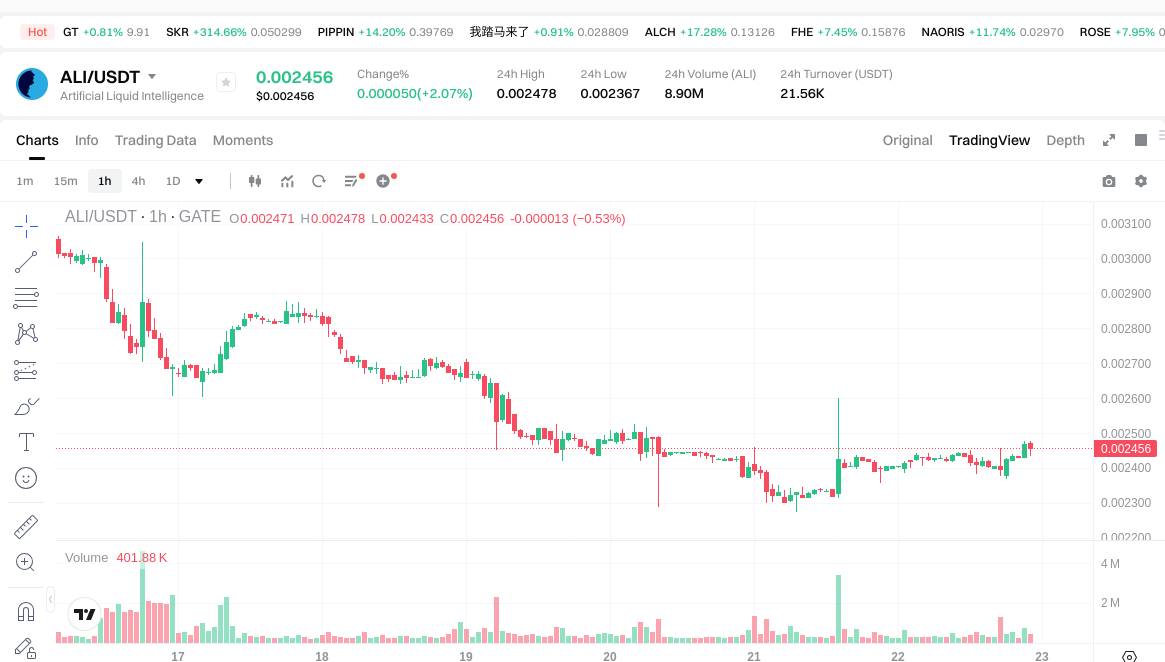
As of January 22, 2026, ALI's circulating supply stands at 9,118,091,184 tokens, with a total supply of 9,870,903,732.81426 tokens.
The circulating supply represents approximately 92.37% of the total supply, indicating a relatively high proportion of tokens already in circulation.
New tokens enter the market through the protocol's issuance mechanisms, which affects supply and demand dynamics.
Price Volatility
ALI reached its all-time high of $0.201312 on April 2, 2022, driven by favorable market conditions and increased interest in AI-integrated NFT technologies.
Its all-time low of $0.00196181 occurred on December 18, 2025, reflecting broader market corrections and reduced trading activity.
These fluctuations demonstrate the impact of market sentiment, technological developments, and external factors on token valuation.
Click to view the current ALI market price
On-Chain Metrics
- 24-Hour Trading Volume: $21,493.03 (reflecting current market activity)
- Token Holders: 16,119 addresses (indicating community participation levels)
- Market Capitalization: $22,348,441.49 (representing the token's overall market value)
Artificial Liquid Intelligence Ecosystem Applications and Partners
Core Use Cases
Artificial Liquid Intelligence's ecosystem supports multiple applications:
- NFT Innovation: The iNFT Protocol enables the creation of interactive and intelligent NFTs (iNFTs), embedding AI animation, interaction, and generative AI capabilities into NFTs.
- Metaverse Integration: Noah's Ark, described as the world's first intelligent metaverse, allows users to create, train, and earn from their iNFTs using the iNFT Protocol.
Strategic Partnerships
While specific partnership details are not extensively documented in the available materials, Alethea AI's focus on decentralized AI protocols and NFT standards positions it as a collaborative force in the blockchain and AI intersection. These developments provide a foundation for Artificial Liquid Intelligence's ecosystem expansion.
Controversies and Challenges
Artificial Liquid Intelligence faces several challenges:
- Market Volatility: The token has experienced notable price fluctuations, with a 1-year decline of approximately 82.59% and recent 7-day drop of around 19.03%.
- Competitive Landscape: Operating in the evolving space where AI meets blockchain, ALI competes with emerging projects in NFT and metaverse sectors.
- Adoption Barriers: As a relatively specialized protocol focusing on intelligent NFTs, broader market adoption remains an ongoing challenge.
These issues have sparked discussions within the community and continue to drive innovation efforts.
Artificial Liquid Intelligence Community and Social Media Atmosphere
Community Engagement
Artificial Liquid Intelligence maintains an active community presence with approximately 16,119 token holders as of January 2026. The project operates across multiple platforms including X (formerly Twitter), Reddit, Medium, and GitHub, fostering developer and user engagement. Community interest tends to spike around announcements related to iNFT protocol developments and Noah's Ark metaverse updates.
Social Media Sentiment
Sentiment on X displays mixed perspectives:
- Supporters emphasize ALI's innovative approach to combining AI with NFTs, viewing it as a pioneering force in creating interactive digital assets and intelligent metaverse experiences.
- Critics raise concerns about price performance, particularly the substantial decline over the past year, and question the project's ability to compete in an increasingly crowded NFT and metaverse market.
Recent trends suggest cautious optimism among long-term holders focusing on technological development rather than short-term price movements.
Popular Topics
X users actively discuss Artificial Liquid Intelligence's technological innovations in intelligent NFTs, the practical applications of the iNFT Protocol, and the development progress of Noah's Ark metaverse, revealing both enthusiasm for its transformative potential and awareness of adoption challenges.
Artificial Liquid Intelligence Additional Information Sources
- Official Website: Visit Alethea AI official website for features, use cases, and latest developments.
- Whitepaper: The Alethea AI Whitepaper details its technical architecture, goals, and vision for decentralized AI ownership and governance.
- X Activity: On X platform, Artificial Liquid Intelligence maintains an active presence via @real_alethea, with posts covering topics including iNFT Protocol updates, Noah's Ark metaverse development, and AI-blockchain integration research, generating engagement from the community.
Artificial Liquid Intelligence Future Roadmap
- Ongoing Development: Continued enhancement of the iNFT Protocol to expand AI capabilities and interactivity features for NFTs
- Ecosystem Goals: Expansion of Noah's Ark metaverse with increased user participation and intelligent NFT creation tools
- Long-term Vision: Establishing the iNFT standard as a foundational protocol for AI-powered digital assets and intelligent metaverse experiences
How to Participate in Artificial Liquid Intelligence?
- Purchase Channels: ALI is available on Gate.com and other exchanges, with trading pairs against major cryptocurrencies
- Storage Solutions: As an ERC-20 token on Ethereum, ALI can be stored in compatible wallets including MetaMask and hardware wallets supporting Ethereum-based tokens
- Explore the Ecosystem: Visit the official documentation and Noah's Ark platform to understand iNFT creation and metaverse participation opportunities
- Developer Contribution: Access development resources through the project's GitHub repository to contribute to the iNFT Protocol ecosystem
Summary
Artificial Liquid Intelligence is redefining the intersection of AI and NFTs through its innovative iNFT Protocol, offering interactive and intelligent digital assets within the Noah's Ark metaverse. Its focus on decentralized AI ownership, active development community, and unique technological approach distinguish it in the blockchain space. Despite facing market volatility and adoption challenges, ALI's commitment to advancing intelligent NFT standards and metaverse applications positions it as a noteworthy project in the decentralized AI and digital asset landscape. Whether you are new to blockchain or an experienced participant, Artificial Liquid Intelligence represents an interesting exploration of AI-enhanced NFT technology.
FAQ
What is ALI crypto token and what is its purpose?
ALI is a utility token designed for decentralized AI applications and services. It powers governance, staking, and access to AI-driven features within the Web3 ecosystem, enabling users to participate in AI protocol development and earn rewards.
How can I buy and store ALI tokens?
You can purchase ALI tokens through major cryptocurrency exchanges supporting the token. For storage, use secure wallets like MetaMask, Ledger, or cold storage solutions to safeguard your ALI holdings safely.
What is the total supply and market cap of ALI cryptocurrency?
ALI has a total supply of 1 billion tokens. Market cap fluctuates based on current price and circulating supply. For real-time market cap data, check major crypto data aggregators for the latest valuation.
What are the main risks and security considerations when investing in ALI?
ALI investment risks include market volatility, liquidity constraints, smart contract vulnerabilities, and regulatory uncertainty. Secure your private keys, use reputable wallets, enable two-factor authentication, and conduct thorough due diligence before investing.
Which blockchain network does ALI operate on?
ALI operates on multiple blockchain networks including Ethereum, Polygon, and Arbitrum, enabling seamless cross-chain compatibility and enhanced accessibility for users across different blockchain ecosystems.
What is the difference between ALI and other similar crypto projects?
ALI distinguishes itself through superior tokenomics, innovative governance mechanisms, and stronger community-driven development. With higher transaction volume and faster blockchain confirmation times, ALI offers enhanced scalability and efficiency compared to competing projects in the ecosystem.
Share
Content
Artificial Liquid Intelligence's Positioning and Significance
Origin and Development History
How Does Artificial Liquid Intelligence Work?
ALI Market Performance
Artificial Liquid Intelligence Ecosystem Applications and Partners
Controversies and Challenges
Artificial Liquid Intelligence Community and Social Media Atmosphere
Artificial Liquid Intelligence Additional Information Sources
Artificial Liquid Intelligence Future Roadmap
How to Participate in Artificial Liquid Intelligence?
Summary
FAQ
How to Buy Cryptocurrency


Trending Cryptocurrencies



Treasure NFT Marketplace: A 2025 Guide for Web3 Gamers and Investors

What are the new trends in the NFT market in 2025?

NFT Treasure Hunting: Top Strategies for Web3 Collectors in 2025

How to Create and Sell NFTs: A Step-by-Step Guide for Beginners

The technical principles and application scenarios of 2025 NFTs
How to Create an NFT in 2025: A Step-by-Step Guide
Why Is Crypto Down? Market Analysis and Key Factors

What is BNKR: A Comprehensive Guide to Understanding the Decentralized Banking Revolution

What is C98: A Comprehensive Guide to Understanding This Digital Asset and Its Role in the Crypto Market

What is ABT: A Comprehensive Guide to Activity-Based Therapy and Its Applications in Modern Healthcare

What is BENQI: A Complete Guide to the Avalanche Lending Protocol and Its DeFi Opportunities