XRP Price USD
What Is Ripple (XRP)?
Ripple (XRP) is the native digital asset of the XRP Ledger, a decentralized public blockchain designed for fast and low-cost value transfers. Decentralization means that the network does not rely on any single authority; instead, transactions are validated by a distributed set of independent validator nodes.
XRP is purpose-built for payments and settlements, making it widely used for cross-border remittances, transferring funds between exchanges, and merchant payments—scenarios that demand speed and minimal transaction fees.
What Is the Current Price, Market Cap, and Circulating Supply of XRP?
As of 2026-01-22 (source: input data), the price of XRP is $1.955. The circulating supply is 60,789,498,738 XRP; total supply is 99,985,727,631 XRP; and the maximum supply is capped at 100,000,000,000 XRP.
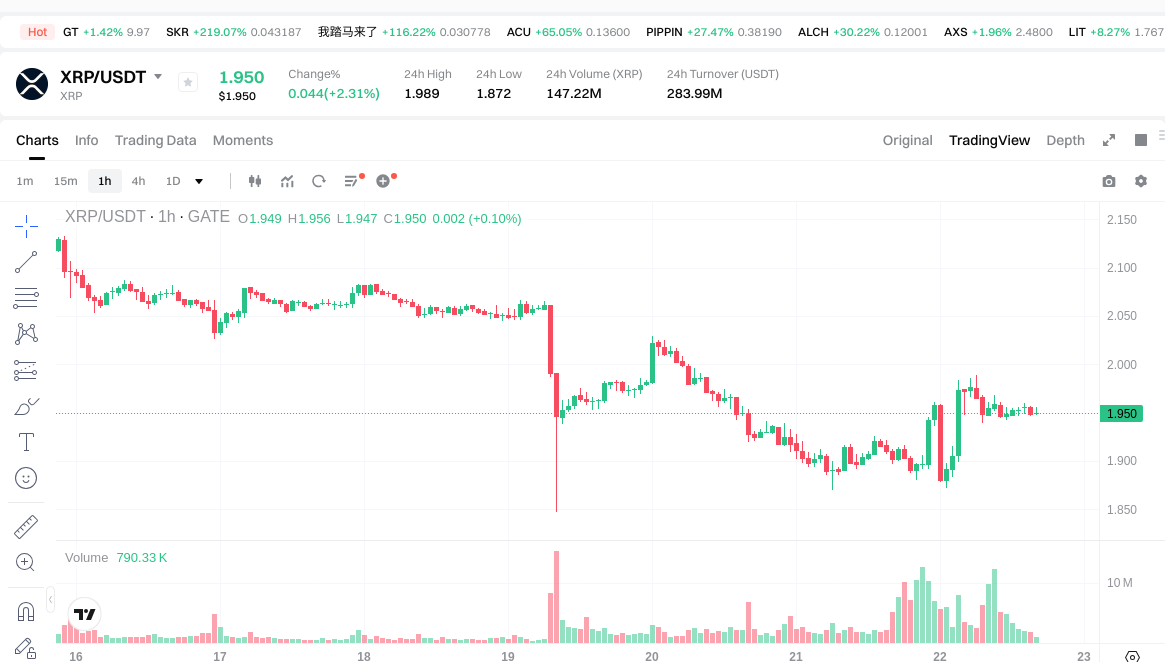
Click to view XRP USDT Price
The circulating market cap stands at $195,472,097,518.605011. Fully Diluted Valuation (FDV), which estimates market cap if all tokens were in circulation, is also $195,472,097,518.605011. XRP’s market dominance is 6.041%. Short-term performance: -0.05% over 1 hour, +2.35% over 24 hours, -7.18% over 7 days, and +3.71% over 30 days. The 24-hour trading volume is $284,635,316.074693.
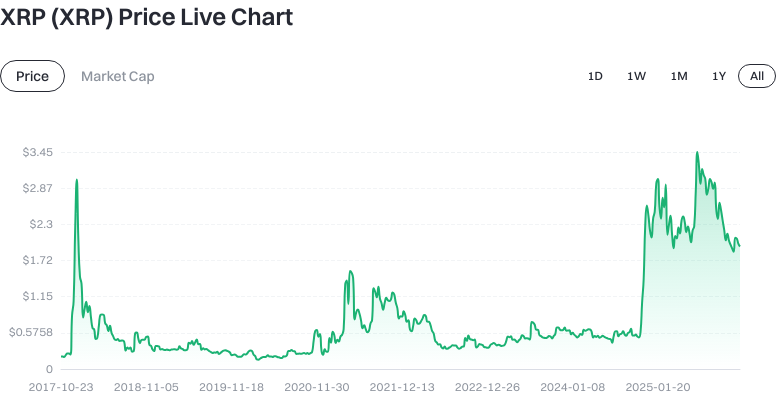
Click to view Latest XRP Price Data
Market capitalization is calculated as price multiplied by circulating supply and is commonly used to gauge the relative size and market attention of a crypto asset.
Who Created Ripple (XRP) and When?
XRP was launched on 2011-04-17 (source: input data). In its early phase, a team focused on payment technology initiated the project. Since then, an open-source community and a network of independent validators have formed around the XRP Ledger. Its development has centered on cross-border payments and fund settlements and has gradually expanded to include trading, remittance, and enterprise integration.
How Does Ripple (XRP) Work?
The XRP Ledger is an open-source public blockchain that achieves consensus through a unique mechanism where validator nodes agree on transactions and ledger states without mining. The consensus process relies on distributed voting and message broadcasting to confirm new blocks and transactions—enabling transaction finality in approximately three seconds.
In terms of fees and performance, each transaction costs about $0.0002 in fees and the network throughput exceeds 1,500 transactions per second (TPS), making it suitable for high-frequency payments. The network commits to carbon neutrality by managing energy consumption and offsetting emissions to achieve net-zero operations.
XRP has a one-time maximum issuance (capped at 100 billion), with no new tokens created through mining. The ledger features a built-in decentralized exchange (DEX) and “trust lines” (which represent issued assets and IOUs), supporting multi-asset accounting and swaps.
What Are the Use Cases for Ripple (XRP)?
- Cross-Border Remittances: Financial institutions and service providers can use XRP as a bridge asset to settle transfers between different fiat currencies quickly and cost-effectively.
- Exchange Transfers: Instantly move funds between platforms or wallets with minimal waiting time and low fees—ideal for frequent fund management.
- Merchant Payments & Micropayments: Low transaction fees and fast confirmations make XRP suitable for small-value, high-frequency payments such as digital goods or subscription services.
- Multi-Asset Swaps: Leverage XRPL’s built-in DEX and trust lines to exchange and settle between different issued assets.
What Wallets and Extensions Are Available in the XRP Ecosystem?
Wallet options include hot wallets and cold wallets. Hot wallets connect to the internet for frequent transactions; cold wallets store private keys offline for long-term holding. Private keys grant control over assets—back them up securely and store them safely.
Common tools in the XRPL ecosystem include mobile wallets, browser wallets, and developer utilities. Payment Channels enable high-frequency micropayments, while the built-in DEX supports asset swaps. Some wallets offer one-click signing and tag management to streamline receiving and sending XRP.
What Are the Key Risks and Regulatory Considerations for Ripple (XRP)?
- Price Volatility: Crypto asset prices are influenced by market trends, liquidity, and macroeconomic factors; expect significant short-term fluctuations.
- Regulation & Compliance: Cross-border payments must comply with various jurisdictions’ regulations; policy changes can impact service access and usage.
- Custody & Private Key Security: Storing assets on exchanges means relying on their custody—pay attention to platform security. For self-custody, securely back up your private keys and mnemonic phrases; losing them could mean permanent loss of access.
- Technical & Operational Risks: Network or wallet software may contain vulnerabilities. When transferring XRP to exchanges, always include the correct “destination tag”—mistakes can result in failed or delayed deposits.
How Can I Buy and Safely Store Ripple (XRP) on Gate?
Step 1: Register & Verify Identity. Sign up on Gate’s website or app and complete KYC (identity verification) to ensure compliant trading and higher account limits.
Step 2: Deposit Funds. On the “Assets” page, choose fiat deposit or transfer existing crypto to fund your account for purchasing XRP.
Step 3: Place a Buy Order. Search for “XRP/USDT” in the spot market and choose between a market order (executes at current price) or limit order (set your preferred price and amount).
Step 4: Choose Storage Method. For short-term trading, you may keep assets on your Gate account; for long-term holding, withdraw to a self-custody wallet. If a destination tag is required during withdrawal, double-check both address and tag.
Step 5: Security Settings & Backup. Enable two-factor authentication (2FA) and withdrawal whitelist; for self-custody wallets, back up mnemonic phrases and private keys offline—store securely to prevent loss or leaks.
How Does Ripple (XRP) Differ from Stellar (XLM)?
- Positioning & Ecosystem: Both target payments and remittances; XRP focuses on cross-border settlement with financial institutions, while Stellar (XLM) emphasizes inclusive retail payments.
- Consensus Mechanism: XRPL uses a vote-based consensus model without mining for rapid finality; Stellar uses SCP (Federated Byzantine Agreement), with differences in node structure and voting rules.
- Supply & Issuance: XRP has a fixed maximum supply of 100 billion with one-time issuance; XLM’s supply mechanism has changed over time with significant burns reducing its total supply.
- Features & Smart Contracts: XRPL offers a built-in DEX and trust lines for multi-asset settlement; Stellar is rolling out smart contract capabilities with recent upgrades—each network differs in contract features and implementation paths.
- Governance & Community: Both have foundations supporting ecosystem development but differ in validator participation structures and governance approaches.
Summary of Ripple (XRP)
Ripple (XRP) is optimized for rapid, low-cost value transfer—ideal for cross-border remittances and high-frequency payments. As of 2026-01-22 (input data), XRP demonstrates substantial price, market cap, and circulation scale. Its network performance and carbon neutrality underpin its payment-centric use cases. In practice, users should select between custodial or self-custody storage based on their needs, manage private keys and destination tags with care, and remain attentive to regulatory compliance. For investors: consider dollar-cost averaging purchases, maintain liquidity reserves, and prioritize security measures. For users: understanding fees, confirmation times, and wallet tools can help ensure safer settlements and transfers.
FAQ
What Factors Affect the USD Price of XRP?
The USD price of XRP is mainly driven by market supply-demand dynamics, macroeconomic conditions, and regulatory developments. Progress in SEC litigation, increased institutional adoption, or Bitcoin price movements can all impact volatility. Stay updated via official announcements and market data; use platforms like Gate for real-time quotes rather than focusing solely on short-term price changes.
Where Can I Track XRP’s USD Price Performance?
Click to view Latest XRP Price Data
Platforms like Gate, CoinMarketCap, CoinGecko all provide real-time USD pricing and historical charts for XRP. Gate supports multiple candlestick intervals for trend analysis. It’s recommended to consult multiple data sources for comprehensive market insights.
How Should I Handle Large Swings in XRP’s USD Price?
Volatility is typical in crypto markets. Consider using dollar-cost averaging strategies to reduce risk rather than investing all at once. Set clear stop-loss/take-profit levels to avoid emotional reactions to price swings. Gate allows you to set price alerts—plan investments rationally with a long-term perspective.
How Does XRP’s USD Price Correlate With Other Cryptocurrencies?
XRP’s price often correlates positively with major cryptocurrencies like Bitcoin or Ethereum—overall market trends influence individual asset performance. However, due to its focus on payments and institutional adoption prospects, XRP sometimes exhibits independent price movements. Diversifying across multiple assets can help mitigate investment risk.
What Does It Mean When XRP Hits New Highs or Lows?
A new high generally signals strong market sentiment or rising institutional interest but beware of hype-driven bubbles. New lows may indicate market corrections or negative news—sometimes presenting buying opportunities at lower prices. Combine fundamental research with technical analysis rather than blindly chasing rallies or panicking during dips.
Ripple (XRP) Key Terms Glossary
- Consensus Mechanism: Ripple employs a Federated Byzantine Agreement protocol where validator nodes collectively ensure transaction finality.
- Payment Settlement: XRP acts as a bridge asset for cross-border payments—enabling rapid settlement between different fiat currencies.
- Escrow Burn: Ripple periodically destroys escrowed XRP to reduce circulating supply and enhance scarcity.
- Validator Node: Independent nodes participating in consensus validation on the Ripple network—responsible for confirming and recording transactions.
- Transaction Fees: Each transaction requires burning a small amount of XRP as a network fee—deterring spam transactions or DDoS attacks.
- Liquidity Provider: Participants acting as market makers within the Ripple network—facilitating liquidity between different assets.
Further Reading & References on Ripple (XRP)
-
Official Website / Whitepaper:
-
Developer Docs:
-
Authoritative Media / Research:
Related Articles
What is Wrapped XRP (wXRP) and How Does it Work?

Gate Alpha Launches Points System: Trade On-Chain, Earn Points, Unlock Airdrops