What is TNSR Coin?
What Is Tensor (TNSR)?
Tensor (TNSR) is a native token on Solana designed for use within the Tensor NFT marketplace, functioning as both a governance and incentive token. As a governance token, TNSR allows holders to participate in voting on platform rules and parameter adjustments. As an incentive, it rewards traders and creators for beneficial activities. Tensor is a leading NFT marketplace and aggregator in the Solana ecosystem, serving active trading and creation scenarios. Within this ecosystem, TNSR plays a key role in governance, rewards distribution, and potential fee-related benefits.
Current Price, Market Cap, and Circulating Supply of Tensor (TNSR)
As of 2026-01-21, according to available market data: the latest price of TNSR is $0.06568, with a circulating supply of 334,607,238.977170 TNSR. Both the total and maximum supply are 1,000,000,000 TNSR. The circulating market cap is $65,680,000, and the fully diluted market cap is also $65,680,000, representing approximately 0.002% of the market share. Recent trends indicate a 1-hour change of 2.08%, a 24-hour change of 1.45%, a 7-day change of -10.89%, and a 30-day change of -23.69%. The 24-hour trading volume stands at $457,357.87.
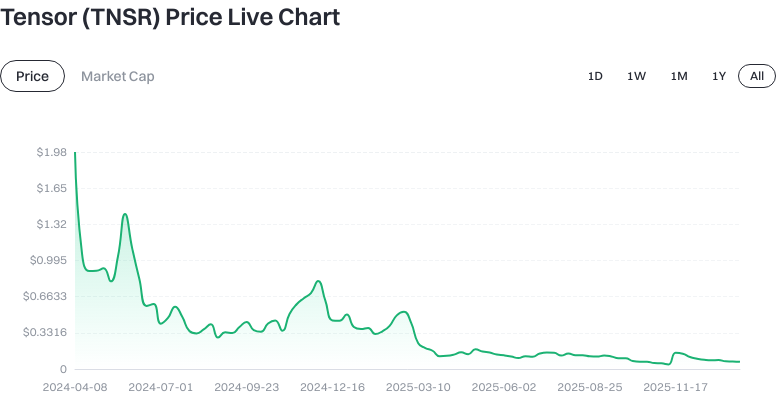
Click to view TNSR latest price data
Market capitalization is calculated as price multiplied by the relevant supply and serves as an estimate of the token's overall size. The fully diluted market cap assumes maximum supply in circulation and helps evaluate potential scale after full token release. Differences in methodologies among data providers may lead to discrepancies in market cap and supply calculations—this is common for newly launched tokens or those with dynamic release schedules.
Who Created Tensor (TNSR) and When?
The Tensor marketplace was developed by the Tensor team on Solana, targeting both traders and creators, with an emphasis on high-performance and low-fee NFT trading experiences. The TNSR token was launched on 2024-04-07 to serve governance and incentive functions (source: official announcements and public information as of 2024-04). As the ecosystem evolves, the project team typically guides protocol upgrades and community engagement through foundations or governance frameworks.
How Does Tensor (TNSR) Work?
TNSR is issued under Solana's SPL standard. SPL is Solana’s native token standard—similar to ERC-20 on Ethereum—and defines rules for token issuance, transfers, and holding. Thanks to Solana’s high throughput and low network fees, TNSR enables fast on-chain interactions suitable for high-frequency NFT trading.
At the protocol level, governance tokens like TNSR are typically used for voting on marketplace parameters and features—for example, fee structures, incentive distributions, and the rollout of new functionalities. The incentive mechanism rewards active traders, market makers, and quality creators with tokens, boosting liquidity and content supply. Aggregator functionality allows the marketplace to aggregate NFT listings from multiple sources, enhancing trade efficiency and price discovery.
What Can Tensor (TNSR) Be Used For?
Holding TNSR enables participation in governance voting that influences platform upgrades and parameter adjustments. Traders may receive trading incentives during specific campaigns—these can subsidize slippage or encourage liquidity provision. Creators may earn tokens through rewards programs that support their projects and community growth. Additionally, the platform may tie tokens to fee discounts or feature access during special events to drive engagement.
In practice, users can browse NFT collections, place orders, and settle trades on Solana using TNSR for activity rewards and governance feedback—making the marketplace more transparent and sustainable.
Wallets and Expansion Solutions in the Tensor (TNSR) Ecosystem
Within the Solana ecosystem, popular wallets such as Phantom and Solflare support SPL tokens and NFTs, making management and signing easy. Hardware wallets can leverage Solana-compatible integrations for enhanced private key security through offline storage. Users can verify TNSR transactions and wallet addresses via Solana block explorers to confirm contract addresses and avoid counterfeit tokens.
On the expansion side, aggregators and analytics dashboards help users track listings and trades across multiple marketplaces, improving price comparison and strategy execution. For creators, minting tools and royalty management solutions can integrate with the marketplace to optimize distribution and revenue sharing.
Main Risks and Regulatory Considerations for Tensor (TNSR)
Price Volatility: Crypto assets are subject to market sentiment and liquidity fluctuations, leading to significant short-term price swings.
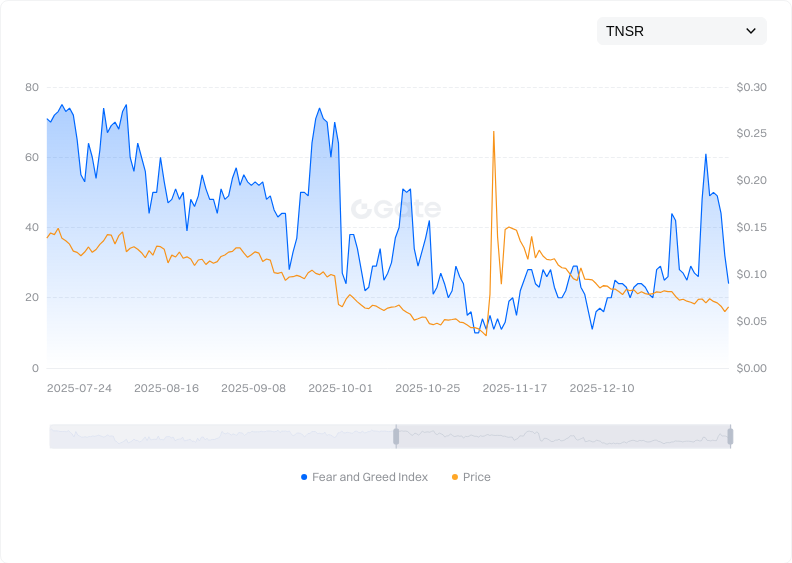
Click to view TNSR Fear & Greed Index
NFT Liquidity Risk: Individual NFT collections may have limited trading depth, constraining price discovery and exit speed.
Technical & Smart Contract Risk: Vulnerabilities in smart contracts or integrated components could lead to asset losses.
Platform & Account Security: Exchange accounts should use strong passwords and two-factor authentication; beware of phishing links and impersonators. Private keys and mnemonic phrases must be stored securely offline—losing them will make asset recovery impossible.
Regulation & Compliance: NFT and token trading regulations vary by jurisdiction—always comply with local laws and tax requirements. Participation in governance or rewards programs may be subject to identity or residency restrictions.
How to Buy and Safely Store Tensor (TNSR) on Gate
Step 1: Register a Gate account and complete identity verification (KYC) using real information to enhance account security and compliance.
Step 2: Deposit funds via fiat channels or by transferring stablecoins like USDT on-chain; confirm your balance in your account assets.
Step 3: Search for trading pairs by entering “TNSR” on Gate’s markets page; review order book depth and verify token contract details to avoid counterfeit tokens.
Step 4: Place an order using limit or market order types as needed; set quantity and price. After execution, check your holdings in your account assets—be mindful of trading fees and slippage.
Step 5: Secure your assets—if holding long-term, withdraw to a self-custody wallet such as Phantom or Solflare. Before large transfers, test with a small amount first; back up your mnemonic phrase and private key securely.
Step 6: Set up account security—enable two-factor authentication, configure withdrawal whitelists, periodically review login devices and authorized apps to minimize theft risks.
Key Differences Between Tensor (TNSR) and Blur (BLUR)
Underlying Blockchain: Tensor operates on Solana—offering high throughput and low transaction fees; Blur runs on Ethereum, leveraging its broader ecosystem but typically incurring higher gas fees and slower confirmations.
Market Positioning & User Base: Both target NFT traders and creators; however, community preferences and trading styles differ between Solana and Ethereum ecosystems—collection distribution and activity levels vary accordingly.
Token Utility & Incentive Models: TNSR focuses on governance plus trading/creation incentives tailored for high-frequency scenarios enabled by Solana’s performance; BLUR is also used for incentives/governance but faces different execution costs due to Ethereum’s fee environment. Specific rules for fee privileges, market making incentives, or airdrop mechanisms are determined by each project’s community/governance processes.
Ecosystem Compatibility: Solana wallets/tools are distinct from Ethereum’s—users should consider differences in asset formats and tool support when migrating strategies across chains.
Summary of Tensor (TNSR)
As the NFT marketplace token within the Solana ecosystem, Tensor (TNSR) is clearly positioned to serve both traders and creators by leveraging Solana’s high performance and low-cost infrastructure. Market data shows active price levels and trading volumes, though short-term volatility requires caution. In terms of application, TNSR is used for governance voting, transaction/trading incentives, creator rewards, as well as fee or feature-based entitlements—driving both market efficiency and ecosystem participation. For optimal asset management after compliant deposits/trades on Gate, combine self-custody wallet practices with robust account security settings. Going forward, stay updated on official governance announcements as well as changes in incentive or fee policies—and monitor Solana network/NFT liquidity conditions to adjust holdings based on your risk profile and strategy goals.
FAQ
What are the main use cases for TNSR?
TNSR serves as the governance token of the Tensor platform—holders can participate in platform decision-making processes and receive a share of trading fees. As the native NFT marketplace token within the Solana ecosystem, TNSR grants community members voting rights over platform development while incentivizing long-term holders to contribute to ecosystem growth.
How can I evaluate whether TNSR is worth investing in?
Evaluate TNSR from three perspectives: First, review Tensor’s ranking by trading volume and user activity within Solana’s NFT market; second, analyze the team’s background, funding status, and technical capabilities; third, assess the token unlock schedule alongside changes in circulating supply. Make investment decisions based on thorough research into project fundamentals in line with your own risk tolerance—avoid blindly following trends.
How does TNSR differ from other NFT platform tokens?
TNSR is focused exclusively on the Solana ecosystem—offering fast transactions at low cost—unlike Ethereum-based NFT tokens such as LooksRare. Tensor emphasizes community governance plus fee-sharing models; compared to purely functional tokens, TNSR provides holders with greater economic incentives and governance power—better aligning with modern DAO principles.
How do I securely store TNSR purchased on Gate?
After buying TNSR, choose a storage method based on amount: keep small amounts in your Gate account for convenience; for larger holdings, withdraw to a hardware wallet (e.g., Ledger) or a Solana-native wallet (e.g., Phantom/Magic Eden). Always secure your private keys or mnemonic phrases properly—regularly review account security settings—and never enter sensitive information over public networks.
What drives price fluctuations of TNSR?
TNSR price movements are mainly influenced by: health of the Solana network and gas fee dynamics; Tensor platform’s trading volume/user growth; broader crypto market trends including Bitcoin performance; project governance proposals or major updates. Additionally, macroeconomic policy shifts and overall market sentiment can indirectly impact prices—so closely monitor multiple dimensions for informed decisions.
Glossary of Key Terms Related to Tensor (TNSR)
- Solana Ecosystem: Tensor is built on the Solana blockchain—benefiting from its high-speed, low-fee network.
- NFT Marketplace: As a leading NFT trading platform on Solana, Tensor provides minting, trading, and auction services.
- Smart Contract: Automated programs running on Solana that power transaction settlement and user interactions within the Tensor platform.
- Gas Fees: Costs required for executing transactions or contract operations on Solana—the Tensor platform offers comparatively low transaction fees.
- Liquidity Mining: An incentive mechanism where users provide liquidity to Tensor markets in exchange for token rewards.
- Governance Token: TNSR grants holders voting power over platform development direction as well as participation rights in decision-making processes.
References & Further Reading on Tensor (TNSR)
-
Official Website / Whitepaper:
-
Development / Documentation:
-
Authoritative Media / Research:
Related Articles
How To Claim The Jupiter Airdrop: A Step-By-Step Guide
Solana Staking Simplified: A Complete Guide to SOL Staking