


What is Sui?

What Is Sui (SUI)?
Sui (SUI) is the native token of the Sui blockchain, a Layer 1 public chain designed to operate independently without relying on other settlement layers. SUI tokens are used to pay transaction fees (gas fees), participate in staking for network security, and enable governance proposals and voting within the ecosystem.
On the Sui network, users pay gas fees for every transfer or on-chain interaction. Validators stake SUI tokens to join consensus and earn rewards. Thanks to Sui's emphasis on parallel execution and its object-based model, SUI also underpins the network’s incentive structure and security mechanisms—especially for high-throughput applications.
Sui (SUI): Current Price, Market Cap, and Circulating Supply
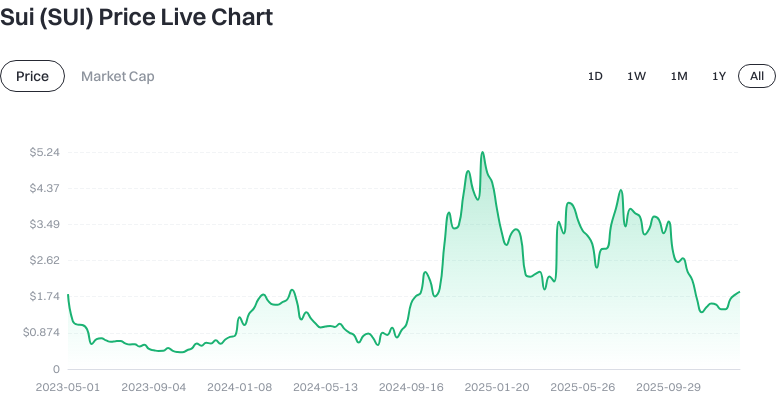
As of January 14, 2026, key data for SUI include: a latest price of $1.874100 per token; a circulating supply of 3,792,183,074.773887 SUI; total and maximum supply both set at 10,000,000,000 SUI; a market capitalization of $18,741,000,000; fully diluted market cap at $18,741,000,000; market dominance at 0.54%; and a 24-hour trading volume of $10,163,959.177460.
Further explanations:
- Price: The USD value per SUI, reflecting real-time trades.
- Circulating Supply: The amount of SUI currently available for trading on the market.
- Total/Max Supply: The number of tokens issued and the theoretical maximum cap.
- Market Cap: Estimated by multiplying price by circulating supply; Fully Diluted Market Cap multiplies price by the max supply to project total potential valuation.
- Price Change (%): Fluctuations over 1 hour, 24 hours, 7 days, and 30 days represent past performance only and do not predict future trends.
Data methodologies may vary between platforms. Always refer to official announcements for the most accurate information.
Who Created Sui (SUI) and When?
Sui was developed by the Mysten Labs team and launched its mainnet on May 2, 2023. Mysten Labs is composed of early contributors to the Move programming language and experts in large-scale distributed systems. Their mission is to bring asset-oriented programming models and high concurrency processing to mainstream blockchain applications.
The mainnet launch marked the transition from testing to live production—enabling developers and users to deploy applications, issue assets, and conduct real transactions on-chain.
How Does Sui (SUI) Work?
Sui utilizes an object-based state model: each asset on-chain is treated as a distinct object, minimizing conflicts between unrelated transactions and maximizing parallel execution efficiency. Parallel execution means that multiple independent transactions can be processed simultaneously—improving throughput, reducing congestion, and lowering fees.
At the consensus layer, validators stake SUI tokens to participate in block production and transaction ordering. Users pay gas fees to have their transactions included in blocks and finalized. Sui’s architecture is horizontally scalable—meaning the network’s capacity grows with added parallelism and node resources.
Smart contracts on Sui are written in Move—a safety-focused contract language that enforces asset (resource) ownership rules, preventing duplication or loss of assets. This enhances auditability and reduces common contract vulnerabilities.
What Are the Use Cases for Sui (SUI)?
Primary uses include paying gas fees for on-chain transactions and contract calls—such as transfers, NFT minting, or in-game item swaps.
Additionally, SUI can be staked with validators to support network security and stability. Stakers are typically rewarded based on chain governance or protocol parameters.
SUI holders also participate in governance by voting on protocol upgrades, parameter changes, or treasury allocations. For builders and platforms, SUI serves as a settlement asset—for fee discounts or community incentives within the ecosystem.
Click to view the latest SUI price
Wallets and Extensions in the Sui (SUI) Ecosystem
You can manage SUI and interact with DApps using browser extension wallets or mobile wallets. Core wallet functions include generating and storing mnemonic phrases (human-readable backups of private keys), displaying balances and transaction history, initiating transfers, and signing authorizations.
Other key ecosystem components are developer tools (for contract compilation/debugging), block explorers (for transaction/object status), and cross-chain/payment interfaces for broader integration scenarios. When choosing tools, prioritize open-source projects with robust security audits and active community support.
Main Risks and Regulatory Considerations for Sui (SUI)
Market Risks: Crypto asset prices are highly volatile; short-term price swings do not guarantee long-term trends. Avoid excessive leverage or investing beyond your risk tolerance.
Technical & Protocol Risks: Smart contracts can have bugs; while parallel execution/object models enhance performance, they still require thorough auditing. Network congestion or upgrades may impact transaction finality.
Tokenomics & Unlock Risks: The pace of token releases, staking incentives, and governance rules affect supply-demand dynamics and price action—always monitor official disclosures for transparency.
Platform & Operational Risks: Mistakes when entering addresses or selecting networks during trades or withdrawals can result in unrecoverable asset loss. Enable two-factor authentication (2FA) to guard against phishing or social engineering attacks. Regulatory policies vary by region; comply with local laws and understand your tax obligations.
How to Buy and Safely Store Sui (SUI) on Gate
- Register & Complete KYC: Go to gate.com to create an account and complete KYC verification to unlock higher limits and withdrawal permissions.
- Set Up Security: Enable two-factor authentication (2FA), configure separate security verifications for login/trading/withdrawals, link and back up your security email and phone.
- Deposit Funds: Deposit crypto assets or fiat currency into your account; transfer funds into the spot trading section as needed. Always double-check deposit networks/tags to avoid loss.
- Find Trading Pairs & Place Orders: Search “SUI” in spot trading; select your preferred pair (e.g., SUI/USDT) and choose between limit orders (custom price) or market orders (instant execution).
- Withdraw to Personal Wallet: For long-term holding or frequent DApp interactions, transfer your SUI to a wallet where you control the private keys. Copy your wallet address carefully, select the SUI network, confirm withdrawal amount, fees, and estimated arrival time.
- Secure Storage & Backup: Safeguard your mnemonic phrase/private key—record offline and store in multiple locations; regularly update your wallet software/antivirus; for large holdings consider hardware wallets and layered management.
This process is for educational purposes only—not investment advice. Confirm all costs, risks, and compliance requirements before proceeding.
Comparison: Sui (SUI) vs Aptos (APT)
Design & Language: Both use the Move language but differ in focus—Sui emphasizes an object model and parallel execution for high-throughput consumer applications; Aptos also prioritizes performance/security but implements state management differently.
Execution & Scalability: Sui optimizes for parallel processing by distinguishing independent transactions—minimizing conflicts; Aptos invests in parallelization/core optimization but follows a distinct ecosystem/toolchain path. Actual performance depends on network state, node setup, and application design.
Ecosystem & Applications: Sui targets NFTs, blockchain gaming, and high-frequency use cases; Aptos has strong presence in social/financial apps. When choosing between them, consider application needs, fee structures, developer support, and community activity—not just single metrics.
Summary of Sui (SUI)
As the native asset of the Sui Layer 1 blockchain, SUI powers gas payments, staking rewards, and governance rights. Its technical architecture leverages an object model with parallel execution to maximize scalability—ideal for high-frequency interactive applications. Current metrics (as of January 14, 2026) offer context on market cap/supply but should be interpreted alongside official project updates. Beginners should start small—double-check addresses/networks, back up mnemonics securely, enable 2FA—and evaluate allocations according to personal use cases, ecosystem growth, and compliance requirements. Risk management and continuous learning are crucial.
FAQ
What Are the Main Features of SUI? Why Choose It?
SUI is the native token of the Sui network. Its standout features include an innovative Narwhal-Bullshark consensus mechanism delivering high throughput and low-latency transactions. Compared to other public blockchains, Sui offers significant advantages in speed and cost—making it well-suited for frequent Web3 interactions. Holders can participate in network governance, pay gas fees, and earn staking rewards.
What Competitive Advantages Does Sui Have Over Ethereum or Solana?
Sui’s object model and parallel transaction execution enable faster confirmations, higher throughput, and lower gas fees. Compared with Ethereum’s account-based model, Sui offers clearer asset ownership; versus Solana’s sequential processing approach, Sui’s parallelization is stronger. These strengths make it especially suitable for DeFi protocols, NFT platforms, and gaming applications with high interaction frequency.
How Can You Earn Rewards by Staking SUI?
SUI supports Proof-of-Stake (PoS) staking. Users can delegate their tokens to validators to earn staking rewards.
Click to view the latest SUI price
On Gate or supported wallets, choose the staking feature, select a validator, delegate your SUI—and receive rewards each epoch (approximately every 24 hours). Staked tokens remain liquid—you can undelegate anytime—but take note of minimum stake amounts and gas fee requirements.
What Are Some Leading DeFi and NFT Projects in the Sui Ecosystem?
Sui’s ecosystem includes top-tier DeFi protocols like Cetus and Aftermath Finance; NFT platforms such as BlueMove and SuiFrens; plus various gaming dApps—all harnessing Sui’s high-speed capabilities for superior user experiences. Newcomers should check Gate’s token pages for ecosystem rankings—prioritizing flagship projects or those integrated with popular wallets.
What Is SUI’s Supply Model & Inflation Policy?
SUI launched with an initial supply of 10 billion tokens governed by an annual inflation cap that decreases over time. Early-stage incentives mean higher initial inflation rates; however, long-term design targets stable inflation. Staking rewards, validator commissions, and burning mechanisms help balance supply/demand dynamics. Investors should monitor real-time circulating data on Gate to understand scarcity trends or pricing pressures.
Quick Reference: Key Terms Related to Sui (SUI)
- Move Language: The native programming language for Sui—built for asset ownership/transfer with a strong type system.
- Object Storage Model: Organizes blockchain state into independent objects—enabling parallel processing/high throughput.
- Gas Fees: Transaction execution fees on the Sui network—paid in SUI tokens.
- Validator: Node operators who validate transactions/maintain network security.
- Staking: Locking up SUI tokens to support validators—earning rewards/governance rights.
- Smart Contract: On-chain automated programs written in Move language.
Further Reading & Resources on Sui (SUI)
-
Official Website / Whitepaper:
-
Development / Documentation:
-
Media / Research:
Related Articles

The Future of Cross-Chain Bridges: Full-Chain Interoperability Becomes Inevitable, Liquidity Bridges Will Decline

Solana Need L2s And Appchains?
