


What is Solana Coin?
What Is Solana?
Solana is a foundational public blockchain designed to achieve high throughput and low latency while maintaining security and decentralization. It leverages a hybrid consensus mechanism combining Proof of History (PoH)—a cryptographically verifiable sequence that acts as a “crypto clock”—with Proof of Stake (PoS), where token holders stake assets to help secure the network. The SOL token is primarily used for paying transaction fees and participating in staking. Due to its strong single-chain parallel processing capabilities, Solana is favored for high-frequency, low-cost on-chain applications.
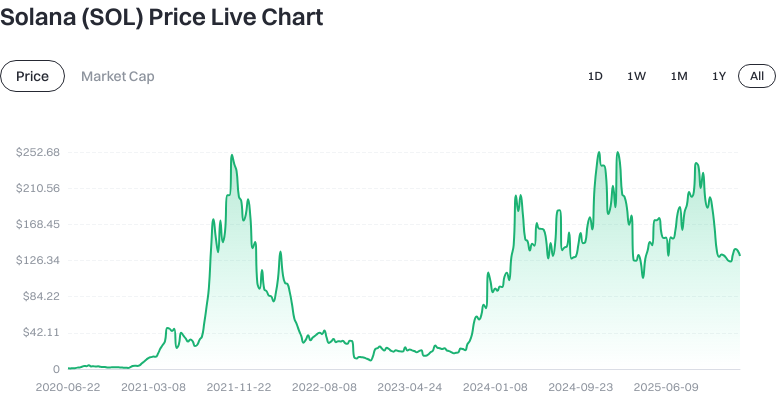
Current Price, Market Cap, and Circulating Supply of Solana (SOL)
As of 2026-01-20, available data shows:
- Price: $131.86
- Circulating Market Cap: ~$81.573 billion
- Circulating Supply: ~565,584,006 SOL
- Total Supply: ~618,635,746 SOL
- Max Supply: ∞ (no enforced hard cap)
- Fully Diluted Market Cap equals Circulating Market Cap, indicating no hard limit in current calculations
- Market Cap Dominance: ~2.51%
- 24-hour Trading Volume: ~$825 million
Short-term volatility:
- 1 hour: -1.24%
- 24 hours: -1.16%
- 7 days: -6.15%
- 30 days: +4.84%
Crypto asset prices are highly volatile. For actual trades, refer to Gate’s real-time prices and be mindful of slippage and transaction fees.
Click to view latest SOL price updates
Who Created Solana (SOL) and When?
Solana was initiated in late 2017 by engineers with backgrounds at Qualcomm, Intel, and Dropbox. Key founders include Anatoly Yakovenko and Raj Gokal. After multiple testnet phases, the mainnet officially launched on March 22, 2020, with the Solana Foundation—a nonprofit—supporting ecosystem development and resource allocation. Since 2021, driven by DeFi and NFT adoption, Solana’s ecosystem has expanded rapidly. The team continues to enhance throughput, stability, and developer tooling to support large-scale applications.
How Does Solana (SOL) Work?
Solana improves network efficiency through a combination of PoH and PoS. Proof of History (PoH) generates a continuous cryptographic timestamp, allowing transactions to be ordered without the need for constant network-wide synchronization. Proof of Stake (PoS) relies on validators—nodes responsible for proposing and confirming blocks—who stake SOL tokens and receive block rewards.
To maximize throughput, Solana uses a parallel execution model called Sealevel, which enables simultaneous processing of non-conflicting transactions, boosting TPS (transactions per second). The network also features optimized transaction forwarding and data propagation mechanisms to reduce confirmation time and minimize congestion.
Click to view latest SOL price updates
For account management, Solana employs a “program account + data account” structure to handle smart contracts (self-executing blockchain programs) and state storage. Fees are generally low; however, the first interaction with certain contracts may require a small amount of SOL to create accounts and reserve storage.
Regular holders can delegate their SOL to validators to earn block rewards; however, returns may decrease if the chosen validator underperforms.
What Can Solana (SOL) Be Used For?
SOL serves as both the native fee token for on-chain transactions and the staking asset for network security incentives. At the application level:
- Payments & Transfers: Low fees and rapid confirmation make it ideal for microtransactions and high-frequency payments.
- DeFi: Used as collateral for lending, decentralized trading, and yield strategies—low fees and fast settlements favor high-frequency strategies.
- NFTs: Lower minting, trading, and airdrop costs support large-scale distribution and interactive experiences.
- Gaming & Social: Seamless for use cases involving frequent micro-interactions or asset settlements.
- Real-world Networks & Data Applications: Suitable for on-chain settlements, data recording, and incentive distribution.
Wallets and Extension Solutions in the Solana (SOL) Ecosystem
Wallets manage private keys (used for signing transactions and controlling assets) and initiate transactions. Common types include:
- Self-custody Wallets: Users hold their own private keys and recovery phrases (mnemonics), available as browser extensions or mobile apps. Ideal for users who value autonomy.
- Hardware Wallets: Private keys are stored offline on a physical device for enhanced security; suitable for long-term or large holdings.
- Block Explorers & Tools: Platforms like Solscan or SolanaFM allow users to check transaction histories, addresses, and contract data—helpful for verifying transfers and auditing contract interactions.
Security tips: Write down mnemonics offline and store them securely; enable strong passwords and biometric authentication; always verify contract sources and permissions before signing; avoid connecting wallets to untrusted sites.
Key Risks and Regulatory Considerations for Solana (SOL)
- Technical & Network Risks: High throughput can lead to congestion during peak times; there have been historical outages. Protocol upgrades or software bugs may affect availability.
- Smart Contract & Application Risks: Contract vulnerabilities, improper permission design, or oracle failures could cause fund losses.
- Cross-chain Bridge Risks: Bridges facilitating asset transfers across blockchains have been frequent attack targets—use with caution and diversify risk.
- Decentralization & Entry Barriers: High hardware and bandwidth requirements may impact validator distribution and overall decentralization.
- Regulatory Uncertainty: In some jurisdictions, tokens may be classified as securities or face other compliance mandates; policy changes can affect trading or application accessibility. Always comply with local laws.
- Market & Liquidity: Prices can be highly volatile; staking often involves unbonding periods, so liquidity versus yield must be balanced.
How Do I Buy and Safely Store Solana (SOL) on Gate?
Step 1: Register an account and complete identity verification/security setup. Visit gate.com to sign up, finish KYC procedures, enable Google Authenticator and SMS verification, and set an anti-phishing code.
Step 2: Deposit or purchase tokens. Use “Buy Crypto/Fast Buy” for fiat purchases of SOL or USDT; alternatively, transfer digital assets into your Gate account via “Assets/Deposit”.
Step 3: Place a spot order for SOL. Go to “Spot Trading” and select the “SOL/USDT” pair. Use a market order for instant execution at current price or a limit order to set your desired entry price. Check price, quantity, and fees before confirming your order.
Step 4: Withdraw to a self-custody wallet (optional). In “Assets/Withdraw”, choose SOL and the Solana network, paste your receiving address (Base58 string), verify details, then submit. Test with a small amount before making larger transfers; some first-time interactions may require a small amount of SOL for account creation.
Step 5: Safe storage. If self-custodying, store recovery phrases/private keys offline, enable wallet password/device locks; if storing on platform, enable withdrawal whitelist, login IP restrictions, two-factor authentication, and regularly review security settings.
How Does Solana (SOL) Differ from Ethereum (ETH)?
- Consensus & Architecture: Solana uses a high-throughput single-chain solution combining PoH + PoS; Ethereum uses PoS with block organization via slots and epochs. Solana’s “crypto clock” reduces synchronization overhead; Ethereum prioritizes global consistency and resilience.
- Performance & Fees: Solana aims for high TPS with low fees—ideal for frequent interactions; Ethereum’s mainnet has lower throughput with higher fees during congestion.
- Scaling Approaches: Solana emphasizes Layer 1 parallel execution; Ethereum focuses on Layer 2 (L2) networks that batch transactions off-chain before posting results back.
- Development & Compatibility: Solana contracts are primarily written in Rust/C and are not EVM-compatible; Ethereum uses Solidity with the EVM—a more mature toolchain with easier migration.
- Decentralization & Entry Barriers: Solana requires higher hardware/bandwidth for nodes; Ethereum prioritizes broader node accessibility. Each chain balances security, performance, and decentralization differently.
- Ecosystem Maturity: As of 2026, Ethereum’s DeFi and infrastructure are more developed; Solana excels in high-frequency apps and user growth. They’re complementary rather than direct substitutes—offering distinct technical paths.
Click to view latest SOL price updates
Summary of Solana (SOL)
Solana is a public blockchain tailored for high-throughput, low-fee use cases. The SOL token is essential for both transaction fees and staking. Its current price and market cap underscore its significance among leading public chains—but users should remain aware of network congestion risks, contract security issues, and regulatory uncertainties. To join the Solana ecosystem, complete identity verification/security steps on Gate before purchasing SOL; choose between platform custody or self-custody wallets based on your needs. For safe operation, start with small test amounts, double-check networks/addresses, diversify risk, and stay informed about upgrades or regulatory changes to strike a balance between efficiency and security.
FAQ
Is Solana Really That Much Faster Than Ethereum?
Yes—Solana can process tens of thousands of transactions per second (TPS), far surpassing Ethereum’s ~15 TPS. Its unique Proof of History (PoH) mechanism allows nodes to verify transaction order without waiting, greatly improving efficiency. This speed makes Solana particularly well-suited for high-frequency DeFi and NFT applications.
Which Well-Known DeFi Projects Are in the Solana Ecosystem?
Notable projects include Raydium (DEX), Magic Eden (NFT marketplace), Phantom (wallet), among others. These applications leverage Solana’s low fees and high-speed performance for an enhanced user experience. Beginners can explore the ecosystem starting with wallets and DEXs.
Has Solana Experienced Outages? What Is Its Current Stability?
Between 2021–2022, Solana faced periods of network congestion causing transaction halts. The team has since improved stability by optimizing validator configurations and increasing network capacity. While risks remain in extreme scenarios, overall uptime has significantly improved.
Will Solana’s Inflation Mechanism Cause Long-Term Price Depreciation?
Solana employs a decreasing inflation model—starting at around 8% annually and gradually reducing to 1.5%. While inflation increases supply over time, burn mechanisms and growing ecosystem demand help offset this effect. Long-term price trends depend on ecosystem growth and market demand; inflation is just one influencing factor.
How Should Beginners Safely Buy and Store Solana?
You can purchase Solana directly with fiat on major exchanges like Gate, then transfer it to secure wallets such as Phantom or Ledger. Start small to familiarize yourself with the process; prioritize strong account security (robust passwords, backup mnemonics), and avoid keeping large amounts on exchanges long-term.
Glossary of Key Solana (SOL) Terms
- PoH (Proof of History): Solana’s unique consensus component using verifiable delay functions to timestamp transactions—boosting throughput.
- Sealevel: The runtime environment powering parallel smart contract execution on Solana—greatly increasing transaction speeds.
- Lamports: The smallest unit on the Solana network; 1 SOL = 100 million Lamports—used for paying transaction fees.
- Validator: Node operators in the Solana network who stake SOL to propose blocks and earn rewards.
- Program: Smart contracts on Solana—written primarily in Rust—for deploying business logic on-chain.
- Account Model: The data storage framework where each account manages its own state—enabling parallel transaction processing.
Further Reading & References on Solana (SOL)
-
Official Website/Whitepaper:
-
Development/Documentation:
-
Authoritative Media/Research:
Related Articles

The Future of Cross-Chain Bridges: Full-Chain Interoperability Becomes Inevitable, Liquidity Bridges Will Decline

Solana Need L2s And Appchains?
