What is Pnut Coin?

What Is Pnut (PNUT)?
Pnut (symbol: PNUT) is a crypto asset issued around the story of “Peanut the Squirrel (P'Nut),” with a total maximum supply of 1 billion PNUT—meaning it is not an inflationary asset. PNUT emphasizes cultural consensus and community mobilization and is generally recognized as a meme coin, rather than a utility token used for underlying computations or network fees.
In the crypto industry, “meme coins” are tokens inspired by internet culture, viral events, or characters, whose value depends heavily on community attention and narrative. The distinction between “coin” and “token” is often that coins are native assets of their own blockchains, while tokens are issued via smart contracts on existing public chains. While PNUT is labeled as a coin here, refer to the project’s official documentation for technical details.
PNUT Price, Market Cap, and Circulating Supply
As of January 15, 2026:
- Price: approximately $0.08481
- Circulating supply: about 999,842,602.356370 PNUT
- Total and max supply: 1,000,000,000 PNUT
- Market capitalization: roughly $84,810,000
- Fully diluted valuation: approximately $84,810,000
- 24-hour trading volume: around $691,473.08
- Price change: +0.55% (1h), -6.75% (24h), -3.91% (7d), +10.20% (30d)
- Market dominance: ~0.0024%
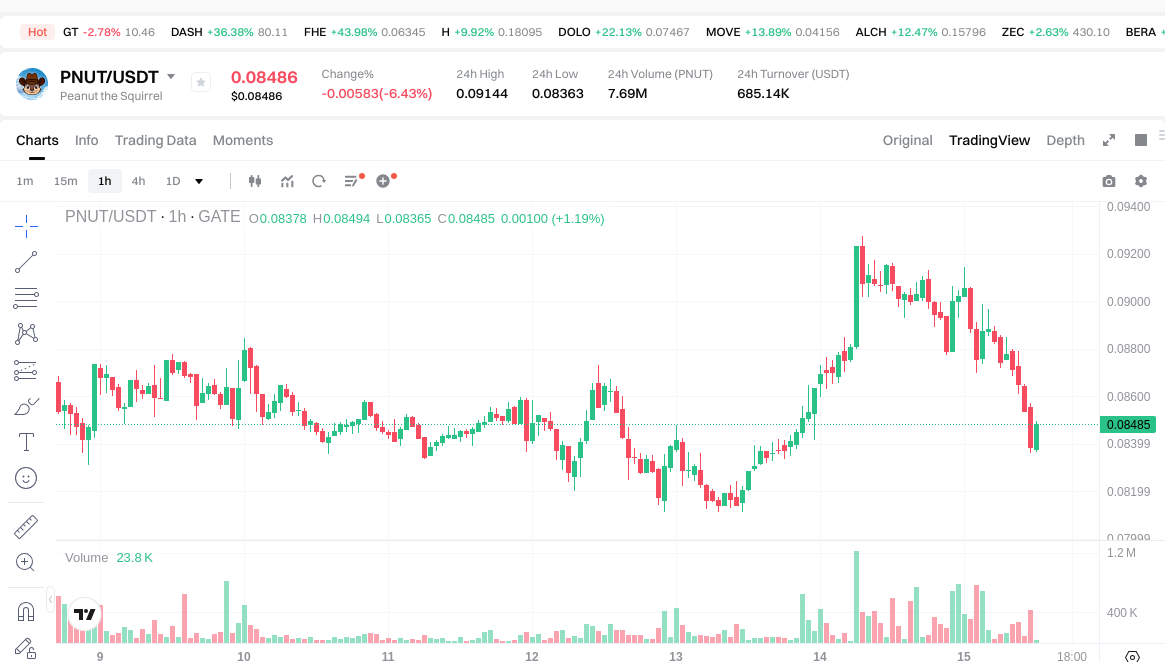
View PNUT USDT Price
Source: Input-provided market data (date: 2026-01-15).
Market capitalization is calculated as “price × circulating supply,” reflecting relative size; fully diluted valuation assumes all tokens are in circulation—cap limits and vesting schedules affect interpretation. Trading volume indicates market activity; short-term price movements reflect volatility and do not indicate long-term trends.
Who Created Pnut (PNUT) and When?
PNUT was launched by its community to commemorate “Peanut the Squirrel” and promote public governance reform initiatives; the specific launch date is not disclosed in the input—refer to official project announcements for any time-sensitive information.
From a narrative perspective, “Peanut the Squirrel” received significant social media attention after being mistakenly removed and euthanized, sparking broad discussion. PNUT immortalizes this story and advocacy on the blockchain, using commemoration and mobilization as core elements to unite community support and resources.
How Does Pnut (PNUT) Work?
PNUT uses blockchain technology for transaction records. Users initiate transfers with their wallet addresses; after network confirmation, transactions are recorded on an immutable distributed ledger. The total supply of PNUT is capped at 1 billion, making it a finite asset.
If issued via smart contract, the contract manages balances, transfer permissions, and may include additional rules (such as minting, burning, or fee allocation). For details, refer to the official contract documentation. Transfers typically require gas fees, which are paid to process transactions on-chain.
What Can Pnut (PNUT) Be Used For?
PNUT’s primary use cases are cultural and community-focused: supporting commemoration and advocacy, participating in community events, tipping, redeeming merchandise, and making donations or fundraising on compatible platforms.
For example, the community might launch animal welfare fundraisers using PNUT as the donation medium or enable the exchange of NFTs or themed merchandise to turn cultural recognition into sustainable community action. Whether governance voting or other features exist depends on future project updates.
Key Risks and Regulatory Considerations of Pnut (PNUT)
Main risks associated with PNUT include:
- Price volatility: As a meme coin, its price is highly sensitive to sentiment and trending topics.
- Liquidity risk: Fluctuations in trading volume can cause slippage and impact trading costs.
- Technical and smart contract risk: If based on smart contracts, code vulnerabilities or permission issues may introduce uncertainty.
- Concentrated holdings: High concentration among large or early holders may lead to severe price swings if they sell.
- Regulatory policy: Compliance requirements for crypto assets vary by jurisdiction; policy changes can impact trading and usage.
- Account security: Your private key is the sole credential for controlling assets—if leaked, assets can be irreversibly lost; mnemonic phrases should be backed up securely offline.
- Platform risk: Always check account security settings and withdrawal channels when using exchanges.
Common risk mitigation measures include portfolio diversification, using limit orders to control execution price, enabling two-factor authentication, regularly reviewing official announcements and contract audits, and assessing transparency of community fund usage and token distribution.
Where Is Pnut (PNUT)’s Long-Term Value?
The long-term value of PNUT depends on sustained community engagement, the vitality of its narrative, transparency in fund/project usage, and verifiable real-world outcomes.
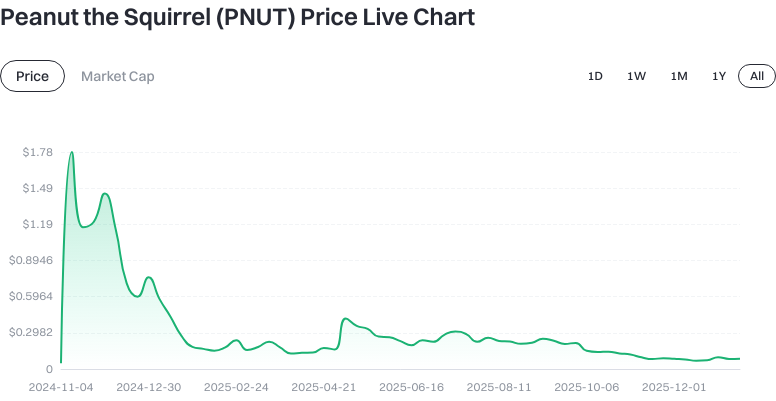
View Latest PNUT Price
A fixed supply creates scarcity but does not guarantee value—demand-side factors such as actual utility, depth of community participation, and brand development are more decisive.
Key metrics to monitor include daily active addresses, on-chain transaction volume and distribution, transparency in community fund allocation, event participation rates, partnership progress, and resilience in various market conditions.
How to Buy and Safely Store Pnut (PNUT) on Gate
You can purchase PNUT through spot trading on Gate and store it securely using a combination of exchange accounts and self-custody wallets.
Step 1: Register a Gate account and complete identity verification. Go to gate.com to sign up, submit ID information as instructed for KYC approval—this increases account security and withdrawal limits.
Step 2: Fund your account. Buy USDT via Gate’s fiat channels or deposit crypto from your wallet/other platforms—always double-check network and address before depositing.
Step 3: Search for PNUT pairs and place an order. On Gate’s trading interface, search for “PNUT” spot pairs. Choose limit orders to specify price/amount or market orders for instant execution.
Step 4: Enable security features. Activate two-factor authentication (2FA), set a strong password and withdrawal whitelist to reduce theft risks.
Step 5: Withdraw to a self-custody wallet (optional). For self-custody, withdraw PNUT to your wallet—where you hold your private key. Back up your mnemonic phrase offline; avoid photos or cloud storage.
Step 6: Keep records and review regularly. Track your trades and backup locations; check official updates periodically; stay alert to phishing links or fake support contacts.
How Does Pnut (PNUT) Differ from Dogecoin?
Both are community-driven projects but differ in origin story, supply model, technology stack, and ecosystem maturity.
- Narrative origin: PNUT is centered around the “Peanut the Squirrel” incident and public governance advocacy; Dogecoin (DOGE) originated from early internet “doge meme” culture and has since built a broad community and brand presence.
- Supply mechanism: PNUT has a max cap of 1 billion; DOGE is inflationary with no fixed upper limit. This impacts dilution over time.
- Technology stack: DOGE operates on its own blockchain with proof-of-work consensus; PNUT’s technical implementation is undisclosed here—refer to official sources for details.
- Use cases & ecosystem: DOGE has seen wider adoption in tipping and some merchant payments; PNUT focuses more on commemoration, advocacy, and community fundraising.
Your choice should align with your goals: DOGE offers greater maturity/ecosystem depth; PNUT is more oriented towards specific narratives and community-driven initiatives.
Summary of Pnut (PNUT)
Pnut centers on the “Peanut the Squirrel” story, prioritizing commemoration and community action with a capped supply of 1 billion tokens. Its price and market cap are driven by market dynamics and community interest. Short-term volatility reflects sentiment more directly, while long-term value relies on transparent fund use, tangible project outcomes, and ongoing cultural resonance. If you participate via Gate, consider using limit orders for better cost control, ensure robust account security with proper self-custody backups, and monitor project announcements, token distribution data, and real-world adoption trends for informed decision-making.
FAQ
Is PNUT Suitable for Beginners?
As a meme coin with high volatility, PNUT is not ideal as a primary investment for those with low risk tolerance or limited experience. Beginners should first understand its community dynamics and market sentiment—and only invest amounts they can afford to lose. Trading on regulated platforms like Gate reduces security risks but always do thorough research before investing.
How Can I Evaluate Whether PNUT Is Worth Attention?
Evaluate factors like community activity level, project update frequency, trading volume, and liquidity. Monitor official announcements and community discussions for genuine project progress. Be cautious of hype or unrealistic promises; assess long-term value rationally instead of following trends blindly.
What Are PNUT’s Trading Pairs?
Major trading pairs include PNUT/USDT and PNUT/USDC stablecoin pairs. On Gate you can view the full list of available pairs along with their market depth. Opt for pairs with sufficient liquidity to ensure quick order execution without excessive slippage.
Does Holding PNUT Generate Returns?
PNUT does not offer staking or dividend mechanisms; profits mainly come from trading price differences. Some exchanges may have promotional rewards or lending features—evaluate risks before participating. Long-term returns depend on market performance and project development.
What Is PNUT’s Total Supply?
PNUT’s total supply is hardcoded in its smart contract—you can verify this data on blockchain explorers. Understanding total supply helps assess scarcity or inflation risk. Always confirm the latest circulating and total supply data via Gate or official sources.
Pnut (PNUT) Key Terms Glossary
- Token supply: Refers to circulating supply, total supply, and maximum supply—indicating token scarcity and inflation expectations.
- Market capitalization: Calculated as token price times circulating supply; measures project size and investment value.
- Price change: The percentage fluctuation in token price over specific periods; signals market sentiment.
- Trading volume: Total value traded within a certain period; reflects market activity level and liquidity.
- Fully diluted valuation: Theoretical market cap if all tokens were unlocked; useful for assessing long-term value.
References & Further Reading
-
Official Site / Whitepaper:
-
Development / Docs:
-
Authoritative Media / Research:
Related Articles
Top 10 Meme Coin Trading Platforms
Review of the Top Ten Meme Bots