What is OP Coin?
What Is Optimism?
Optimism is a Layer 2 blockchain built on top of Ethereum that significantly reduces transaction costs and increases speed by executing transactions off-chain and then submitting the data to Ethereum for settlement. OP is the native governance token of Optimism, enabling holders to participate in governance votes, budget allocation, and ecosystem incentive distribution. Governance tokens are used to determine network rules and resource allocation, but are generally not used for paying network transaction fees.
On the Optimism network, users can transfer funds or interact with decentralized applications (DeFi, NFTs, games) with faster speeds and lower costs; security ultimately relies on Ethereum mainnet for settlement and data storage.
What Are the Current Price, Market Cap, and Circulating Supply of Optimism (OP)?
As of 2026-01-16 (source: provided input data), key OP market metrics are as follows: the latest price is $0.339800; circulating supply is 1,944,092,497 OP; total supply is 4,294,967,296 OP; maximum supply is 4,294,967,296 OP. Market capitalization stands at $1,459,429,887.180800, with the fully diluted valuation (FDV) at the same level. Price changes: +0.38% over 1 hour, -2.41% over 24 hours, +7.29% over 7 days, and +16.89% over 30 days. The 24-hour trading volume is $1,905,439.080013.
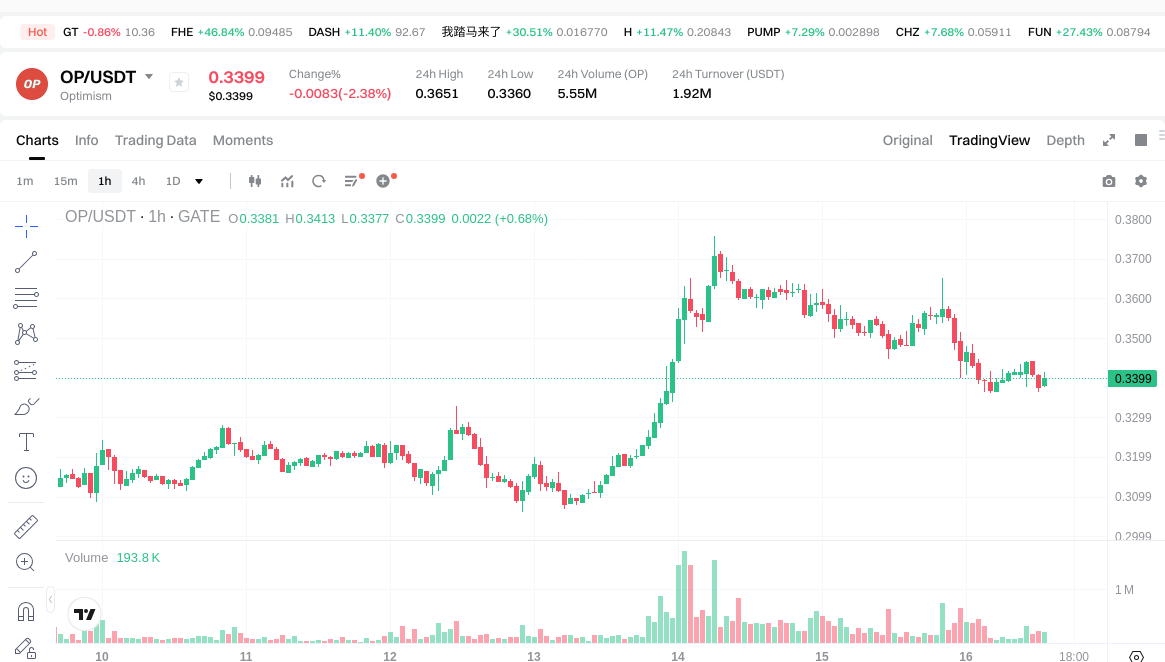
Click to view the OP USDT price
Circulating supply refers to the number of tokens currently available for trading and use in the market; total supply is the aggregate number of tokens issued; maximum supply is the theoretical upper limit of tokens. Market capitalization is calculated as price multiplied by circulating supply and serves as a measure of a token’s relative market size. Fully diluted valuation (FDV) is price times max or total supply and represents the potential valuation if all tokens are released.
Who Created Optimism (OP) and When?
The OP token was launched on 2022-05-30 (source: input information). Optimism’s development and maintenance are led by the OP Labs team and the Optimism Foundation, while governance is managed by the community-driven Optimism Collective. Prior to mainnet launch, Optimism underwent multiple rounds of testing and iteration with the goal of delivering scalable transaction throughput without compromising Ethereum-level security (see: Optimism official docs, accessed 2024-10).
How Does Optimism (OP) Work?
Optimism uses an optimistic rollup mechanism. Rollups “bundle” multiple transactions together and submit transaction results and essential data to Ethereum to leverage mainnet security and reduce costs. The term “optimistic” means transactions are assumed valid by default; if someone disputes a transaction, a fraud proof process can be triggered to correct invalid states.
A sequencer sorts transactions and quickly produces blocks, allowing users to see near-instant transaction results; batch data is then posted to Ethereum for final settlement. Data availability means that key data required for verifying transactions is published on-chain or in a trusted location so anyone can verify the network state.
The OP Stack is Optimism’s modular tech stack that lets developers launch new Layer 2 chains while sharing security and tooling with the broader Optimism ecosystem. The Superchain vision aims for collaboration across multiple OP Stack-based chains to unify standards and lower integration costs (source: Optimism Docs, accessed 2024-10).
For example: If you swap tokens on a decentralized exchange using Optimism, your transaction is rapidly processed by the sequencer and instantly shown as successful in the interface. The batch is then submitted to Ethereum for final settlement. Withdrawing funds from Optimism back to Ethereum requires waiting through a dispute period during which any improper state can be challenged.
What Can You Do with Optimism (OP)?
The core utility of OP is governance. Holders can vote on proposals related to protocol upgrades, budget allocation, and ecosystem incentive policies; they may also delegate voting power to trusted representatives to boost participation. Governance voting is an on-chain or platform-based process enabling collective decision-making for public matters.
Within the ecosystem, OP often incentivizes developers and users—for example, through grants for constructive projects or rewards for active users. Note that transaction fees on Optimism are typically paid in ETH rather than OP.
As an end user, you can: participate in governance votes and delegations; keep up with new ecosystem incentives and proposals; experience lower fees and faster confirmation in DeFi, NFT, gaming, and other applications on Optimism (see: Optimism governance docs, accessed 2024-10).
What Wallets and Expansion Solutions Exist in the Optimism (OP) Ecosystem?
Major Ethereum-compatible wallets such as MetaMask and Rabby support adding the “Optimism Mainnet” network, while hardware wallets like Ledger can enhance private key security. The official Optimism Bridge enables secure cross-chain asset transfers with Ethereum.
For expansion solutions, OP Stack makes it easier for developers to launch new Layer 2 chains and share infrastructure with the broader ecosystem. The Superchain vision emphasizes multi-chain collaboration and standardization to reduce cross-chain application complexity (source: Optimism Docs, accessed 2024-10).
When using wallets, always select “Optimism Mainnet” in your network list and verify the token contract address to avoid sending assets to the wrong network or fraudulent contracts.
What Are the Main Risks and Regulatory Considerations for Optimism (OP)?
Technical risks: Layer 2 systems involve sequencers and cross-chain bridges—smart contract vulnerabilities can impact fund security. The optimistic rollup dispute period means withdrawals from Layer 2 to mainnet require waiting time during which prices may fluctuate.
Operational & decentralization risks: Sequencer decentralization is ongoing; excessive centralization can pose block production or downtime risks. Governance risks include proposal quality and concentration of delegated voting power that may affect inclusiveness of decisions.
Asset & compliance risks: Cross-chain bridges are high-risk points; always verify official bridges and contract addresses. Assets held on exchange accounts are subject to platform rules—enable security features and diversify storage. Regulatory and tax treatment of crypto assets varies by jurisdiction; know local requirements before trading.
Mitigation tips: Test cross-chain transfers or withdrawals with small amounts; enable two-factor authentication and withdrawal whitelists; use hardware wallets for long-term storage; follow official announcements and security audit reports.
How Do I Buy and Safely Store Optimism (OP) on Gate?
Step 1: Register a Gate account and complete identity verification. Visit gate.com and submit required KYC documents as prompted to enhance account security.
Step 2: Deposit funds. Use fiat onramps or transfer assets like USDT/ETH from your own wallet. On deposit, select the correct network (e.g., Ethereum) and double-check address/tag details.
Step 3: Find a trading pair and place an order. On the spot trading page search for “OP” and select an OP/USDT pair. A limit order lets you set your buy price; a market order executes instantly at current rates.
Step 4: Confirm trade completion and holdings. After ordering, check “Orders” and “Assets” pages for trade status and balance details; note fees and execution price.
Step 5: Withdraw to a self-custody wallet. For long-term holding or governance participation, withdraw OP to a wallet supporting Optimism. On the withdrawal page select the correct network (such as Ethereum (ERC-20) or Optimism Mainnet); start with a small test before withdrawing larger sums.
Step 6: Store securely. Back up your seed phrase offline; enable two-factor authentication and withdrawal whitelists; regularly review approvals/signature logs to guard against phishing attempts.
How Does Optimism (OP) Compare to Arbitrum?
Technology & architecture: Both use optimistic rollups, but Optimism’s OP Stack prioritizes modularity and multi-chain cooperation (Superchain), while Arbitrum uses Nitro architecture with its own Orbit solution—each offers distinct implementation details for developers.
Governance & tokens: Both OP and ARB serve as governance/incentive tokens but differ in governance procedures, treasury allocation strategies, and delegation models. Optimism emphasizes public goods funding and retroactive grants; Arbitrum is highly active in DAO governance and treasury proposals.
Ecosystem & usage: Both networks host large DeFi/app ecosystems with similar fees and performance. Choice often depends on where your preferred applications reside or which governance/incentive mechanisms you prefer.
Decentralization roadmap: Both are advancing sequencer decentralization and security upgrades but at different paces/technical directions. Users should monitor official roadmaps and upgrade announcements for each chain.
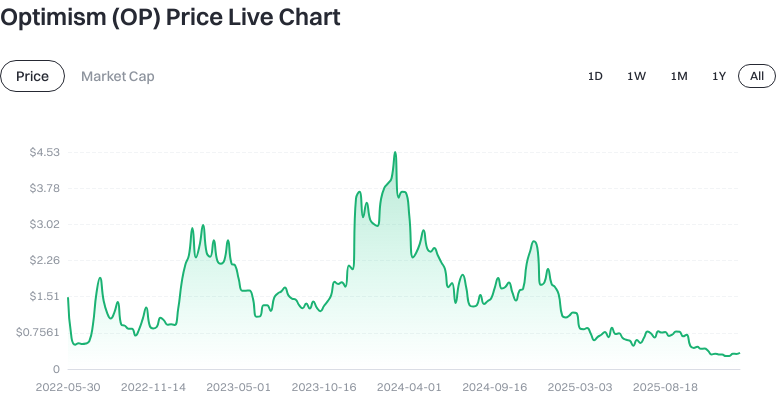
Click to view the latest OP price trends
Summary of Optimism (OP)
Optimism is a vital Layer 2 network within the Ethereum ecosystem, offering lower costs and faster confirmation times via optimistic rollups while maintaining mainnet security guarantees. As a governance token, OP facilitates voting, funding allocation, and ecosystem incentives within its limited supply. Its price and market cap fluctuate with broader market conditions—understanding circulating supply versus FDV helps assess risk and potential valuation. To get started, master wallet network selection, bridge usage, and dispute periods before buying/safely withdrawing through Gate step-by-step. Comparing Arbitrum helps you choose based on app distribution or governance preferences. Start small, learn iteratively, stay updated with official docs/governance proposals, and prioritize safety/compliance while engaging with the Optimism ecosystem.
FAQ
What’s the difference between OP Token, Bitcoin, and Ethereum?
OP is the governance token for the Optimism network, while Bitcoin and Ethereum are independent blockchains. OP’s primary function is enabling community members to participate in governance decisions for Optimism’s development. Bitcoin serves as a store of value; Ethereum is a smart contract platform.
What benefits come with holding OP tokens?
Holding OP grants governance rights—you can vote on protocol upgrades and treasury allocation. Some projects in the Optimism ecosystem may distribute airdrops or rewards to OP holders. However, OP does not offer fixed returns; potential benefits come from price appreciation driven by ecosystem growth or participation in governance.
Is OP suitable for beginner investors? What should I be aware of?
As a Layer 2 governance token, OP represents a medium-risk asset class—newcomers should understand its technical fundamentals before investing. Main risks include price volatility, technical vulnerabilities, and regulatory uncertainty. Learn basics via regulated platforms like Gate first; invest only what you can afford to lose—avoid going all-in or using leverage.
Where can I safely buy and store OP?
You can buy OP on regulated exchanges like Gate using various payment methods. For enhanced safety after purchase, transfer your tokens to a self-custody wallet (e.g., MetaMask) or hardware wallet. For short-term trading it’s fine to keep tokens on an exchange but always enable two-factor authentication and fund password protection to minimize theft risk.
What factors mainly influence OP’s price?
OP’s price is affected by multiple drivers: growth of the Optimism ecosystem, Ethereum mainnet performance, overall crypto market trends, governance proposal activity, community sentiment, major exchange listings, technical upgrades, as well as competitor actions (such as Arbitrum). Investors should monitor these variables collectively when assessing price trends.
Glossary of Key Terms Related to Optimism (OP)
- Layer 2 (L2): A scaling solution built atop a main blockchain that improves performance by lowering transaction costs and increasing speed.
- Optimistic Rollup: A scaling technology that assumes transactions are valid unless proven otherwise via fraud proofs.
- Gas Fees: The computational resource costs required to execute transactions—significantly lower on L2 than on mainnet.
- Cross-Chain Bridging: Mechanisms connecting OP with Ethereum mainnet that allow safe asset transfers between chains.
- Smart Contract: Self-executing code programs—OP is fully EVM-compatible so existing smart contracts can be deployed.
- Governance Token: Grants holders influence over protocol decisions/upgrades through voting rights affecting ecosystem direction.
Further Reading & References for Optimism (OP)
-
Official Website/Whitepaper:
-
Development/Documentation:
-
Authoritative Media/Research:
Related Articles

Exploration of the Layer2 Solution: zkLink
What is Plume Network