


What is Brise Coin?

What Is Bitgert?
Bitgert (symbol: BRISE), also known as Brise, is a cryptocurrency token originally issued on the Ethereum blockchain. As an ERC-20 token, it relies on smart contracts to record balances and facilitate transfers. Unlike native coins of independent blockchains, BRISE operates atop existing networks such as Ethereum and circulates across ecosystems including BNB Chain and Solana through cross-chain bridges.
In practice, BRISE can be transferred between wallets or used within decentralized applications (DApps) in its ecosystem for payments or settlements. Due to its large total supply, its price is typically represented with many decimal places, so users must pay close attention to contract addresses and network compatibility when investing or transferring BRISE.
What Are the Current Price, Market Cap, and Circulating Supply of Bitgert (BRISE)?
As of 2026-01-21 05:56 UTC, based on the provided data: the circulating market capitalization is approximately $11,335,021.91, with a fully diluted market cap of about $28,646,217.78. The circulating supply is roughly 395,690,000,000,000 BRISE tokens, traded across 91 pairs with a 24-hour volume near $1,086,872.92. The token price hovers around $0.00000003, showing +0.1125% change in the last hour, -4.6619% over 24 hours, -7.7466% over 7 days, and +5.1060% over 30 days.
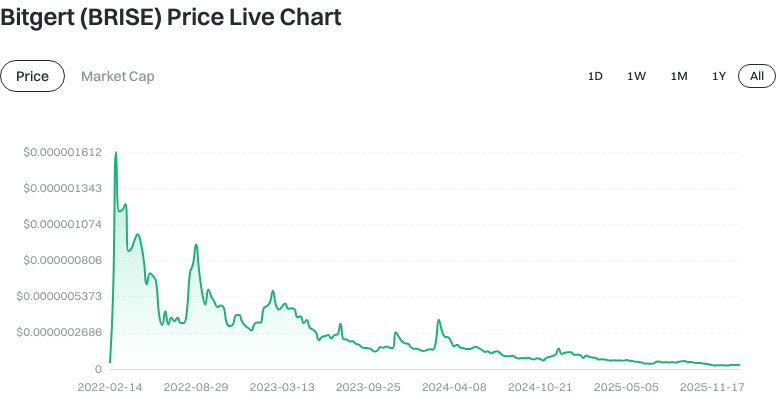
Click to view latest BRISE price data
(Source: Provided data; Official website: https://bitgert.com/)
Key Terms:
- Circulating Market Cap: The number of tokens in circulation multiplied by the current price; indicates relative market size.
- Fully Diluted Market Cap: Market capitalization estimated if all tokens are released; reflects potential dilution.
Who Created Bitgert (BRISE) and When?
BRISE was launched on July 7, 2021, by the Bitgert project team. Public information mainly highlights community and ecosystem expansion, with core team details not fully disclosed. Starting as an Ethereum-based token, BRISE has since expanded to other chains through multi-chain deployment and cross-chain bridges (Reference: project website, accessed 2026-01-21).
How Does Bitgert (BRISE) Work?
As an Ethereum token, BRISE complies with the ERC-20 standard. Transactions are executed and recorded by smart contracts, requiring users to pay Ethereum gas fees for confirmation on-chain. Via cross-chain bridges, holders can access equivalent assets on other blockchains that mirror their Ethereum BRISE holdings for multi-chain use cases.
Regarding supply, available data shows a total supply of 1,000,000,000,000,000 tokens with around 395,690,000,000,000 in circulation. The supply is not unlimited ("Is supply unlimited: No"). Any mechanisms for burning or minting tokens depend on official contracts and announcements.
Common Terms:
- ERC-20: The universal Ethereum token standard enabling broad wallet and application support.
- Smart Contract: Self-executing blockchain code governing token issuance and transfer rules.
- Cross-Chain Bridge: Technology enabling asset transfers or mirroring between different blockchains—users should carefully assess associated security and custodial risks.
What Can Bitgert (BRISE) Be Used For?
Primarily, BRISE is used for on-chain transfers and payments, enabling fast settlements between compatible wallets.
Additionally, within the Bitgert ecosystem, BRISE acts as a payment or settlement asset in supported DApps. Some third-party protocols may enable liquidity provision, yield farming, or staking with BRISE; however, each contract carries unique risks and should be individually verified for legitimacy and security.
Given its small unit value, BRISE is often used for micro-transactions or as an incentive token in community events—these uses depend on platform support.
Which Wallets and Extensions Support Bitgert (BRISE)?
- Popular Software Wallets: MetaMask supports managing BRISE on Ethereum; simply import the token by pasting the official contract address. For BRISE versions on other chains, switch to the corresponding network and import that network’s token contract address.
- Hardware Wallets: Devices like Ledger and Trezor can be used with software wallets to store private keys offline for enhanced security.
- Block Explorers: On Ethereum, Etherscan can be used to check BRISE contracts and transaction records; use appropriate explorers for other chains.
- Official Information Sources: Always verify contract addresses, cross-chain updates, and ecosystem announcements via https://bitgert.com/ and official social media channels to avoid interacting with fake contracts.
Key Terms:
- Private Key / Seed Phrase: Credentials granting asset ownership; always store offline—never screenshot or upload them to the cloud.
- Custodial vs Non-Custodial Wallets: Custodial wallets are managed by platforms (they hold your private key), while non-custodial wallets require users to secure their own keys—offering greater security but more responsibility.
What Are the Main Risks and Regulatory Considerations for Bitgert (BRISE)?
- Contract & Cross-Chain Risks: Smart contracts may have vulnerabilities; cross-chain bridges are frequent targets for exploits—if compromised, mirrored assets may lose backing.
- Liquidity & Volatility: Limited trading volume can cause high slippage and volatility; large trades may significantly impact price.
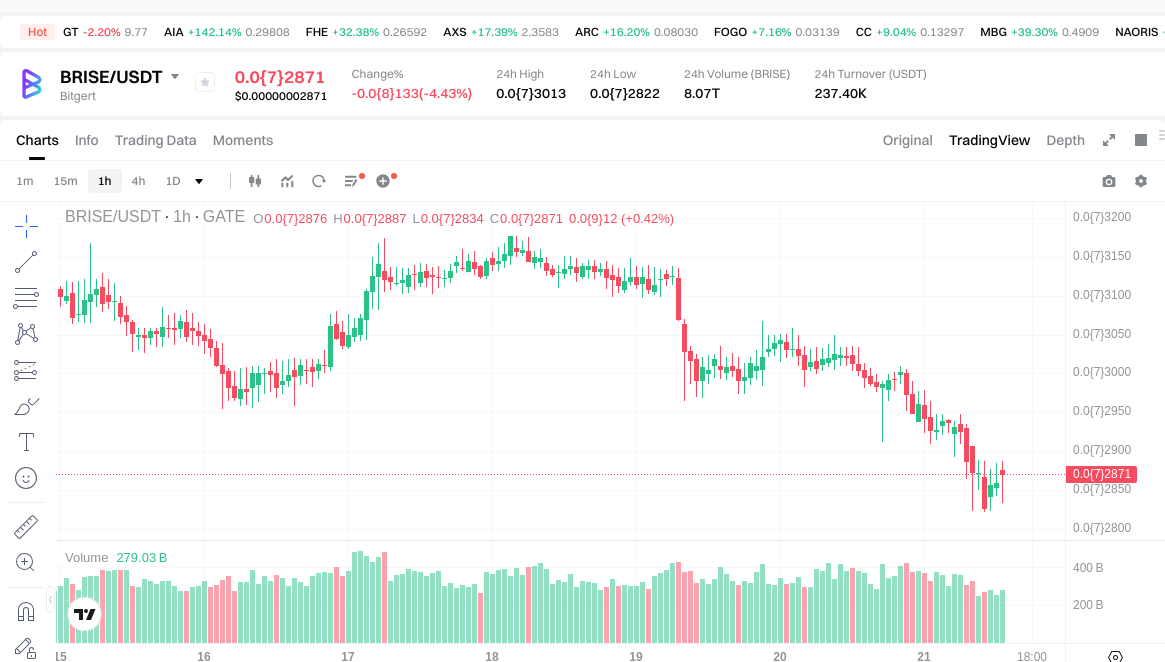
Click to view BRISE/USDT Price
- Supply & Price Display: The large supply means prices are displayed with many decimals; always reference actual exchange rates during trades due to possible rounding discrepancies.
- Regulation & Compliance: Crypto regulations and tax policies vary widely by jurisdiction; review local laws before trading.
- Fake Contracts & Phishing: Similar-named tokens and phishing sites are common—verify all contracts and links through official channels.
- Platform Operations: Choosing incorrect networks for deposits or withdrawals can result in irreversible loss; enable two-factor authentication and withdrawal whitelists for account security.
How Do I Buy and Safely Store Bitgert (BRISE) on Gate?
Step 1: Register and Complete KYC. Go to Gate’s official site to create an account; complete email/phone verification and identity authentication. Enable two-factor authentication (2FA) and withdrawal whitelist features.
Step 2: Deposit Funds. Purchase USDT with fiat currency or transfer USDT from another wallet/platform to Gate. Always confirm network compatibility before transferring—test with a small amount first.
Step 3: Place an Order for BRISE. Search “BRISE” in the spot trading section. Choose a limit order (set your own buy price) or market order (execute at current market price). Splitting orders can help reduce slippage risk.
Step 4: Withdraw to a Non-Custodial Wallet (Optional). Prepare your target wallet address. On the withdrawal page, select the network and contract matching your wallet (e.g., Ethereum ERC-20 or a mapped network). Test with a small withdrawal before moving larger amounts.
Step 5: Store Securely. Keep your seed phrase/private key offline; regularly review wallet approvals and revoke unnecessary DApp access; avoid operating your wallet over public networks or untrusted links.
Fee Note: Both purchases and withdrawals incur trading fees and gas fees—refer to Gate’s platform and network status for real-time rates.
How Is Bitgert (BRISE) Different from Shiba Inu (SHIB)?
- Positioning & Ecosystem: Both started on Ethereum. SHIB has launched its layer 2 network Shibarium and expanded its ecosystem; BRISE focuses on cross-chain distribution and its project applications—refer to official updates for details.
- Supply & Mechanisms: Both have large supplies with prices quoted in tiny fractions. SHIB’s burn events are well-known in its community; BRISE’s supply is fixed (“Is supply unlimited: No”), with any burns subject to contract rules and official announcements.
- Technical Approach: SHIB emphasizes Ethereum ecosystem development and its own layer 2; BRISE prioritizes cross-chain integration and multi-ecosystem deployment. Each makes trade-offs between scalability and security.
- Liquidity & Volatility: Both are highly volatile; actual liquidity depends on available trading pairs and market depth.
- Risk Profile: SHIB faces risks associated with layer 2 solutions and ecosystem applications; BRISE requires extra vigilance regarding cross-chain bridge security and consistency across multiple chain deployments. Both projects require robust contract auditing and operational transparency.
Summary of Bitgert (BRISE)
Bitgert (BRISE) is a token issued on Ethereum—also referred to as Brise—with a massive total supply and prices quoted in very small fractions. It circulates across multiple blockchains via cross-chain bridges. As of January 21st, 2026, data suggests its market cap and trading volume are modest in size with noticeable short-term volatility. BRISE serves as a means of on-chain transfers and payments within the project ecosystem. Participation in staking or other contracts should be guided by official announcements and smart contract audits. When investing or using BRISE on Gate, follow recommended steps—verify contract addresses and withdrawal networks, test with small transactions before transferring larger sums, self-custody critical assets, and securely store seed phrases. Regularly monitor project updates and regulatory developments to make more informed decisions regarding risk and opportunity.
FAQ
Are Brise Token and Bitgert the Same Thing?
Yes. Brise is the token issued by the Bitgert project—the names refer to the same asset. “Brise” is the token’s abbreviation; “Bitgert” is the full project name. On exchanges you’ll see trading pairs labeled “BRISE,” which denotes this cryptocurrency.
How Can Beginners Quickly Understand Brise’s Core Value?
The core value of Brise lies in powering the Bitgert ecosystem—it acts like an access pass for applications within that ecosystem. By holding Brise tokens, you can participate in on-chain governance, use ecosystem services, or earn rewards through staking. In essence, it bridges users with Bitgert’s suite of applications.
Is Brise Suitable for Beginners? What Should Be Noted?
As a relatively new project token, Brise experiences high volatility—beginners should exercise caution. Start by understanding the project fundamentals; only invest funds you can afford to lose. Buy from reputable exchanges like Gate; set stop-losses/take-profits to avoid impulsive buying or selling during price swings.
How Can You Assess Brise’s Future Prospects?
Consider several factors: growth of Bitgert ecosystem applications; community activity levels; frequency of developer updates; progress of partnerships with major projects. Also monitor market sentiment and industry trends—never blindly follow hype. Long-term investors should regularly review project progress.
How Do I Buy Brise on Gate Exchange?
After registering an account on Gate and logging in, search for the BRISE trading pair under spot trading. You can exchange USDT or BNB for Brise using either limit or market orders. Once purchased, transferring Brise to a non-custodial wallet enhances asset security for long-term holding.
Brise (BRISE) Essential Glossary
- Token Burn: Periodic reduction of circulating tokens to increase the relative value of remaining tokens.
- Liquidity Mining: Earning trading fees or mining rewards by providing liquidity to a trading pair.
- Slippage: The difference between expected execution price and actual trade price due to insufficient market liquidity.
- Smart Contract: Blockchain-based self-executing code managing token issuance, burns, etc.
- Cross-Chain Bridging: Techniques allowing tokens to move from one blockchain to another.
- Inflation Mechanism: When newly issued tokens outpace burns, resulting in decreased token value.
Brise (BRISE) References & Further Reading
-
Official Website/Whitepaper:
-
Development/Documentation:
-
Authoritative Media & Research:
Related Articles

In-depth Explanation of Yala: Building a Modular DeFi Yield Aggregator with $YU Stablecoin as a Medium

The Future of Cross-Chain Bridges: Full-Chain Interoperability Becomes Inevitable, Liquidity Bridges Will Decline
