


Value of 1 Bitcoin
What Is Bitcoin?
Bitcoin is the world’s first decentralized digital currency, designed for transferring and storing value without banking intermediaries. Decentralization means the network does not rely on any single institution; instead, it is collectively maintained by numerous independent nodes. Bitcoin operates on a blockchain—an open, time-sequenced ledger that records transactions transparently. It uses a Proof of Work consensus mechanism, where miners compete with computational power to validate transactions and secure the network, making it extremely resistant to tampering.
What Are Bitcoin’s (BTC) Current Price, Market Cap, and Circulating Supply?
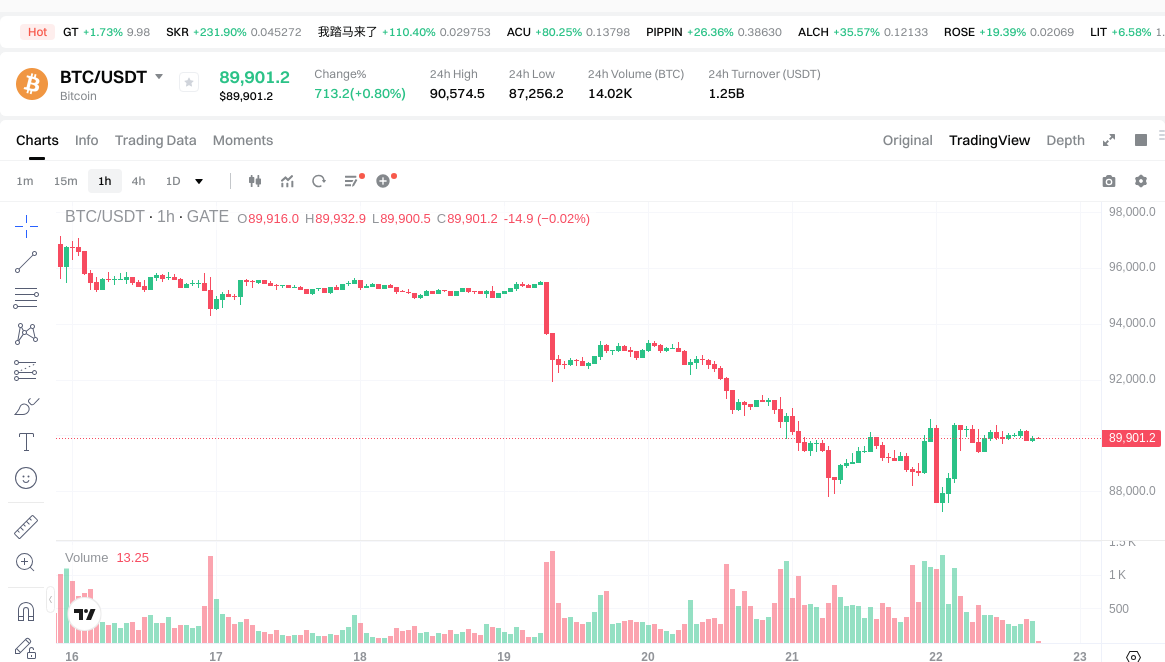
As of 2026-01-22: Bitcoin is trading around $89,884.50. The circulating supply stands at approximately 19,979,131 BTC (the amount actively available in the market). Total issued supply is about 19,979,159 BTC, while the maximum supply is capped at 21,000,000 BTC by protocol design.
View BTC USDT price
Circulating market cap is approximately $1,795,816,717,135 (price × circulating supply), with fully diluted market cap also around $1,795,816,717,135 (price × max supply). Bitcoin's dominance is roughly 55.54%. Recent price movement: +0.04% over 1 hour, +0.89% over 24 hours, -6.90% over 7 days, and +2.71% over 30 days.
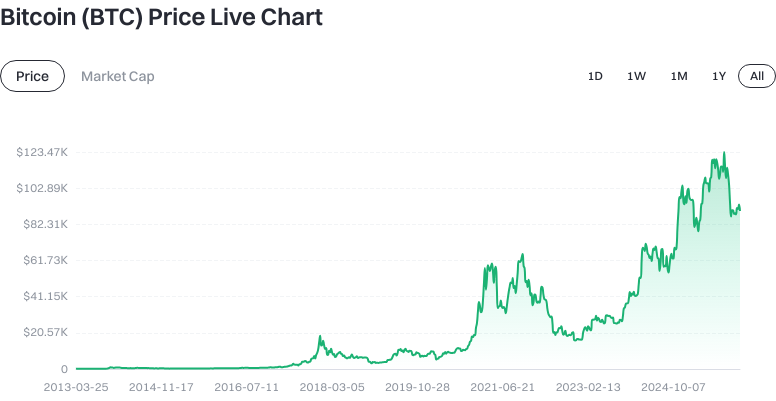
24-hour trading volume is around $1,254,056,840, indicating active market participation. These figures help illustrate scale and volatility; they are for informational purposes only and do not constitute investment advice.
Who Created Bitcoin (BTC), and When?
Bitcoin was introduced in 2008 by a developer using the pseudonym "Satoshi Nakamoto," who published the original whitepaper. The network officially launched in 2009 with the mining of the genesis block. Satoshi’s design delegated currency issuance and transaction verification to a distributed network, preventing artificial inflation. Bitcoin’s issuance follows a fixed schedule: block rewards halve roughly every four years—a process known as "halving"—which is a key mechanism affecting supply and miner incentives.
How Does Bitcoin (BTC) Work?
Bitcoin records transactions on a blockchain—a public ledger shared by all nodes—where each block of transactions is linked in chronological order. The Proof of Work mechanism allows miners to compete for the right to add new blocks by solving computational puzzles; the first to solve it earns block rewards and transaction fees. Ownership is secured by private keys (secret strings controlling funds), while public keys and addresses are used for receiving payments; only those holding the private key can sign and send transactions. Full nodes independently verify all transactions and blocks according to protocol rules, enhancing both security and decentralization.
What Can You Do With Bitcoin (BTC)?
Bitcoin serves as both a means of cross-border payments and a store of value. For international transfers, users can send funds directly to another address without traditional intermediaries—often faster and more easily verified. As a store of value, some holders view Bitcoin as a scarce asset thanks to its maximum supply cap of 21 million coins. Other use cases include online merchant payments, donations, and remittances; real-world experience depends on network congestion and transaction fees.
What Wallets and Scaling Solutions Exist in the Bitcoin (BTC) Ecosystem?
Wallets fall into custodial and non-custodial categories. Custodial wallets are managed by platforms that hold private keys—convenient but reliant on platform trust; non-custodial wallets let users control their own private keys for greater security. Hot wallets are connected online via mobile or desktop apps for easy access; cold wallets store assets offline on hardware devices or paper, ideal for long-term holding. For scaling, the Lightning Network enables fast, low-cost microtransactions off-chain before settling to the main blockchain. Multi-signature setups allow multiple private keys to jointly authorize transactions for enhanced fund security.
What Are the Main Risks and Regulatory Considerations for Bitcoin (BTC)?
Price volatility: Short-term fluctuations can be significant; it's important to maintain adequate financial buffers. Regulation and compliance: Crypto asset policies and tax requirements vary by jurisdiction—opening accounts and trading typically require identity verification (KYC). Custody and private key risks: Storing coins on platforms exposes you to platform security and operational risk; self-custody requires careful backup of your mnemonic phrase and protection against loss. Network risks: On-chain congestion can lead to higher fees and slower confirmations. Security threats: Beware of phishing links, fake apps, and social engineering attacks.
How Can I Buy and Safely Store Bitcoin (BTC) on Gate?
Step 1: Register an account on gate.com and complete identity verification. KYC helps enhance account security and ensures regulatory compliance.
Step 2: Enable two-factor authentication (2FA). Link your phone or an authenticator app in security settings to add protection for login and withdrawals.
Step 3: Deposit funds or recharge your account. Use fiat gateways to buy stablecoins or BTC directly, or transfer crypto from other wallets into your Gate account—start with a small test amount to confirm successful deposit.
Step 4: Purchase BTC in the spot market. Select trading pairs such as BTC/USDT; place a “limit order” for your desired price or a “market order” to buy instantly at current prices. Set your quantity, confirm the order, and review your trade history.
Step 5: Safe storage. For short-term use, keep assets in your Gate account with withdrawal whitelist and password enabled; for long-term holding, transfer to a non-custodial wallet, back up your mnemonic phrase securely offline. Test withdrawals with small amounts first to confirm address accuracy and network fees.
Step 6: Ongoing management. Set price alerts and risk controls; regularly review your asset allocation. Watch out for phishing sites and fake customer support—never share verification codes or mnemonic phrases.
How Is Bitcoin (BTC) Different From Ethereum (ETH)?
Purpose: Bitcoin focuses on secure value storage and peer-to-peer digital cash; Ethereum prioritizes programmable smart contracts and decentralized applications. Consensus mechanism: Bitcoin uses Proof of Work (PoW); Ethereum now runs on Proof of Stake (PoS), where validators stake tokens to verify blocks. Supply and monetary policy: Bitcoin’s supply is capped at 21 million coins; Ethereum has no fixed cap—inflation and burn mechanisms affect net issuance based on network activity and staking trends. Functionality and ecosystem: Bitcoin’s main chain is streamlined for reliability and security; Ethereum enables complex contracts with a richer ecosystem but faces distinct scalability and security trade-offs.
Summary: Understanding Bitcoin (BTC)
Bitcoin is a digital currency built around decentralization, a fixed supply cap, and Proof of Work consensus—aiming to offer trusted global value transfer and storage. Market data highlights its high valuation and notable volatility; understanding supply dynamics, transaction fees, and confirmation times helps assess user experience. Historical context and technical mechanisms explain Bitcoin’s censorship resistance and immutability; its use cases show potential in cross-border payments, long-term holding, and ecosystem expansion. In practice, opening a compliant account on Gate, applying risk controls, and ensuring secure storage are key steps; comparing with Ethereum clarifies their roles and trade-offs as assets. Overall, prioritize security and compliance—make cautious allocations based on personal goals and risk tolerance.
FAQ
Why Does Bitcoin Have Value?
Bitcoin derives value from its scarcity, security features, and widespread market consensus. The maximum supply is fixed at 21 million coins—making it impossible to inflate—similar to gold’s rarity. Blockchain technology ensures transactions are immutable and highly secure. Over more than a decade of market validation, Bitcoin has been increasingly recognized as "digital gold," fueling its price growth.
How Is Bitcoin’s Price Determined?
Bitcoin’s price is set by market supply and demand—much like stocks or commodities. Prices rise when buyers outnumber sellers; they fall when sellers dominate. Influential factors include macroeconomic trends, regulatory developments, technological progress, and overall market sentiment. On Gate or other exchanges you can track real-time global prices for Bitcoin; slight regional differences may exist.
Can Bitcoin’s Value Drop to Zero?
Bitcoin’s value depends on continued market consensus. In theory, if everyone stopped recognizing it as valuable, its price could approach zero—but this scenario is highly unlikely. Today, Bitcoin has become a key option in global asset allocation; institutional investors and central banks increasingly monitor it. Price volatility remains a risk—new investors should assess their risk tolerance carefully before investing and avoid putting in more than they can afford to lose.
Can Holding Bitcoin Generate Returns?
There are two main ways to potentially earn from holding Bitcoin: first is capital appreciation—buying low, selling high; second is earning interest via lending or staking programs. Note that price appreciation is uncertain; past performance does not guarantee future results. Gate offers various yield products—always learn thoroughly before participating to avoid losses from lack of understanding.
Is Bitcoin Better Suited for Long-Term Holding or Short-Term Trading?
This depends on your investment style and risk tolerance. Long-term holders believe in Bitcoin’s future potential and are less concerned with short-term volatility; short-term traders seek profit from price swings but require more knowledge and experience. Beginners are usually advised to start with small amounts held long-term—use platforms like Gate to learn buying/selling workflows before exploring more advanced strategies.
Key Terms Related to Bitcoin (BTC)
- Proof of Work (PoW): A consensus mechanism where computational puzzles validate transactions, securing the network’s integrity and decentralization.
- Blockchain: A sequence of cryptographically linked data blocks that record all transaction history in an immutable ledger.
- Mining: The process where miners use computation to validate transactions and bundle them into blocks in exchange for BTC rewards.
- Hash Function: A cryptographic function converting any data into a fixed-length hash value that preserves data integrity.
- Supply Cap: Bitcoin’s total supply is permanently limited to 21 million coins—ensuring scarcity and underlying value via algorithmic controls.
- UTXO Model: The Unspent Transaction Output model records ownership history for every bitcoin unit across all transactions.
Reference & Further Reading on Bitcoin (BTC)
-
Official Website / Whitepaper:
-
Development / Documentation:
-
Authoritative Media / Research:
Related Articles

In-depth Explanation of Yala: Building a Modular DeFi Yield Aggregator with $YU Stablecoin as a Medium
BTC and Projects in The BRC-20 Ecosystem
