The four-year cycle is dead. What will drive crypto in 2026?
2025 did not deliver the anticipated rally, but it may mark what we look back on as the beginning of crypto’s transition from speculation to a more established asset class.
The traditional four-year cycle is becoming obsolete. Market performance is no longer dictated by self-fulfilling timing narratives, but by where liquidity flows and investor mindshare concentrates.
What changed in 2025
Historically, crypto-native wealth acted as a fungible pool. Bitcoin gains spilled into ETH, then blue chips, then altcoins.
Wintermute OTC flow data shows this transmission weakened in 2025.
ETFs and DATs evolved into “walled gardens.” They provide sustained demand for large-cap assets but don’t naturally rotate capital into the wider market.
With retail interest diverted toward equities, 2025 became a year of extreme concentration.
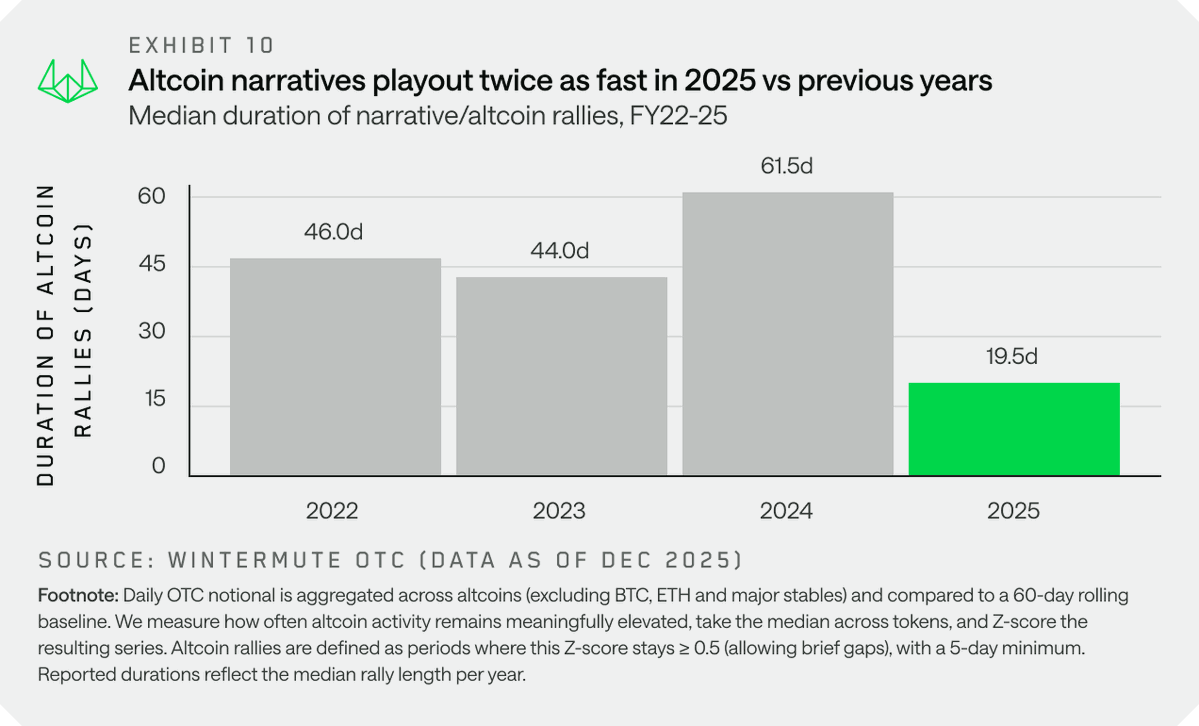
Altcoin rallies averaged 20 days in 2025, down from 60 days in 2024.
A handful of majors absorbed the vast majority of new capital while the broader market struggled.
Three paths forward for 2026
For the market to broaden beyond majors, at least one of three things needs to happen:
1. ETFs and DATs widen their mandates
Much of the new liquidity remains confined to institutional channels. A broader recovery requires expansion of their investable universe.
Early signs are emerging through SOL and XRP ETF filings.
2. Majors perform
A strong rally in Bitcoin or ETH would likely generate a wealth effect that could spill into the broader market, similar to 2024.
How much capital ultimately flows back into digital assets remains uncertain.
3. Mindshare returns
Retail investor mindshare could rotate back from equities (AI, rare earths, quantum) to crypto, bringing fresh capital inflows and stablecoin mints.
This is the least likely scenario but would meaningfully broaden market participation.
What determines 2026
Outcomes will depend on whether one of these catalysts meaningfully broadens liquidity beyond a handful of large-cap assets, or whether concentration persists.
Understanding where capital can flow and what structural changes are needed will determine what works in 2026.
Disclaimer:
- This article is reprinted from [wintermute_t]. All copyrights belong to the original author [wintermute_t]. If there are objections to this reprint, please contact the Gate Learn team, and they will handle it promptly.
- Liability Disclaimer: The views and opinions expressed in this article are solely those of the author and do not constitute any investment advice.
- Translations of the article into other languages are done by the Gate Learn team. Unless mentioned, copying, distributing, or plagiarizing the translated articles is prohibited.
Share


Related Articles

Reflections on Ethereum Governance Following the 3074 Saga

Gate Research: 2024 Cryptocurrency Market Review and 2025 Trend Forecast

Gate Research: BTC Breaks $100K Milestone, November Crypto Trading Volume Exceeds $10 Trillion For First Time

Altseason 2025: Narrative Rotation and Capital Restructuring in an Atypical Bull Market

NFTs and Memecoins in Last vs Current Bull Markets