Gate Research: Crypto Market Rally Triggers Nearly $700M in Short Liquidations | Vitalik Buterin Highlights Flaws in Decentralized Stablecoins
Summary
- Bitcoin has reclaimed the $96,000 level and continues to trade steadily within an ascending channel. Ethereum has broken through the key $3,300 resistance and remains in a high-level consolidation phase.
- Recently, the Zcash Foundation stated that the SEC has concluded its multi-year investigation without taking enforcement action. On Thursday, a shift among key supporters led the Senate Banking Committee to cancel the amendment hearing for the CLARITY Act.
- As both Bitcoin and Ethereum broke higher, nearly $700 million in short positions were liquidated. Vitalik Buterin pointed out flaws in decentralized stablecoins, while developments around Zcash and potential quantum threats drew market attention.
- Over the past week, a total of 18 crypto and crypto-related projects announced completed fundraisings or M&A activities, spanning sectors such as RWA, staking services, CeFi, and infrastructure.
- ONDO, TRUMP, and ZRO are set to unlock approximately $778 million, $278 million, and $42.42 million worth of tokens, respectively, over the next seven days.
Market Overview
Market Commentary
- BTC Market Update — Bitcoin has reclaimed the $96,000 level and continues to move steadily within an ascending channel. This rebound shows notable strength in both magnitude and structure: prices rebounded from the $90,000–$92,000 short-term bottom range, posting a single-day gain of about 4.6% and reaching the highest level since late November. From a market-structure perspective, spot buying has been the primary driver of this move, followed by passive short covering in the futures market, which further amplified the upside. Meanwhile, the ten spot Bitcoin ETFs recorded combined net inflows of nearly 90,000 BTC, with other major crypto ETFs also seeing net inflows. On-chain data points to increasing participant divergence: the average spot order size around the $90,000 level has expanded significantly, suggesting quiet accumulation by institutions or high-net-worth investors, while short-term holders have turned into net sellers, with the 30-day net change in short-term holdings falling into negative territory. Bitcoin is currently at a critical decision zone, and the next move will determine whether it can push toward a breakout above $100,000 or remain in a high-level consolidation phase.
- ETH Market Update — After two consecutive days of strong gains, Ethereum broke above the key $3,300 resistance formed in early January and briefly tested $3,400, before entering high-level consolidation around $3,300. This rally has been driven more by clear “hard catalysts” rather than pure sentiment: on one hand, progress on relevant legislative proposals has improved policy expectations; on the other, easing inflation has provided macro tailwinds, jointly lifting risk appetite and supporting a broad rebound in crypto assets. From a technical perspective, on the daily chart Ethereum is gradually approaching the 200-day exponential moving average (EMA) near $3,600, marking the third test of this key dynamic resistance since November. It is worth noting that prices moving within a range often follow the inertia of “touching the upper bound and pulling back toward the lower bound.” Therefore, unless ETH can decisively break above and hold the 200-day EMA, attention should still be paid to the $2,600–$2,730 zone as a potential consolidation and support area.
- Altcoins — Most altcoins posted broad-based gains this week, pushing the market back into the “Greed” zone. The Crypto Fear & Greed Index rebounded sharply to 61, compared with a weekly average of 28 last week, reflecting a rapid recovery in market confidence.
- Stablecoins — Total stablecoin market capitalization currently stands at $309.63 billion, up $1.725 billion over the past week, representing a 0.56% increase.
- Gas Fees — Ethereum network gas fees remained generally below 1 Gwei over the past week, with the highest single-hour peak at 0.147 Gwei. As of January 15, the daily average gas fee was 0.147 Gwei.
Trending Tokens
After a strong one-day rally, the crypto market showed clear divergence over the past 24 hours. Bitcoin edged up by about 0.2%, remaining relatively resilient among major assets and indicating continued capital allocation toward “core assets.” In contrast, major altcoins such as Ethereum, BNB, and SOL generally pulled back, with ETH down nearly 2% and XRP’s losses widening to over 4%, reflecting a temporary cooling in risk appetite. Overall, short-term capital has shifted toward a more defensive and wait-and-see stance, though some tokens continue to attract inflows. These assets are analyzed in detail below.
ICP Internet Computer (+27.85%, Circulating Market Cap: $2.432B)
According to Gate market data, ICP is currently priced at $0.0013709, up 27.85% over the past 24 hours. Internet Computer (ICP), launched by the DFINITY Foundation, is a decentralized network designed to enable developers to build and run scalable Web applications and services directly on-chain without relying on traditional cloud platforms. Its core innovations include chain-key cryptography and Canister smart contracts, supporting high-performance, low-cost on-chain computation and cross-chain interactions.
On January 15, the DFINITY Foundation released the Mission70 whitepaper, proposing to reduce ICP’s inflation rate by approximately 70% by 2026, primarily through lowering new token issuance. This proposal had been widely anticipated by the market prior to its official release. A declining inflation rate implies tighter long-term supply, especially given that around 40% of ICP is currently locked for staking, further constraining circulating supply. Overall, Mission70 aims to enhance the network’s long-term sustainability and address token holders’ concerns about dilution. However, the plan still needs to go through governance processes, with voting arrangements and implementation timelines yet to be clarified, leaving execution uncertainties.
DOLO Dolomite (+20.10%, Circulating Market Cap: $26.92M)
According to Gate market data, DOLO is currently trading at $0.07356, up 20.10% over the past 24 hours. Dolomite (DOLO) is a decentralized lending and margin trading protocol that supports multi-asset collateralization, leveraged trading, and efficient capital utilization. Its core strength lies in a highly modular risk management and account system, which enhances capital efficiency while maintaining security, catering to professional DeFi users and strategy-driven capital.
On January 12, World Liberty Financial (WLFI) launched “World Liberty Markets,” a lending platform built on Dolomite. Users can now directly borrow assets such as USD1 (a stablecoin issued by WLFI with a market cap of $3.4 billion), ETH, and USDC via Dolomite’s infrastructure. This integration introduces real-world demand into the Dolomite ecosystem. USD1’s scale provides immediate utility for DOLO as a settlement layer, while WLFI’s political connections have attracted mainstream capital attention. Increased protocol usage typically supports token value through fee mechanisms. Going forward, attention should be paid to the approval outcome of WLFI’s application for a national trust bank license, as approval would accelerate USD1 adoption on Dolomite.
ARRR Pirate Chain (+39.20%, Circulating Market Cap: $123M)
According to Gate market data, ARRR is currently priced at $0.6352, up more than 39.20% over the past 24 hours. Launched in 2018, Pirate Chain is a privacy-focused cryptocurrency built on zk-SNARK zero-knowledge proof technology, emphasizing a “privacy-by-default” on-chain transaction experience. Pirate Chain uses a PoW consensus with the Equihash algorithm and enhances security through a delayed Proof-of-Work (dPoW) mechanism, anchoring its block hashes to the Bitcoin blockchain to improve resistance against 51% attacks.
The latest ARRR price surge has been driven by a combination of renewed interest in privacy coins and increased community exposure. On one hand, ARRR’s rally has coincided with a broader resurgence in attention toward privacy coins, as regulators intensify scrutiny of transparent blockchains, leading some investors to view ARRR’s mandatory zk-SNARK privacy as a hedge against regulatory surveillance. On the other hand, community-driven speculation has also played a role: unverified rumors on X about Zcash developers migrating to ARRR sparked discussion and boosted the project’s visibility.
Key Market Data Highlights
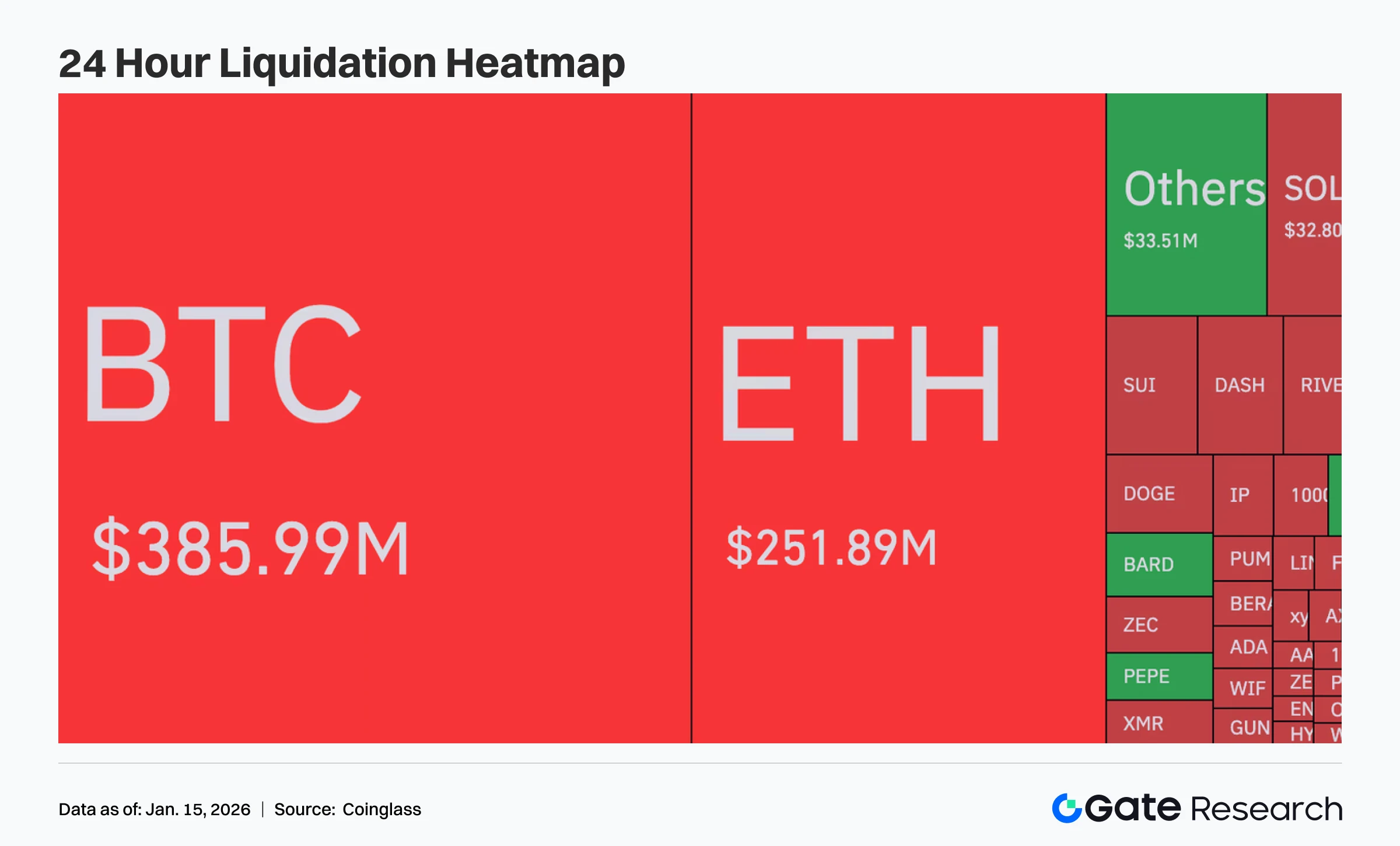
Crypto market rebound triggers the largest short squeeze since October, with $577 million in short positions liquidated over the past 24 hours
On January 14, according to Glassnode data, driven by the crypto market rebound, total liquidations across the market reached $684 million over the past 24 hours, of which $577 million were short liquidations. This rebound also marked the largest short liquidation by market cap among the top 500 cryptocurrencies since the “10/11 crash.”
The market may be approaching a critical psychological and technical inflection point. As crypto prices—led by Bitcoin—rapidly broke higher, a large buildup of short positions was forcefully liquidated, creating a classic “short squeeze.” In the short term, Bitcoin’s break above $95,000 serves as a key green light for renewed risk appetite across the digital asset market. This move has reignited bullish momentum, with market participants now watching closely for a potential push above the $100,000 threshold and a possible retest of all-time highs.
Key supporters falter as the Senate Banking Committee cancels the CLARITY Act amendment hearing
The Senate Banking Committee had originally scheduled a hearing for Thursday morning to consider amendments, but on January 15 it canceled the planned session to revise and vote on comprehensive crypto legislation. The CLARITY Act is designed to clarify regulatory jurisdiction between the Commodity Futures Trading Commission (CFTC) and the Securities and Exchange Commission (SEC), define when digital assets should be classified as securities or commodities, and establish new disclosure requirements. The bill text was released Monday evening, with the amendment submission deadline set for late Tuesday night, paving the way for a Thursday vote. However, cracks in support began to emerge on Wednesday.
Democratic Senator Ruben Gallego, a key negotiator on the bill, said he was supposed to meet with Patrick Witt, Executive Director of the President’s Digital Asset Advisory Committee, but the meeting did not take place. He stated that he is currently unable to support the bill. Shortly thereafter, the first publicly listed, fully licensed exchange announced it was withdrawing its support. CEO Brian Armstrong wrote on X that he had concerns about provisions related to stablecoin yields, tokenized equity, and decentralized finance. That said, other crypto companies and advocacy groups continue to back the bill and say they remain committed to pushing for it to become law in 2026.
FED officials jointly defend policy independence while signaling a pause in rate cuts
On January 15, several Federal Reserve officials emphasized publicly on Wednesday that political or judicial pressure should not interfere with monetary policy decisions, underscoring the importance of central bank independence. At the same time, officials broadly signaled that a pause in rate cuts is likely at this month’s meeting, citing the resilience of the U.S. economy and still-elevated inflation, which warrant maintaining restrictive monetary policy.
Notably, a consensus appears to be forming within the Fed. The presidents of the Chicago Fed, Atlanta Fed, and New York Fed stressed that maintaining long-term inflation stability is critical, and that keeping rates unchanged in the near term is a more prudent choice until inflation shows clearer and sustained progress downward. Regarding the economic outlook, only a small number of officials—such as Governor Mester—argued that inflation is clearly moving along the right path. Most officials indicated that another rate cut at the late-January FOMC meeting is unlikely. Markets generally expect that rate cuts may not resume until after June this year at the earliest.
Focus of the Week
Bitcoin and Ethereum Break Higher, Nearly $700 Million in Short Positions Liquidated
Bitcoin and Ethereum have surged in tandem in recent days, triggering sharp volatility in derivatives markets. On January 14, Bitcoin broke above the key resistance level of $95,000 and briefly climbed to $97,800 during U.S. trading hours, posting a roughly 3.5% gain within 24 hours. Ethereum outperformed, rising about 5% to $3,380, marking a more than one-month high and its first move above the $3,300 level since 2026. Market participants noted that Bitcoin’s breakout above a major psychological threshold significantly revived risk appetite, suggesting further short-term upside potential for crypto assets.
The rapid price rally forced a large number of leveraged bearish positions into liquidation. According to CoinGlass data, nearly $700 million in short positions were liquidated over the past 24 hours, including approximately $380 million in Bitcoin shorts and more than $250 million in Ethereum shorts. Gabe Selby, Head of Research at CF Benchmarks, commented that the breakout triggered concentrated short covering, but noted that the current rally appears more technical and “mechanical” in nature, driven largely by market makers correcting supply-demand imbalances left by the prior downturn.
Vitalik Buterin Highlights Flaws in Decentralized Stablecoins; Zcash Turmoil and Quantum Risks Draw Attention
CoinDesk’s latest edition of The Protocol highlights several key developments in crypto technology. Ethereum co-founder Vitalik Buterin published an article arguing that today’s decentralized stablecoins still suffer from fundamental design flaws, particularly their reliance on the U.S. dollar as a sole anchor and on oracle mechanisms. He warned that, over the long term, inflation in a single national currency and potentially manipulable data sources could undermine the resilience of stablecoin systems. Instead, he suggested that future designs might consider tracking broader price indices or purchasing-power metrics rather than focusing exclusively on the dollar.
Meanwhile, privacy-focused project Zcash has been hit by governance turmoil. Following conflicts between its main developer, Electric Coin Company, and the nonprofit organization supporting the network, the core development team resigned en masse. After the news broke, the ZEC token fell nearly 14% within 24 hours. In addition, Elon Musk’s X platform announced plans to introduce “smart cashtags” to more precisely tag and display crypto asset information on the platform. On another technological frontier, BTQ Technologies launched a test network called “Bitcoin Quantum,” aiming to explore potential defenses against future quantum computing threats to Bitcoin.
Metaplanet One Step Away from Resuming Equity Financing to Buy Bitcoin
Shares of Japanese listed company Metaplanet jumped 15% on Wednesday to ¥605, leaving the stock just about 5% below the key trigger price of ¥637. If this level is reached, the company’s previously suspended “Moving Strike Warrant” (MSW) mechanism would be reactivated, allowing the EVO Fund to exercise its 23rd series of warrants. This could result in the issuance of up to 105 million new shares, unlocking several hundred million dollars in potential financing to continue accumulating Bitcoin. As one of Asia’s largest corporate Bitcoin holders, Metaplanet currently holds 35,102 BTC, ranking fourth globally.
The financing plan had earlier been paused after the stock retreated from its historical highs and the ratio of market capitalization to the value of its Bitcoin holdings (mNAV) briefly fell below 1, raising concerns about shareholder dilution. Recently, mNAV has rebounded to around 1.36, the highest level since last October. Beyond the 23rd series, if the share price rises further to ¥777, the 24th series of warrants would be triggered, enabling the issuance of up to another 105 million shares. Since its December lows, Metaplanet’s stock has rebounded roughly 90%, bringing it closer to the threshold for expanding its Bitcoin holdings through renewed financing.
Funding Weekly Recap
According to RootData, between January 9 and January 15, 2026, a total of 18 crypto and crypto-related projects announced funding rounds or mergers and acquisitions, spanning sectors such as RWA, staking services, CeFi, and infrastructure. Highlights among the largest deals include:
Rain
On January 9, Rain announced the completion of a $250 million funding round at a valuation of $1.95 billion, with participation from ICONIQ Capital, Dragonfly, and others.
Rain focuses on crypto payments and financial infrastructure, providing compliant and scalable digital asset payment and settlement solutions for enterprises and institutions. The new funding will be used to expand its global payment network, enhance compliance and risk management capabilities, and accelerate product deployment for large institutional clients, supporting broader real-world adoption of crypto assets.
3iQ
On January 8, 3iQ completed a $112 million M&A transaction, being acquired by Coincheck.
3iQ is a well-known digital asset management firm offering crypto investment products and compliant access for institutional investors. The acquisition will help Coincheck strengthen its presence in asset management and institutional services, while enabling 3iQ to expand into broader international markets and reinforce its influence in compliant crypto investing.
Upexi
On January 13, Upexi announced the completion of a $36 million post-IPO financing round led by Hivemind Capital.
Upexi is a publicly listed company focused on the intersection of consumer products and digital assets, and has increasingly expanded into crypto and blockchain-related initiatives. The funds will be used to strengthen its balance sheet, expand its digital asset strategy, and support future investments and acquisitions in crypto and emerging technologies.
Next Week to Watch
Token Unlocks
According to Tokenomist data, several major token unlocks are scheduled over the next seven days (January 16–January 22, 2026). The top three by unlock value are:
- ONDO: Approximately $778 million in tokens to be unlocked, accounting for 61.4% of the total unlock value.
- TRUMP: Approximately $278 million in tokens to be unlocked, representing 25.0% of the total.
- ZRO: Approximately $42.42 million in tokens to be unlocked, accounting for 12.6% of the total.
References:
- Gate, https://www.gate.com/trade/BTC_USDT
- Farside Investors, https://farside.co.uk/btc/
- Gate, https://www.gate.com/trade/ETH_USDT
- Gate, https://www.gate.com/crypto-market-data
- DeFiLlama, https://defillama.com/stablecoins
- Etherscan, https://etherscan.io/gastracker
- Coingecoko, https://www.coingecko.com/en/cryptocurrency-heatmap
- Rootdata, https://www.rootdata.com/Fundraising
- Tokenomist, https://tokenomist.ai/
- FT, https://www.ft.com/content/86872584-c844-4d71-af16-60157c1585ec
- X, https://x.com/glassnode/status/1998046938357530820
- The Block, https://www.theblock.co/post/385698/senate-banking-committee-postpones-markup
- Japan Times, https://www.japantimes.co.jp/business/2026/01/15/markets/fed-independence-rate-hold/
- The Block, https://www.theblock.co/post/385629/zcash-foundation-says-sec-has-closed-book-on-years-long-probe
Gate Research is a comprehensive blockchain and cryptocurrency research platform that provides deep content for readers, including technical analysis, market insights, industry research, trend forecasting, and macroeconomic policy analysis.
Disclaimer
Investing in cryptocurrency markets involves high risk. Users are advised to conduct their own research and fully understand the nature of the assets and products before making any investment decisions. Gate is not responsible for any losses or damages arising from such decisions.
Share
Content


Related Articles
What Are Altcoins?

What is Blum? All You Need to Know About BLUM in 2025

What Is Dogecoin?

Reflections on Ethereum Governance Following the 3074 Saga

Gate Research: 2024 Cryptocurrency Market Review and 2025 Trend Forecast