Gate 2025 Spot Listing Key Stats: Nearly 80% of Exclusive Projects Opened Up Within the First 30 Minutes, With a Median Gain of ~81%
In 2025, total crypto market cap repeatedly hit new all-time highs. At the same time, on-chain stablecoins and the scale of asset tokenization continued to expand, accelerating capital flows between on-chain venues and CEXs. In an environment of high volatility and heavy new supply, an exchange’s ability to source and screen new assets, as well as the post-listing path of price discovery and pricing, became a key lens for assessing liquidity absorption and shifts in risk appetite. Based on a sample of 447 newly listed spot assets on Gate in 2025, this report reviews multiple post-listing windows from 5 minutes to 30 days, using metrics such as the share of gainers, average gains among gainers, and median returns to characterize overall performance and structural differences.
Sample Overview: Listing Mix and Day-One Return Distribution
From a supply perspective, Gate listed 447 newly added spot assets in 2025, including 318 primary listings (28 of which were Gate-exclusive) and 129 non-primary listings. Primary listings accounted for roughly 71% of the total, indicating that most new supply came from first-time listings rather than secondary listings of assets already available on other venues.
Using the listing open price as a common baseline, about 54.8% (245/447) of assets were still above that level 24 hours after listing. Among the gainers, the average 24-hour return reached 635%. However, looking at the median across the full sample (including decliners), the 24-hour median return was 7.57%, and it narrowed further to 3.71% after trimming extreme moves (gains >1,000% or losses <-90%). Taken together, these figures suggest meaningful upside potential within the first day while also indicating that outsized gains are concentrated in a smaller subset of tokens, producing a typical long-tail return profile.
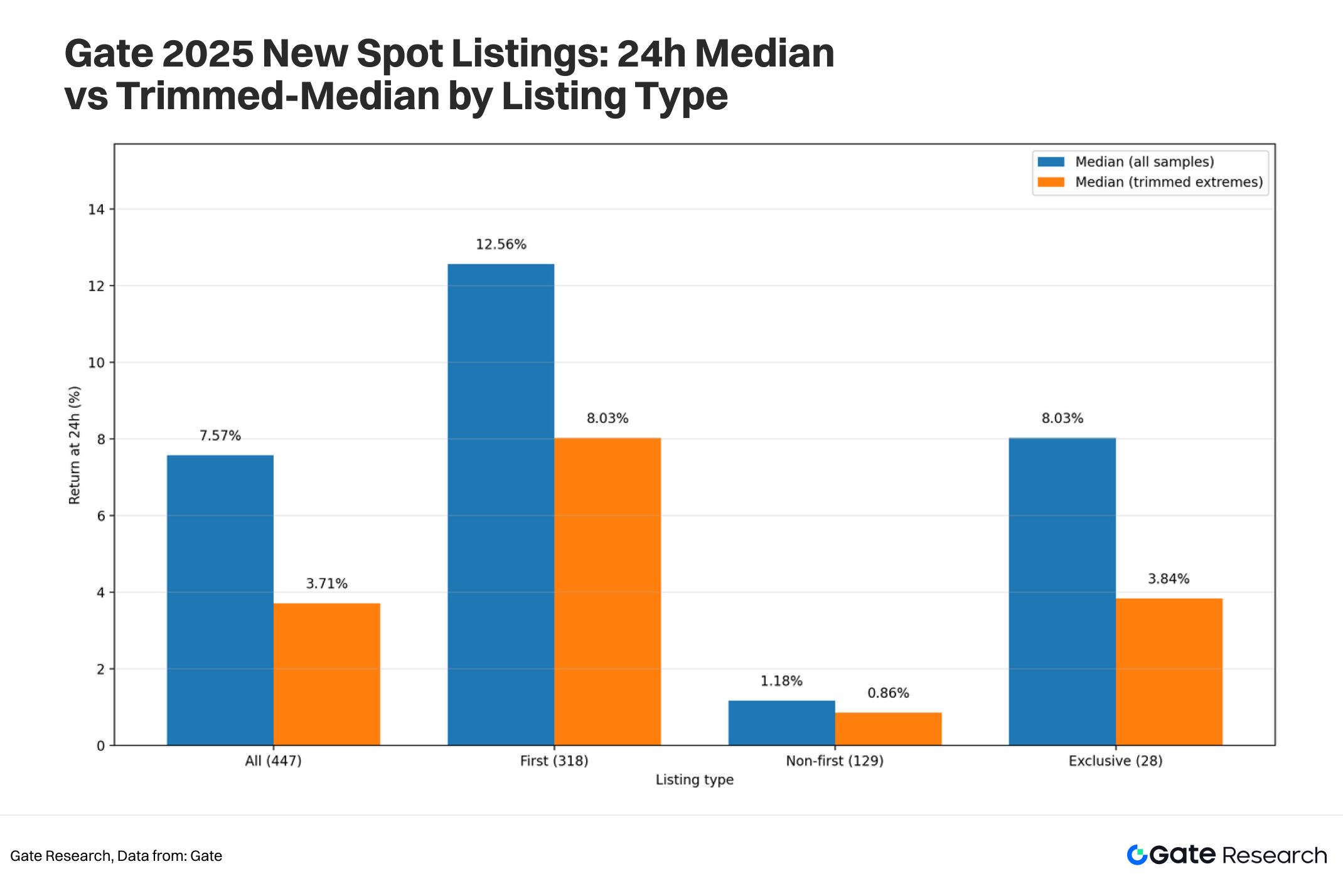
Breaking the results down by listing type shows a clear day-one gap between primary and non-primary listings. In the 24-hour window, the median return across the full primary-listing sample was 12.56% (8.03% after trimming outliers), well above the median for non-primary listings at 1.18% (0.86% after trimming). This divergence is not limited to the 24-hour mark; it widens further at finer early time points, creating a more pronounced separation in return profiles across listing types.
Multi-Window View: Return Trajectory from 5 Minutes to 30 Days
To break performance down over time, we segment the post-listing return path of Gate’s newly listed assets across eight windows: 5 minutes, 30 minutes, 1 hour, 12 hours, 24 hours, 72 hours, 7 days, and 30 days.
1. Short-Horizon Windows Show Higher Positive-Return Coverage
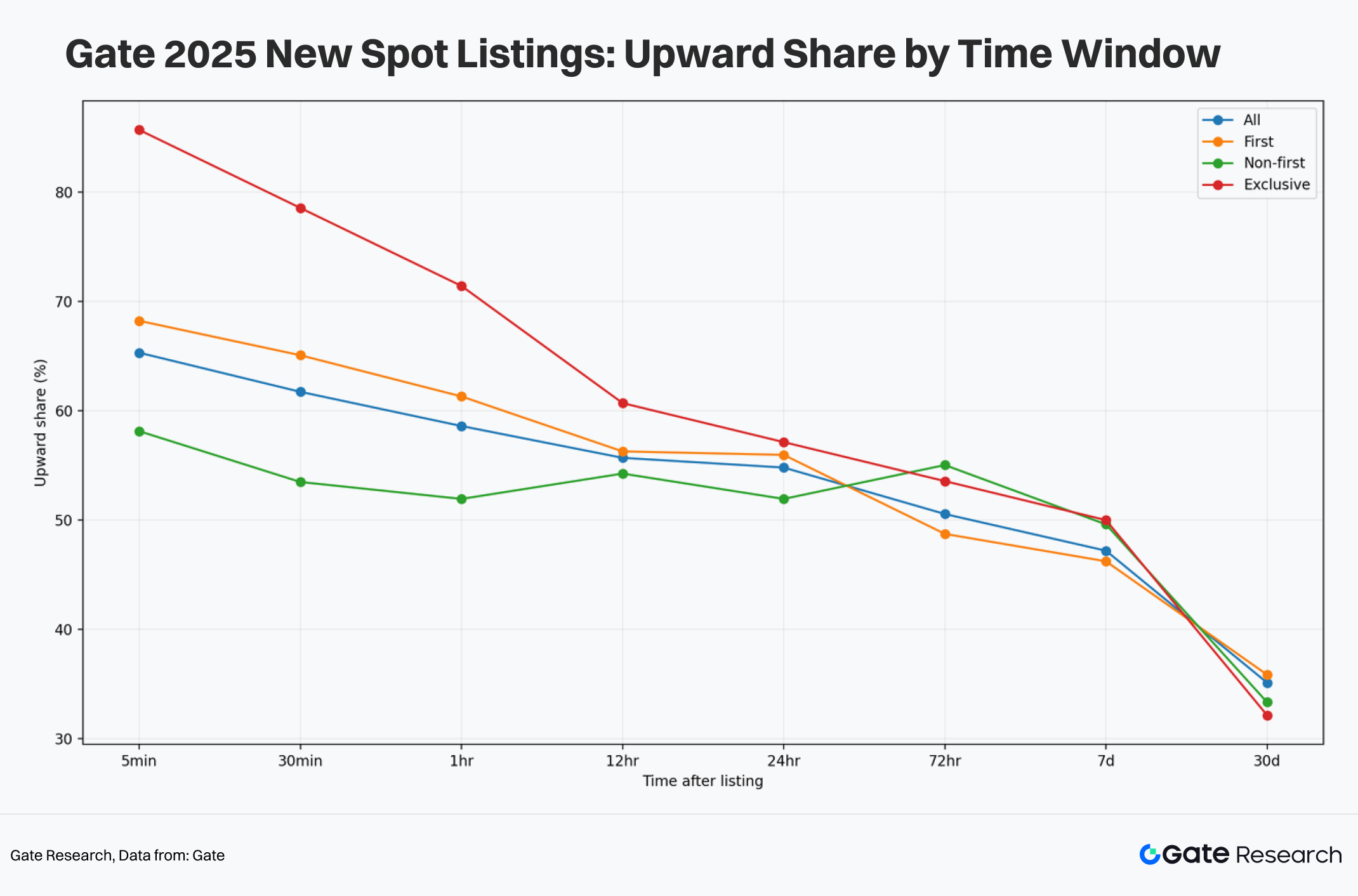
Across the 447-asset sample, short-horizon post-listing windows generally show a higher share of gainers, but this advantage fades as the observation window lengthens.
Based on the full sample:
- 30 minutes: 276/447 gainers (61.74%)
- 24 hours: 245/447 gainers (54.81%)
- 72 hours: 226/447 gainers (50.56%)
- 7 days: 211/447 gainers (47.20%)
- 30 days: 157/447 gainers (35.12%)
Overall, a “majority-up” outcome is largely concentrated within the first 24 hours after listing. By around 72 hours, the share of gainers is close to an even split, and by the 30-day mark, the number of gainers falls to roughly one-third of the sample.
2. Primary vs. Non-Primary Listings Show a Clear Median-Return Split in Early Windows
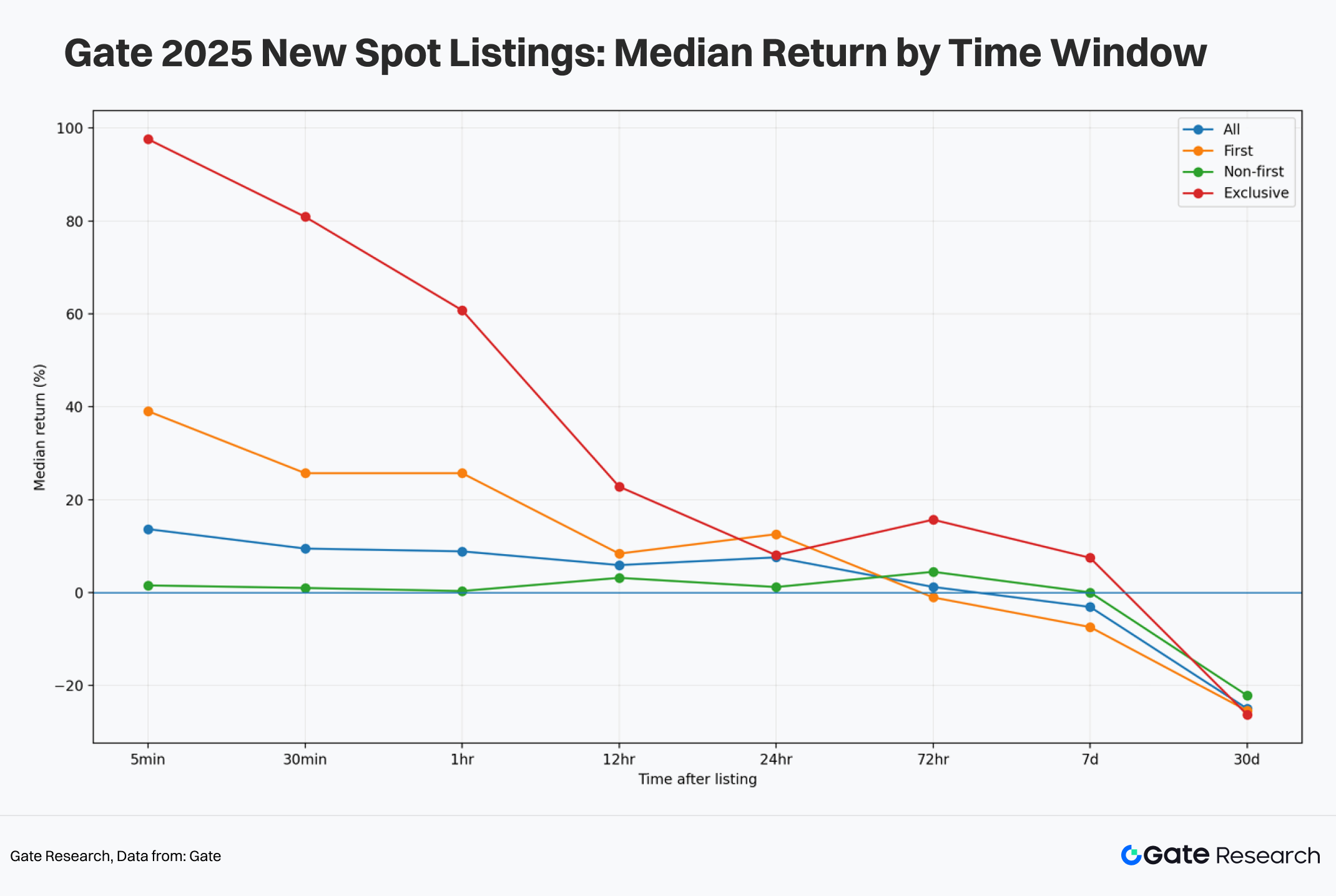
Looking at the median-return time series, Gate’s newly listed assets show a clear stratification across listing types in the early post-listing window. Primary listings, especially Gate-exclusive listings, sustain higher median returns across multiple checkpoints from 5 minutes to 24 hours, while non-primary listings have medians that sit much closer to the zero line. As the window extends to 72 hours and beyond, median returns generally weaken and gradually converge across types.
Comparing median returns across the full sample for primary vs. non-primary listings:
- 30 minutes: primary 25.69% vs. non-primary 0.98%
- 24 hours: primary 12.56% vs. non-primary 1.18%
The share of gainers also differs:
- 30 minutes: primary 65.09% vs. non-primary 53.49%
- 24 hours: primary 55.97% vs. non-primary 51.94%
Overall, in the most critical post-listing price discovery window, primary listings on Gate show materially greater “room” in median returns, while non-primary listings tend to trade in a tighter band around the zero line. Gate-exclusive listings stand out with even stronger positive-return coverage: nearly 80% (22/28) were up within the first 30 minutes, with a median gain of ~81%; at the 1-hour mark, the median gain still exceeded 60%.
3. Around Day Three Marks the Pivot from Broadly Positive Returns to a “Few Winners, Many Givebacks” Regime
The median-return time series for the full sample suggests a clear inflection around the three-day mark. The 24-hour median return remains positive at 7.57%, but it weakens meaningfully by 72 hours (median 1.20%, or -0.49% after trimming outliers), implying that performance is close to breakeven around day three. Beyond that, the 7-day and 30-day medians fall to -3.10% and -25.01% (trimmed: -5.72% and -24.12%), while the share of gainers declines in tandem to 47.20% and 35.12%.
Taken together, these results indicate that post-listing returns do not extend in a linear fashion. On a roughly three-day horizon, the initial advantage of the price discovery phase fades, and divergence across assets—along with drawdowns—becomes the dominant driver of outcomes.
Primary, Exclusive, and Non-Primary Listings: Diverging Return Curves and Opportunity Density
The multi-window statistics above point to distinctly different return-curve shapes for primary versus non-primary listings on Gate. Primary listings are more likely to convert early attention into more visible upside and a higher share of gainers, while non-primary listings tend to trade in a smoother range around the zero line. This divergence reflects Gate’s year-round listing structure and execution: primary listings not only make up the majority of new supply (318/447), but they also tend to generate clearer market feedback during the most important price discovery window.
Within the primary cohort, Gate-exclusive listings amplify this pattern. They function as a more selective subset of Gate’s primary listings and show stronger early positive-return coverage and clearer price signals. Nearly 80% of exclusive listings were up within the first 30 minutes, with a median gain of ~81%, and more than one-third delivered gains of ≥100% within 30 minutes.
The value of the exclusive subset is not simply the outcome of any single token. Rather, it more directly reflects Gate’s combined capabilities in project selection, primary-listing execution, liquidity organization, and capturing market attention. In other words, Gate is not only adding new supply, but also turning listings into a process that can be quickly validated by the market through trading activity, pricing, and wealth effects.
Looking back at representative projects in 2025, Gate’s primary listing pipeline produced multiple “multi-tens-of-x” wealth-effect cases. Across entry-point assets with massive user bases, technical narratives such as AI infrastructure, and meme assets driven by community culture, some primary listings moved rapidly from attention to trading momentum and then to repricing within a short window. While outsized returns are not evenly distributed across all assets, exclusive primary listings are more likely to generate strong market reactions, underscoring Gate’s screening efficiency, execution speed, and liquidity absorption during key early windows.
- In the “massive user base and traffic gateway” category, projects like Pi Network (PI) come with exceptionally high external attention and deep community foundations. After listing on Gate, PI rose by nearly 60x over seven days. For an exchange, the challenge with assets like this is not merely whether to list them, but whether it can absorb a concentrated surge of trading demand under conditions of both high visibility and high controversy, complete price discovery efficiently within key windows, and convert attention into tangible trading momentum and wealth effects.
- As the AI narrative broadened in 2025 and moved from applications toward infrastructure, Gate maintained consistent coverage of AI + infrastructure assets, building a more complete listing mix across both “traffic-driven” and “technology-driven” profiles. Unibase (UB), an early-stage AI infrastructure candidate associated with the x402 narrative, exhibited a steady upward repricing after listing on Gate. It remained relatively resilient during the sharp market volatility on October 11 and continued trending higher, ultimately reaching an ATH of $0.086 on October 30, representing a peak gain of over 500% versus its listing open.
- In cycles where crypto-native meme and community culture segments accelerate, attention tends to move frequently, spread explosively, and differentiate quickly. Projects such as Mubarak (MUBARAK) and Useless (USELESS) are priced less on conventional fundamentals and more on cultural symbols, dissemination efficiency, and the speed at which community consensus expands. What matters for a platform in this category is whether it can respond quickly during an upswing in attention and absorb trading demand in time. After Gate listed MUBARAK early in its hype cycle, the token’s single-day gain at one point exceeded 120%. This reflects Gate’s sensitivity to the cadence of the attention economy—moving fast when narratives lift and absorbing demand as it arrives—helping keep its primary listing pipeline highly actionable and opportunity-dense through rapid narrative rotation.
Across the 447 newly listed spot assets on Gate in 2025, the data supports three relatively clear takeaways. First, in a market defined by high volatility and heavy new supply, Gate sustained a high cadence of new listings. With primary listings accounting for roughly 71%, the primary pool became the core structure of incremental supply. Second, in the critical price discovery window from 5 minutes to 24 hours, primary and Gate-exclusive listings show stronger median returns and higher positive-return coverage. This suggests Gate is not only fast in bringing new assets to market, but also more likely to deliver visible wealth effects in the early window. Third, as the horizon extends to 72 hours, 7 days, and 30 days, median returns weaken and outcomes move into a more dispersed regime. This indicates that post-listing performance is not a linear extension over time, and it also highlights the value of screening and execution in the earliest window. In faster narrative rotation cycles with frequent attention shifts, Gate’s primary and exclusive listing system is better positioned to convert attention into trading momentum and pricing outcomes, generating stronger wealth effects and market responses in select high-potential assets.
Gate Research is a comprehensive blockchain and crypto research platform that provides readers with in-depth content, including technical analysis, hot insights, market reviews, industry research, trend forecasts, and macroeconomic policy analysis.
Disclaimer
Investing in the cryptocurrency market involves high risk. Users are advised to conduct independent research and fully understand the nature of the assets and products before making any investment decisions. Gate is not responsible for any losses or damages arising from such investment decisions.
Share
Content


Related Articles

Gate Research: 2024 Cryptocurrency Market Review and 2025 Trend Forecast

Gate Research: BTC Breaks $100K Milestone, November Crypto Trading Volume Exceeds $10 Trillion For First Time

Gate Research-A Study on the Correlation Between Memecoin and Bitcoin Prices

Gate Research: Web3 Industry Funding Report - November 2024

Gate Research: October Crypto Market Review