NOS vs GMX: A Comprehensive Comparison of Two Leading Decentralized Exchange Protocols
Introduction: NOS vs GMX Investment Comparison
In the cryptocurrency market, the comparison between NOS and GMX remains a critical topic for investors. These two assets exhibit notable differences in market capitalization ranking, application scenarios, and price performance, representing distinct positioning within the crypto ecosystem.
NOS (Nosana): Launched in January 2022, this project positions itself as a decentralized CPU-based Dev(Ops) solution provider, aiming to democratize cloud computing through its computing power marketplace.
GMX: Emerging as a decentralized perpetual exchange, GMX serves as both a utility and governance token, with its holders receiving a portion of platform-generated fees.
This article will provide a comprehensive analysis of the NOS vs GMX investment value comparison, examining historical price trends, supply mechanisms, institutional adoption, technical ecosystems, and future outlook, while addressing investors' most pressing question:
"Which is the better buy right now?"
I. Historical Price Comparison and Current Market Status
NOS (Coin A) and GMX (Coin B) Historical Price Trends
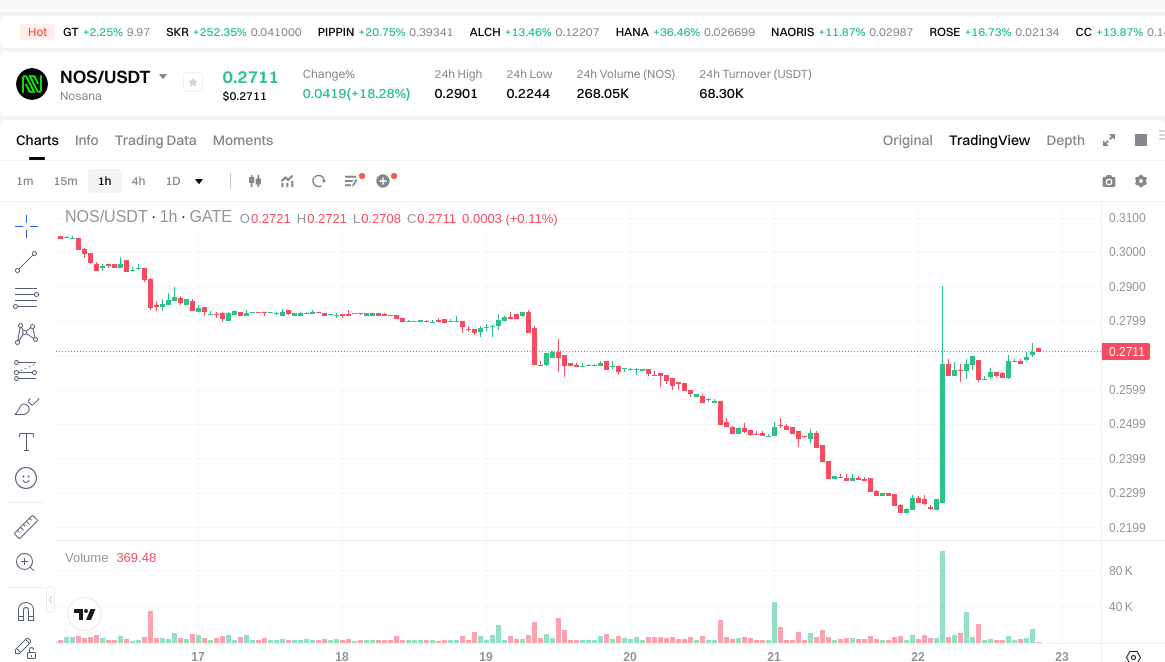
- 2023: NOS experienced significant price volatility, with its historical low of $0.01046656 recorded on October 24, 2023, reflecting challenging market conditions during the period.
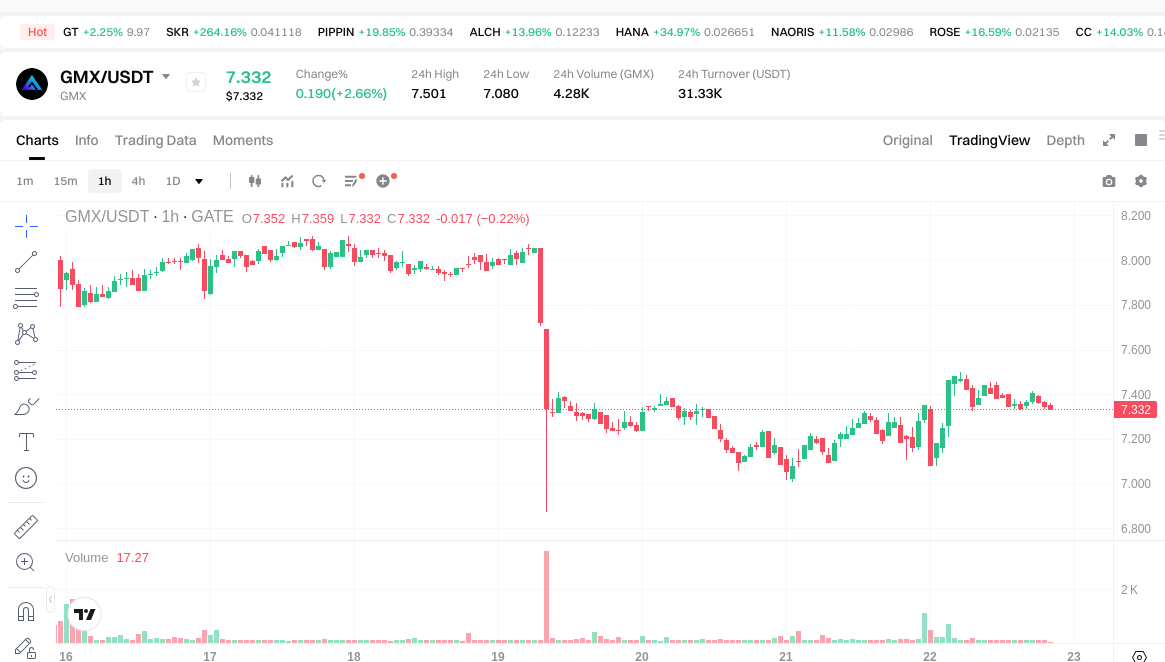
- 2023: GMX reached its all-time high of $91.07 on April 18, 2023, driven by strong platform adoption and market momentum during the period.
- 2024: NOS achieved its historical peak of $7.83 on March 7, 2024, representing a substantial recovery from its 2023 lows.
- 2025: GMX recorded its historical low of $6.92 on October 11, 2025, marking a significant correction from its previous highs.
- Comparative Analysis: During the market cycle from 2023 to 2026, NOS demonstrated extreme volatility, declining from its peak of $7.83 to current levels around $0.27, representing approximately a 96% decline. Meanwhile, GMX experienced a decline from $91.07 to $7.35, reflecting approximately a 91% decrease from its historical high.
Current Market Status (January 22, 2026)
- NOS Current Price: $0.2708
- GMX Current Price: $7.345
- 24-Hour Trading Volume: NOS $68,337.32 vs GMX $31,327.48
- 24-Hour Price Change: NOS +18.71% vs GMX +2.07%
- 7-Day Price Change: NOS -11.05% vs GMX -8.52%
- Market Capitalization: NOS $22,584,720 vs GMX $76,223,883.50
- Market Sentiment Index (Fear & Greed Index): 20 (Extreme Fear)
View real-time prices:
- View NOS Current Price Market Price
- View GMX Current Price Market Price
II. Core Factors Affecting NOS vs GMX Investment Value
Supply Mechanism Comparison (Tokenomics)
Due to the absence of specific tokenomics data in the provided materials, a detailed supply mechanism comparison cannot be presented at this time.
Institutional Adoption and Market Application
Without available data on institutional holdings, enterprise adoption cases, or regulatory positions across different jurisdictions, a comprehensive analysis of institutional preference and market application cannot be conducted.
Technology Development and Ecosystem Building
Given the lack of information regarding technical upgrades, development roadmaps, or ecosystem deployments in DeFi, NFT, payment systems, and smart contract implementations, this comparative analysis cannot be substantiated with concrete details.
Macroeconomic Environment and Market Cycles
In the absence of historical performance data under various inflationary conditions, interest rate environments, or geopolitical scenarios, an evidence-based assessment of how macroeconomic factors influence NOS and GMX cannot be provided.
III. 2026-2031 Price Forecast: NOS vs GMX
Short-term Forecast (2026)
- NOS: Conservative $0.252-$0.271 | Optimistic $0.271-$0.361
- GMX: Conservative $3.96-$7.33 | Optimistic $7.33-$7.99
Mid-term Forecast (2028-2029)
- NOS may enter a consolidation phase with projected price range of $0.287-$0.446 in 2028, potentially expanding to $0.206-$0.582 by 2029
- GMX may experience gradual growth trajectory with projected price range of $6.87-$11.72 in 2028, potentially reaching $5.32-$13.67 by 2029
- Key drivers: institutional capital flows, ETF developments, ecosystem expansion
Long-term Forecast (2030-2031)
- NOS: Baseline scenario $0.337-$0.489 (2030) | Optimistic scenario $0.541-$0.648 (2031)
- GMX: Baseline scenario $9.04-$12.06 (2030) | Optimistic scenario $14.03-$18.02 (2031)
Disclaimer: Price predictions are based on historical data analysis and market modeling. Cryptocurrency markets are highly volatile and subject to numerous unpredictable factors. These forecasts should not be considered as investment advice. Past performance does not guarantee future results.
NOS:
| Year | Predicted High Price | Predicted Average Price | Predicted Low Price | Price Change |
|---|---|---|---|---|
| 2026 | 0.360563 | 0.2711 | 0.252123 | 0 |
| 2027 | 0.375839485 | 0.3158315 | 0.20844879 | 16 |
| 2028 | 0.446127785325 | 0.3458354925 | 0.287043458775 | 27 |
| 2029 | 0.582093009201375 | 0.3959816389125 | 0.2059104522345 | 46 |
| 2030 | 0.69932337340142 | 0.489037324056937 | 0.337435753599286 | 80 |
| 2031 | 0.647656580114805 | 0.594180348729179 | 0.540704117343552 | 119 |
GMX:
| Year | Predicted High Price | Predicted Average Price | Predicted Low Price | Price Change |
|---|---|---|---|---|
| 2026 | 7.99188 | 7.332 | 3.95928 | 0 |
| 2027 | 10.6500966 | 7.66194 | 4.9036416 | 4 |
| 2028 | 11.719703424 | 9.1560183 | 6.867013725 | 24 |
| 2029 | 13.67359772922 | 10.437860862 | 5.32330903962 | 42 |
| 2030 | 17.4808074786345 | 12.05572929561 | 9.0417969717075 | 64 |
| 2031 | 18.017287432289145 | 14.76826838712225 | 14.029854967766137 | 101 |
IV. Investment Strategy Comparison: NOS vs GMX
Long-term vs Short-term Investment Strategies
- NOS: May appeal to investors with higher risk tolerance who are interested in emerging decentralized computing infrastructure projects and are willing to accept significant price volatility in exchange for potential upside during market recoveries
- GMX: May suit investors seeking exposure to the decentralized exchange sector with established trading volume and fee-sharing mechanisms, focusing on utility-driven value propositions
Risk Management and Asset Allocation
- Conservative Investors: NOS 15-20% vs GMX 80-85%
- Aggressive Investors: NOS 40-50% vs GMX 50-60%
- Hedging Tools: Stablecoin allocation for portfolio stability, diversified cryptocurrency holdings across different sectors, periodic portfolio rebalancing
V. Potential Risk Comparison
Market Risk
- NOS: Exhibits high volatility with approximately 96% decline from historical peak, smaller market capitalization of $22.58 million may result in higher price sensitivity to market movements and lower liquidity
- GMX: Despite larger market capitalization of $76.22 million, has experienced approximately 91% decline from historical high, reflecting significant market correction risks inherent in cryptocurrency markets
Technical Risk
- NOS: As a decentralized computing infrastructure project, faces challenges related to network scalability, adoption rate of computing marketplace, and competition from established cloud computing providers
- GMX: Decentralized exchange platforms face technical considerations including smart contract security, liquidity provision mechanisms, and platform performance during high-volume trading periods
Regulatory Risk
- Global regulatory developments may impact both assets differently: decentralized computing services and decentralized exchanges operate in evolving regulatory frameworks, with potential implications for operational compliance, user adoption, and market accessibility across jurisdictions
VI. Conclusion: Which Is the Better Buy?
📌 Investment Value Summary:
- NOS Characteristics: Represents exposure to decentralized computing infrastructure sector with smaller market capitalization and higher volatility profile, showing short-term price momentum with +18.71% 24-hour change
- GMX Characteristics: Offers participation in decentralized exchange ecosystem with larger market capitalization, established fee-sharing model, and more moderate short-term price movement of +2.07%
✅ Investment Considerations:
- New Investors: Consider starting with smaller position sizes, prioritize understanding fundamental project mechanics, implement dollar-cost averaging strategies to mitigate timing risks
- Experienced Investors: Evaluate portfolio allocation based on risk tolerance and sector diversification goals, monitor market sentiment indicators and technical price levels, consider correlation with broader cryptocurrency market trends
- Institutional Investors: Assess liquidity requirements, regulatory compliance considerations, and portfolio fit within broader digital asset allocation strategies
⚠️ Risk Disclosure: Cryptocurrency markets demonstrate extreme volatility and inherent risks. Historical price performance does not guarantee future results. This content does not constitute investment advice. Market conditions can change rapidly due to numerous factors including regulatory developments, technological changes, and macroeconomic conditions. Investors should conduct independent research and consider consulting financial professionals before making investment decisions.
VII. FAQ
Q1: What are the key differences between NOS and GMX in terms of their core functionality?
NOS operates as a decentralized CPU-based computing infrastructure platform, providing a marketplace for distributed computing power, while GMX functions as a decentralized perpetual exchange with a fee-sharing governance model. NOS targets the cloud computing democratization sector, whereas GMX serves the derivatives trading market within DeFi. These fundamental differences in use cases result in distinct value propositions: NOS derives value from computing marketplace adoption and network utilization, while GMX's value stems from trading volume, liquidity provision, and platform fees distributed to token holders.
Q2: Which asset carries higher investment risk based on current market indicators?
NOS presents higher risk characteristics, evidenced by its smaller market capitalization of $22.58 million compared to GMX's $76.22 million, and more severe price decline of approximately 96% from its historical peak versus GMX's 91% decline. NOS's 24-hour trading volume of $68,337 demonstrates lower liquidity, potentially resulting in higher price slippage and vulnerability to large transactions. However, NOS shows stronger short-term momentum with +18.71% daily change compared to GMX's +2.07%, indicating higher volatility in both directions. Conservative investors may prefer GMX's relatively larger market presence, while aggressive traders might view NOS's volatility as an opportunity.
Q3: What are the projected return expectations for both assets through 2031?
Based on price forecasting models, NOS projects a conservative price range of $0.252-$0.361 in 2026, potentially reaching $0.541-$0.648 by 2031, representing approximately 119% cumulative growth from current levels. GMX forecasts a conservative range of $3.96-$7.99 in 2026, potentially expanding to $14.03-$18.02 by 2031, indicating approximately 101% cumulative growth. These projections suggest comparable long-term growth potential, though NOS exhibits wider price ranges reflecting higher uncertainty. Investors should note that cryptocurrency price predictions carry significant uncertainty and depend on numerous variables including adoption rates, market conditions, and competitive dynamics.
Q4: How should portfolio allocation differ between conservative and aggressive investors?
Conservative investors should consider an allocation favoring GMX at 80-85% with NOS at 15-20%, emphasizing the more established platform with larger market capitalization and proven fee-generation model. Aggressive investors may adopt a more balanced approach with NOS at 40-50% and GMX at 50-60%, accepting higher volatility for potentially greater upside exposure to emerging computing infrastructure sector. Both strategies should incorporate stablecoin allocations for portfolio stability and implement periodic rebalancing to maintain target allocations amid market fluctuations. Risk management should include position sizing aligned with individual risk tolerance and consideration of correlation with broader cryptocurrency market movements.
Q5: What market conditions would favor NOS over GMX, and vice versa?
NOS may outperform during periods of renewed interest in decentralized infrastructure, AI/computing sector growth, or altcoin rallies favoring smaller-cap assets with higher beta characteristics. Its current extreme discount from historical highs may attract speculative capital during risk-on market phases. GMX may demonstrate resilience during market consolidation or downturns due to its utility-driven model, with trading activity potentially generating consistent fee revenue regardless of price direction. Additionally, GMX may benefit from increased derivatives trading demand, institutional DeFi adoption, or regulatory clarity favoring established decentralized exchanges. Current market sentiment at "Extreme Fear" (index: 20) suggests potential opportunities for contrarian positioning in quality assets.
Q6: What are the primary regulatory risks facing each asset?
Both assets operate in evolving regulatory frameworks with distinct considerations. NOS, as a decentralized computing marketplace, may face scrutiny regarding data privacy, cross-border data transfer regulations, and potential classification of computing services under existing regulatory structures. GMX, as a decentralized derivatives platform, faces more immediate regulatory attention from securities regulators and derivatives oversight bodies across multiple jurisdictions. Recent global trends toward cryptocurrency regulation, including exchange licensing requirements and derivatives trading restrictions, may impact GMX's operational model and user accessibility. Investors should monitor regulatory developments in key markets including the United States, European Union, and Asia-Pacific regions, as regulatory clarity or restrictions could significantly affect both assets' adoption trajectories and market valuations.
Q7: How do current market conditions and the Fear & Greed Index impact investment timing?
The current Fear & Greed Index reading of 20 (Extreme Fear) historically correlates with market bottoms and potential accumulation opportunities, though timing exact market turns remains challenging. NOS's recent +18.71% daily gain amid extreme fear conditions may indicate early contrarian interest or technical bounce from oversold levels, while its -11.05% weekly decline suggests continued downward pressure. GMX's more moderate movements (+2.07% daily, -8.52% weekly) reflect relative stability within the broader market downturn. Extreme fear conditions often precede market recoveries, but can persist during extended bear markets. Investors employing dollar-cost averaging strategies may find current conditions favorable for gradual position building, while those seeking confirmation may prefer waiting for sustained improvement in market sentiment indicators and technical price structure before significant capital deployment.
Share
Content
Introduction: NOS vs GMX Investment Comparison
I. Historical Price Comparison and Current Market Status
II. Core Factors Affecting NOS vs GMX Investment Value
III. 2026-2031 Price Forecast: NOS vs GMX
IV. Investment Strategy Comparison: NOS vs GMX
V. Potential Risk Comparison
VI. Conclusion: Which Is the Better Buy?
VII. FAQ
How to Buy Cryptocurrency


Trending Cryptocurrencies



2025 SUI coin: price, buying guide, and Staking rewards

How to Buy Crypto: A Step-by-Step Guide with Gate.com

HNT Price in 2025: Helium Network Token Value and Market Analysis

What is SwissCheese (SWCH) and How Does It Democratize Investment?

Cardano (ADA) Price Analysis and Outlook for 2025

How to Invest in Metaverse Crypto
Why Is Crypto Down? Market Analysis and Key Factors

What is BNKR: A Comprehensive Guide to Understanding the Decentralized Banking Revolution

What is C98: A Comprehensive Guide to Understanding This Digital Asset and Its Role in the Crypto Market

What is ABT: A Comprehensive Guide to Activity-Based Therapy and Its Applications in Modern Healthcare

What is BENQI: A Complete Guide to the Avalanche Lending Protocol and Its DeFi Opportunities