WLD meaning

What Is Worldcoin?
Worldcoin refers to an open-source, decentralized crypto project and its native token, WLD. The initiative aims to provide everyone with a verifiable human identity and access to the global digital economy. Decentralization means the system is not controlled by any single entity; instead, governance and decision-making are driven by the community and protocol rules.
The core concept is “verifiable humanness”: users generate cryptographically provable identities via specialized devices and technologies. WLD serves as the incentive, governance, and payment token, enabling applications to distinguish real people from bots without collecting unnecessary personal data.
Current Price, Market Cap, and Circulating Supply of Worldcoin (WLD)
As of 2026-01-20 (user-supplied data), WLD is priced at approximately $0.498100. The circulating supply stands at 2,747,976,284.091147 tokens, with a circulating market cap of about $4,981,000,000 and a fully diluted valuation of roughly $4,981,000,000.

View WLD USDT Price
Both the total and maximum supply are set at 10,000,000,000 tokens, representing about 0.15% market share.
Market cap is calculated as price multiplied by circulating supply, measuring the size of tokens currently in circulation; fully diluted valuation reflects the theoretical market cap if all tokens were released. Recent fluctuations: 1h -0.44%, 24h +2.46%, 7d -11.07%, 30d -2.84%; 24-hour trading volume is around $1,113,423.95.
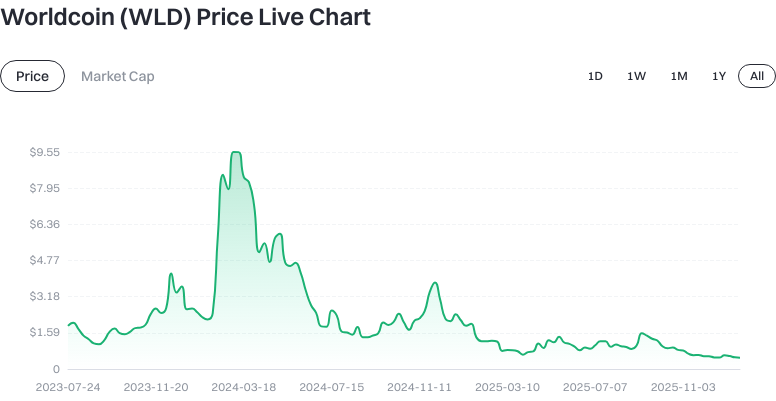
Prices change with the market; refer to actual order prices when trading.
Who Created Worldcoin (WLD), and When?
Worldcoin was launched by Tools for Humanity, co-founded by Sam Altman and others according to public sources. The mainnet and WLD token officially went live on July 23, 2023 (sources: Worldcoin official releases and project documentation, 2023–2024).
The project aims to build a global identity and payment infrastructure, enabling any application to integrate a “unique identity per person” proof—helping reduce fake accounts and bot-related abuse and costs.
How Does Worldcoin (WLD) Work?
Worldcoin uses dedicated hardware to hash users’ biometric data and combines this with zero-knowledge proofs to generate a “World ID.” Zero-knowledge proofs are cryptographic techniques that allow users to prove statements—such as “I am a unique human”—without revealing underlying data.
On-chain, WLD acts as a token for incentives, governance, and payments. Publicly available information indicates WLD is deployed on Ethereum layer-2 networks (such as Optimism), which helps lower transaction fees and increase scalability. The protocol prioritizes decentralized governance, gradually shifting decision-making power to the community over time.
What Can You Do With Worldcoin (WLD)?
Identity applications: Social platforms use World ID to enforce one-account-per-person or one-vote-per-person policies, reducing bot spam and fake engagement. DAOs leverage identity checks to prevent vote manipulation by multiple accounts owned by a single individual.
Distribution and incentives: Airdrops or subsidies require fair “one person, one claim” rules; WLD acts as an incentive or participation credential, helping reduce sybil attacks (where multiple fake identities claim rewards).
Payments and access: Connected applications use WLD or identity-linked credentials for payments, subscriptions, or access control—improving compliance and risk management efficiency.
Major Risks and Regulatory Considerations for Worldcoin (WLD)
Privacy and compliance are critical concerns. While zero-knowledge proofs minimize exposure of raw data, biometric data collection itself may face regulatory scrutiny and compliance requirements in different jurisdictions. The project must continuously demonstrate data minimization and security.
Supply and unlock risk: With a capped supply of 10 billion tokens, future release schedules affect market dynamics. Unlocks and distribution plans may cause price volatility. Investors should monitor official updates on token supply and allocation.
Market risk: Crypto asset prices can be highly volatile with sharp short-term swings. Exchange security and self-custody security are equally important—loss or leakage of private keys can result in irreversible asset loss. Private keys are cryptographic credentials controlling assets; safeguarding them is essential.
Long-Term Value of Worldcoin (WLD)
Long-term value depends on the real-world adoption of “verifiable humanness” and resulting network effects. As more applications use World ID for identity verification and anti-bot mechanisms, WLD’s role in incentives and governance becomes stickier.
Key metrics to watch include: growth in verified users, number and quality of active applications, developer integration speed, governance participation rates, regulatory progress, transparency in token releases, and market absorption capacity.
How to Buy and Safely Store Worldcoin (WLD) on Gate
Step 1: Register an account on Gate (gate.com) and complete KYC verification; enable two-factor authentication and other security settings.
Step 2: Deposit funds. Use fiat onramps or transfer stablecoins like USDT—check deposit network and confirmation status.
Step 3: Search for “WLD” and select your preferred trading pair. On the order page, a market order executes at current prices; limit orders let you set your own price and quantity.
Step 4: After your order fills, check your holdings and transaction records on the asset page. Strengthen account security by enabling withdrawal whitelist, fund password, and device login alerts.
Step 5 (optional): Withdraw to a self-custody wallet. Choose the correct network (Ethereum or layer-2), verify address details, note network fees. Safeguard mnemonic phrases and private keys—back up offline; avoid screenshots or cloud storage.
Step 6: Ongoing security management. Regularly review security settings, track withdrawal history, avoid unsafe network environments, monitor token supply updates and major announcements.
How Is Worldcoin (WLD) Different From Ethereum (ETH)?
Purpose: Ethereum is a general-purpose smart contract platform and foundational settlement layer; ETH is its native asset. Worldcoin focuses on identity verification and distribution scenarios; WLD operates as an application-layer token. Smart contracts are programs that execute rules automatically on-chain.
Value source: ETH accrues value from network usage (“gas fees”) and staking for security; WLD’s value is closely tied to adoption of its identity network, incentives, and governance—especially how well “one account per person” is realized.
Risk profile: ETH benefits from broad ecosystem usage and long-term development; WLD is more influenced by regulatory compliance around privacy, token unlocks, and adoption speed. Both are subject to market volatility and macro trends; consider your risk tolerance when allocating assets.
Worldcoin (WLD) Summary
Worldcoin (WLD) is dedicated to bringing “verifiable humanness” to the open internet and global economy—offering foundational capabilities for identity verification and anti-abuse use cases. WLD serves as the incentive, governance, and payment token. As of 2026-01-20 data, price and market cap fluctuate with broader trends; long-term value hinges on adoption rates, regulatory progress, compliance stability, and transparent supply management. If you choose to participate, you can buy and secure WLD via Gate while keeping an eye on privacy developments, network metrics, regulatory news, and unlock schedules—helping you assess allocation strategies within acceptable risk levels.
FAQ
What Is the Relationship Between the WLD Token and the Worldcoin Project?
WLD is the native token issued by the Worldcoin project for ecosystem governance and incentives. Worldcoin—founded by Sam Altman—is a global identity and financial inclusion initiative; WLD is its core asset. Holding WLD allows participation in community decision-making and serves as a key credential for accessing Worldcoin services.
How Can I Obtain WLD Tokens?
There are three main ways to get WLD: buy directly on exchanges like Gate; claim airdrop rewards after iris verification via the official Worldcoin app; or earn through incentive programs in ecosystem projects. For beginners, purchasing from Gate is recommended before exploring verification-based rewards via the official app.
What Are the Practical Uses of WLD Tokens?
WLD’s main uses include: community governance voting—holders vote on Worldcoin’s direction; ecosystem incentives—rewarding user participation in projects; trading liquidity—free buying/selling on Gate or other exchanges. As the ecosystem grows, use cases for WLD may further expand.
Why Does WLD’s Price Vary Across Different Exchanges?
Price differences stem primarily from each exchange’s liquidity profile and supply-demand dynamics. Major exchanges like Gate offer higher liquidity for stable pricing; smaller exchanges may see greater volatility due to lower trading volumes. It’s best to trade on reputable platforms with robust liquidity—Gate provides real-time prices in a secure environment.
What Risks and Security Issues Should I Be Aware of When Holding WLD?
Key risks include: policy risk—some countries scrutinize Worldcoin’s identity verification approach; market risk—expect significant price volatility; security risk—use trusted exchanges and cold wallets for safe storage. Always buy from platforms like Gate and keep your wallet security updated regularly.
Glossary of Key Worldcoin (WLD) Terms
- Biometric Verification: Using iris scans or other biometric features to verify user identity—a core technology for Worldcoin.
- Orb: Worldcoin’s biometric device; users scan their iris with an Orb to receive WLD tokens.
- Universal Basic Income (UBI): Worldcoin’s mechanism for distributing unconditional basic income globally.
- Privacy Protection: Techniques such as zero-knowledge proofs used by Worldcoin to safeguard user biometrics and transaction privacy.
- World ID: A biometric-based digital identity system that verifies uniqueness of users—prevents duplicate claims.
- Airdrop Distribution: Mechanism through which verified users periodically receive WLD tokens after biometric authentication.
References & Further Reading for Worldcoin (WLD)
-
Official Website / Whitepaper:
-
Developer Resources / Documentation:
-
Media & Research:
Related Articles

Arweave: Capturing Market Opportunity with AO Computer
The Upcoming AO Token: Potentially the Ultimate Solution for On-Chain AI Agents