


What is CRV Coin?

What Is CRV Token?
CRV is the governance token of the Curve protocol, empowering holders to vote on parameters such as trading fees, reward distribution, and pool weights. Governance tokens grant holders the right to participate in protocol decision-making.
Within Curve, users can lock their CRV for a specified period in exchange for veCRV (vote-escrowed CRV), which determines their voting power and boosts their rewards in specific pools. Curve operates as an automated market maker (AMM) optimized for low-slippage swaps between stablecoins and similar assets (such as wrapped Bitcoin or Ethereum derivatives). Slippage refers to the difference between the expected order price and the actual execution price.
Current Price, Market Cap, and Circulating Supply of CRV (as of 2026-01-21)
Based on available market data:
-
Latest price: ~$0.373300 USD
-
Circulating market cap: ~$875,003,094.53 USD
-
24-hour trading volume: ~$945,859.04 USD
-
Circulating supply: ~1,469,237,782 CRV
-
Total supply: ~2,343,967,571.73 CRV
-
Max supply: ~3,030,303,031 CRV
Market capitalization is calculated as price multiplied by circulating supply, reflecting the current market valuation of tokens in circulation. Fully diluted valuation (FDV) is typically price multiplied by max supply, representing the potential value if all tokens were released; actual reported values may vary depending on vesting schedules and calculation methodologies. Price change over 1 hour: ~0.19%; 24 hours: ~-4.33%; 7 days: ~-14.05%; 30 days: ~5.07%.
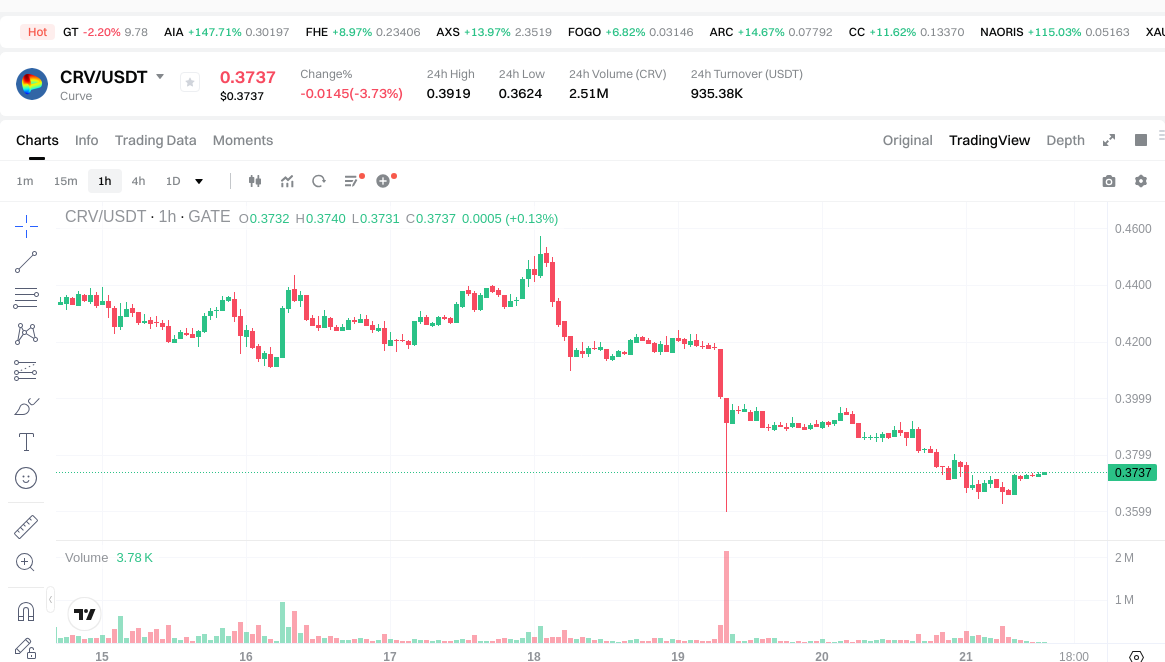
View the CRV USDT Price
These metrics help users understand short-term volatility and market scale, but for long-term analysis, it is essential to consider fundamentals such as protocol fee revenue, token lock-up durations, and governance outcomes.
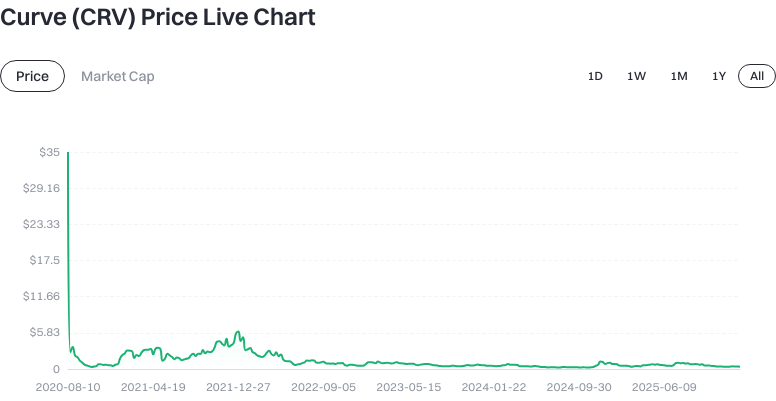
View the Latest CRV Price
Who Created CRV (CRV), and When?
Curve protocol was launched by developer and entrepreneur Michael Egorov in January 2020, focusing on efficient stablecoin and like-asset swaps. According to available data, the CRV token was issued on August 13, 2020, to enable governance and incentivize liquidity providers.
The timeline was protocol launch first, followed by token issuance to allow for parameter adjustments via community governance and incentive mechanisms during the later operational phase. Information is based on public sources and Curve community documentation, referencing official releases from 2020 (as of 2026-01-21).
How Does CRV (CRV) Work?
Curve uses a stable swap algorithm within its AMM framework. An AMM (automated market maker) is a protocol that uses mathematical formulas instead of order books to price assets within liquidity pools—funds containing two or more assets provided by users. Trades are executed by adjusting the asset ratios within these pools. The stable swap algorithm significantly reduces slippage when trading assets with similar prices, making it ideal for stablecoins (e.g., USD-pegged tokens) and like-kind assets.
Rewards and governance in Curve are facilitated through veCRV. Users lock their CRV for a set period to receive veCRV, which can be used to:
- Vote on reward weights for different pools (Gauge voting), directing more incentives to strategically important pools.
- Boost yield shares in participated pools, granting higher returns for long-term participants.
Fees primarily come from trading activity and are distributed to liquidity providers (LPs) according to each pool’s fee structure. LPs deposit assets into pools and receive LP tokens representing their share and entitlements.
What Can You Do with CRV (CRV)?
Primarily, CRV is used for governance voting—to determine protocol parameters, reward allocations across pools, and potential upgrades. By locking CRV for veCRV, users can increase their yield in select pools, making it attractive for long-term LPs. Liquidity providers earn transaction fees and may also receive additional CRV incentives by providing liquidity to stablecoin or like-asset pools—an option suitable for passive income strategies.
In practice, institutions or individuals may need to swap large amounts of USDC for DAI for settlement or collateralization; Curve’s low slippage and deep liquidity help minimize costs. Asset managers may allocate funds to stable asset pools to pursue steady fee yields and CRV rewards.
Main Risks and Regulatory Considerations for CRV (CRV)
Price volatility risk: Despite being a governance token, CRV’s price is still influenced by market sentiment, vesting schedules, and expected protocol revenue.
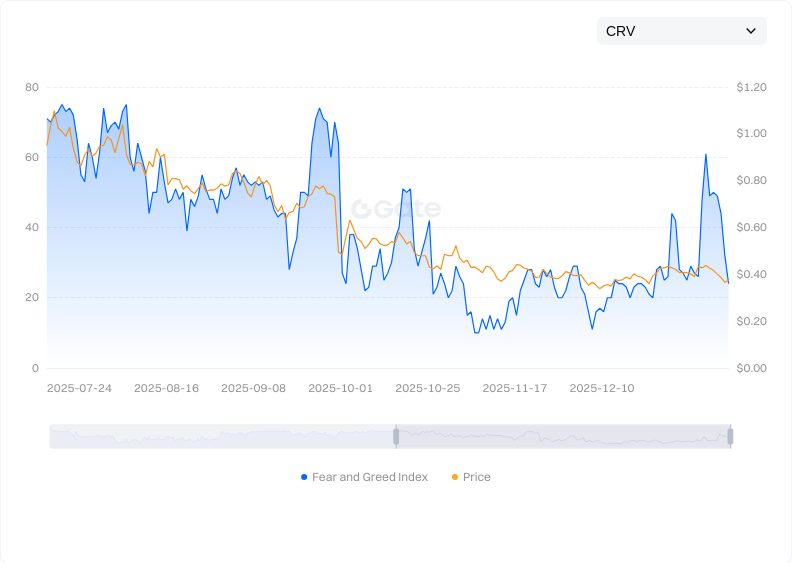
View the CRV Fear & Greed Index
Smart contract risk: Curve’s AMM and reward systems are governed by smart contracts that may contain vulnerabilities or be subject to attacks—potentially resulting in loss of funds. Always review audit reports and official announcements.
Stablecoin depegging risk: If a stablecoin within a pool loses its peg (fails to maintain its expected price), LPs and traders may incur losses.
Governance centralization & voting dynamics: If veCRV voting power becomes concentrated among a few addresses, decisions may favor certain interests and impact rewards or protocol parameters.
Regulatory uncertainty: Jurisdictions vary in their regulatory approach to DeFi governance tokens and yield activities—impacting usage and compliance requirements. Exchange operations and withdrawals must also comply with local laws and KYC standards.
Custody & private key security: Holding assets on exchanges exposes users to platform risk; self-custody requires secure backup of seed phrases and private keys to avoid loss or theft.
What Drives the Long-Term Value of CRV (CRV)?
Long-term value depends on actual protocol usage and fee revenue, liquidity depth and stability, sustained engagement via veCRV lock-ups, and Curve’s position within multichain ecosystems focused on stable assets. As institutional and individual demand grows for stablecoin settlement and cross-platform liquidity management, efficient low-slippage swapping remains highly sought after.
Additionally, Gauge voting directs incentives toward productive pools to optimize capital efficiency; lock-up mechanisms encourage sustained governance participation. Key metrics to monitor include trading volume, fee income, locked ratio, pool depth and health, and integration breadth across other DeFi protocols.
How Can I Buy and Securely Store CRV (CRV) on Gate?
Step 1: Register an account on Gate and complete identity verification (KYC). Follow the platform instructions to submit your information for approval—ensuring compliance and withdrawal permissions.
Step 2: Deposit or purchase USDT via fiat gateway or crypto deposit for use in CRV trading.
Step 3: Search for “CRV” in the spot trading section. Select a suitable trading pair (e.g., CRV/USDT), review price data, order book depth, and fees.
Step 4: Place your buy order. Use a market order for instant execution or a limit order to specify your price. Be mindful of slippage and fees before confirming your order.
Step 5: Store your assets securely. For short-term trading, you may leave funds in your Gate account with enhanced security settings; for long-term holding, it’s recommended to withdraw your CRV to a self-custody wallet (such as any ERC-20 compatible wallet). When withdrawing, ensure you select the correct network (commonly Ethereum ERC-20) and verify your address.
Step 6: Strengthen your security posture. Enable two-factor authentication (2FA), withdrawal whitelists, and device locks on your account; for self-custody wallets, back up your seed phrase offline and consider using a hardware wallet for enhanced private key security—never share your recovery phrase.
How Is CRV (CRV) Different from UNI?
Positioning: CRV is focused on low-slippage swaps between stablecoins and similar assets; UNI powers a general-purpose AMM supporting a broader range of tokens but does not optimize slippage for stable asset trades as Curve’s algorithm does.
Algorithm & fees: CRV uses a stable swap algorithm offering minimal slippage when prices are similar; UNI primarily uses the constant product formula suitable for diverse assets. Both distribute trading fees to LPs, but Curve uses Gauge voting to direct additional incentives.
Governance & incentives: Participating in CRV governance requires locking tokens for veCRV to vote and boost rewards; UNI governance involves proposal voting without lock-up incentives. The mechanisms driving incentive allocation and long-term participation differ substantially.
Ecosystem integration: Curve is deeply integrated with stable asset protocols and yield strategies for capital efficiency; Uniswap serves as a universal liquidity layer supporting many long-tail assets. Both are DeFi infrastructure but target different niches.
Summary of CRV (CRV)
The CRV token underpins both governance and incentive systems within the Curve protocol: by locking CRV as veCRV, the community can allocate rewards and adjust parameters toward the most valuable pools—maintaining low-slippage and efficient trading between stablecoins and like assets. While short-term prices are subject to volatility, long-term value is anchored in trading volumes, fee revenues, locked ratios, governance participation rates, and breadth of multi-chain ecosystem integration. To participate safely on Gate, follow step-by-step guidance for purchase and security practices; strategically consider your investment horizon before opting into lock-up or governance activities. Continuously monitor key indicators like pool health and governance outcomes to maximize certainty in usage or holding.
FAQ
What Is the Main Purpose of CRV?
CRV is the governance token of the Curve protocol—holders participate in platform decision-making and share in trading fee revenue. CRV also incentivizes liquidity mining by rewarding users who provide stablecoin liquidity to Curve pools. In essence, CRV functions as both a rights certificate and reward token within the Curve ecosystem.
How Can I Obtain CRV?
There are two main ways to acquire CRV: buy it directly on exchanges such as Gate or earn it through liquidity mining by providing funds to Curve pools. Beginners should start by purchasing on Gate before trying liquidity mining for higher potential returns.
What Are the Benefits of Holding CRV?
Holders of CRV enjoy three core benefits: participating in Curve governance voting to shape protocol direction; sharing platform fee income; earning extra rewards through various DeFi activities. Long-term holding may also appreciate in value as the Curve ecosystem grows.
How Is CRV Different from Other DeFi Tokens?
CRV is specialized for stablecoin trading while many DeFi tokens have broader applications. Curve’s AMM mechanism is specifically optimized for swaps between stablecoins—resulting in lower slippage and fees—which gives CRV a unique role within DeFi.
How Can Beginners Safely Purchase CRV on Gate?
First register a Gate account and complete identity verification; then deposit fiat or crypto funds. Next, search for the CRV/USDT trading pair in spot markets to purchase. After buying, transfer your tokens into a hardware wallet or Gate Vault feature for safekeeping—avoid leaving assets on exchanges long-term.
Glossary of Key Curve (CRV) Terms
- Stablecoin Swap: Curve’s low-slippage exchange mechanism designed for efficient swapping between stablecoins or similar assets.
- Liquidity Mining: The process of providing funds to Curve liquidity pools in exchange for trading fees and additional CRV token rewards.
- Automated Market Maker (AMM): A system using mathematical formulas rather than order books that allows anyone to become a liquidity provider.
- Gauge Mechanism: Enables CRV holders to vote on which liquidity pool receives reward distributions—empowering decentralized community governance.
- Token Locking (veToken): Users lock up CRV to receive veCRV—used for governance voting and earning fee shares.
- Cross-chain Bridging: Allows Curve protocol and the CRV token to operate across multiple blockchains—expanding ecosystem reach.
Curve DAO Token (CRV) References & Further Reading
-
Official Website / Whitepaper:
-
Developer Documentation:
-
Authoritative Media / Research:
Related Articles

In-depth Explanation of Yala: Building a Modular DeFi Yield Aggregator with $YU Stablecoin as a Medium

Sui: How are users leveraging its speed, security, & scalability?
