


What is CKB Crypto?

What Is CKB?
CKB refers to CKByte, the native Layer 1 token of the Nervos Network mainnet. Secured by Proof-of-Work (PoW), where miners compete to produce blocks using computational power, CKB supports smart contracts (programmable on-chain logic) and Layer 2 scaling solutions (L2, which move part of computation and data off-chain to boost performance). Its unique “capacity” design means each CKB represents one byte of on-chain state space. Holders can use this capacity to store assets or application states, pay transaction fees, and access miner services.
Current Price, Market Cap, and Circulating Supply of CKB (CKB)
As of 2026-01-21 (source: provided data), the latest price is approximately $0.002424. The circulating market cap is around $108,320,762, with a fully diluted valuation also at $108,320,762 and a market share of about 0.0034%. Recent price changes: -0.08% in 1 hour, -3.84% in 24 hours, -16.49% over 7 days, and +1.68% over 30 days.
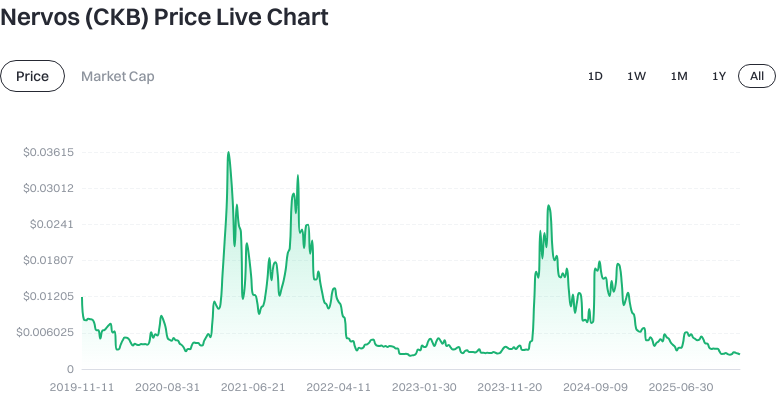
Click to view CKB Latest Price
In the past 24 hours, trading volume was about $46,343, indicating relatively limited liquidity; order execution may require patience.
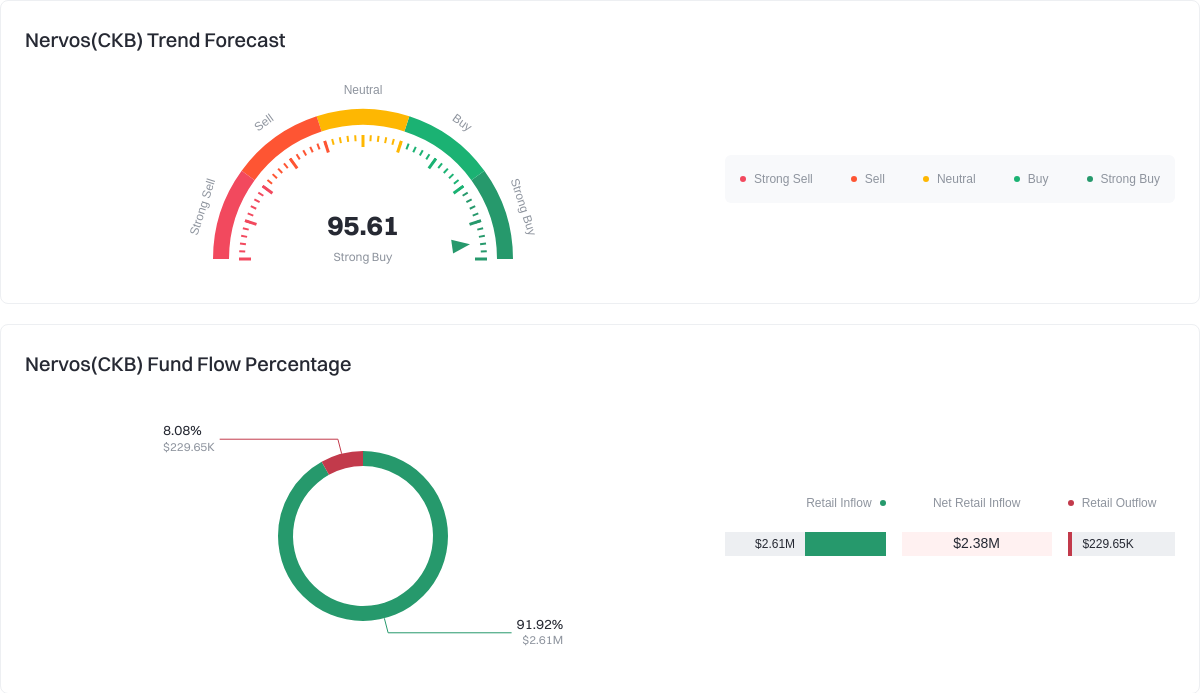
Click to view CKB Fund Flow Share
Supply data shows: circulating supply is about 4.807 billion CKB, while both total and maximum supply are approximately 4.469 billion CKB. This “circulating supply > total/max supply” inconsistency typically results from differences in data sources or inclusion of unlocked tokens or unit variations. Always cross-check with official announcements or block explorer data before making investment decisions.
Who Created CKB (CKB) and When?
CKB originates from the open-source Nervos Network public blockchain ecosystem. The mainnet launched on 2019-10-15 (source: public project info). The project is supported by a foundation and developer community working together to grow the ecosystem. Its goal is to build a universal Layer 1 PoW blockchain, encouraging long-term storage of “common knowledge” (public, verifiable on-chain information), and providing a secure and scalable foundation for diverse applications and assets.
How Does CKB (CKB) Work?
CKB is a Layer 1 blockchain utilizing Proof-of-Work (PoW) consensus. Miners package transactions and earn block rewards plus transaction fees. The network uses a “capacity” model: each CKB represents one byte of state space. Users holding CKB can create “cells” (programmable storage units) on-chain to hold assets and application data.
Smart contracts enable developers to deploy logic on-chain, such as issuing tokens or managing NFTs. To address performance and cost, the ecosystem supports Layer 2 scaling: moving large volumes of computation and state off-chain and submitting results periodically to Layer 1 for security and scalability.
NervosDAO is a special contract allowing holders to lock up CKB for rewards, helping offset long-term issuance or inflation effects; withdrawals return funds and accrued rewards to the user’s address. Since all on-chain storage consumes capacity, the economic model incentivizes long-term retention of stable “common knowledge” on Layer 1, while dynamic data is handled more efficiently off-chain.
What Can You Do With CKB (CKB)?
Primary uses include:
- State storage: Each CKB equals one byte of capacity, suitable for holding asset balances, app configurations, or NFT metadata.
- Transaction fees & miner incentives: Every transaction requires fee payment in CKB to sustain the network.
- Staking for yield: Locking CKB in NervosDAO allows long-term holders to earn rewards, enhancing the holding experience.
On the application layer, developers can issue custom tokens, deploy financial, gaming, or identity contracts, and shift intensive interactions to Layer 2 for better cost and usability. Users can hold various assets on-chain and use capacity design to manage their own data usage and expenses.
Major Risks and Regulatory Considerations for CKB (CKB)
- Price volatility: Crypto asset prices are highly sensitive to liquidity and market sentiment; short-term swings can be significant.
- Consensus & technical risks: PoW relies on mining power and participation; concentrated hashrate or software bugs may impact security or performance.
- Smart contract risk: Bugs or external failures in contract code can cause asset loss—always choose audited or established contracts.
- Regulatory compliance: Rules vary by jurisdiction; fiat onboarding, reporting, and tax must comply with local laws.
- Exchange & private key management: Platforms carry operational/security risks; self-custody requires careful backup of private keys (confidential address control strings) and mnemonic phrases (word sets for key recovery)—loss may be irreversible.
- Data discrepancies: Differences in supply or market cap statistics can affect judgment; always cross-reference sources before investing.
Long-Term Value Proposition of CKB (CKB)
CKB’s value lies in its “capacity as value” concept: tokens represent verifiable on-chain storage space, incentivizing durable storage of public/stable application states on Layer 1 for sustainable data security. PoW provides decentralized base-layer security while Layer 2 scaling enables high-frequency interaction in a cost-effective environment.
Long-term value depends on ecosystem adoption, developer activity, and Layer 2 usability.
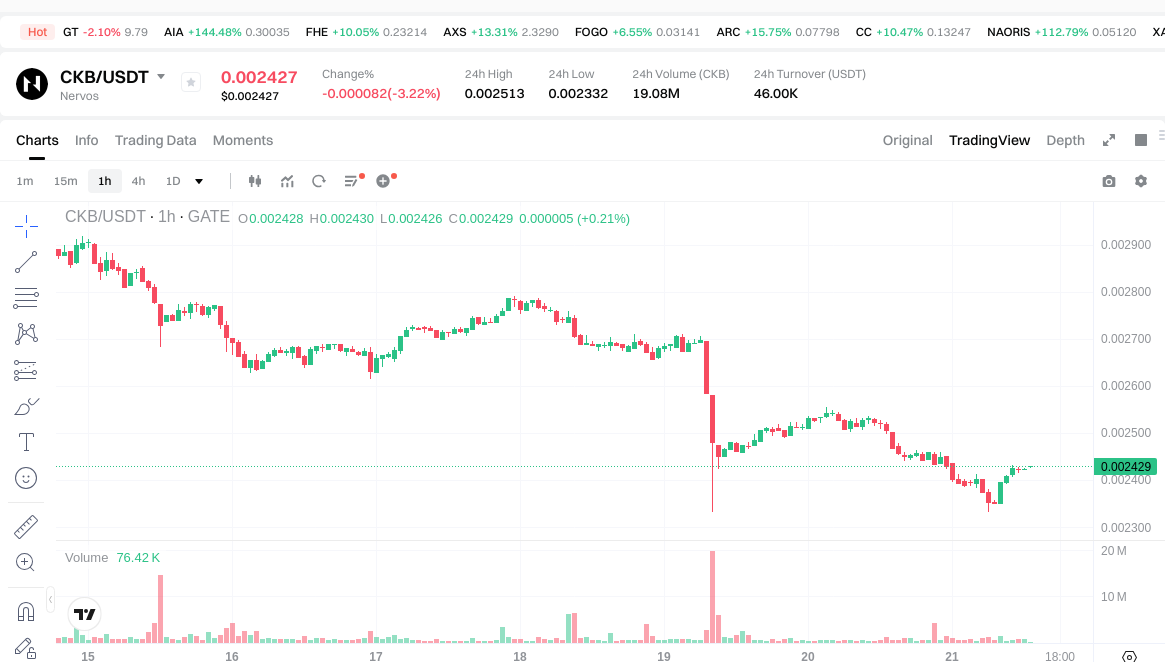
Click to view CKB USDT Price
If more assets and applications anchor their “core states” on CKB—and users leverage NervosDAO for managing holding costs—the network’s utility may strengthen. However, future prospects depend on ongoing tech development and competition from other chains; keep monitoring fundamentals and data.
How to Buy and Safely Store CKB (CKB) on Gate
Step 1: Register a Gate account and complete identity verification (KYC). Enable two-factor authentication for security.
Step 2: Deposit or purchase USDT. Use local compliant methods for fiat deposits; if using blockchain deposits, double-check the network and address.
Step 3: Search for the “CKB/USDT” trading pair on the trading page. Review price, depth, and fee details; set your target price or choose market order.
Step 4: Place your buy order. Limit orders allow you to set a target price; market orders execute quickly at current prices. After execution, check your holdings and cost in the asset page.
Step 5: Withdraw tokens to a self-custody wallet for greater sovereignty and safety. Create a wallet supporting CKB addresses; securely back up your mnemonic phrase and private key, test withdrawal with a small amount first, then transfer as needed.
Step 6: Practice safe storage and ongoing management. Regularly check wallet security; interact with smart contracts cautiously. If planning long-term holding, research NervosDAO locking process along with its potential rewards and risks.
How Is CKB (CKB) Different From Ethereum?
Consensus mechanism: CKB uses PoW; Ethereum currently uses Proof-of-Stake (PoS), where stakers participate in consensus. Energy consumption and security assumptions differ.
State & economic design: CKB measures state by “capacity,” encouraging permanent public data storage; Ethereum uses an account model with gas fees based on computation/storage usage.
Scaling approaches: Both support Layer 2 solutions but differ in emphasis—CKB prioritizes keeping stable core states on Layer 1 while moving high-frequency interactions off-chain; Ethereum Layer 2 focuses on large-scale execution and fee reduction.
Ecosystem & tooling: Ethereum has a larger, more mature ecosystem; CKB targets specialized scenarios like persistent knowledge storage and cross-layer coordination. Each has its advantages—choose based on your needs.
Fees & user experience: CKB holders control fees via capacity; Ethereum fees are highly impacted by network congestion. Actual costs depend on current network conditions.
Summary of CKB (CKB)
CKB is the native token of Nervos Network’s Layer 1 PoW blockchain. Its core innovation is mapping “capacity” to on-chain state space, supporting smart contracts and Layer 2 scaling while enabling staking through NervosDAO. Recent price data shows it is a mid-sized asset with notable short-term volatility—always verify supply statistics before investing. For users, CKB serves as both fee payment/incentive mechanism and flexible allocation of chain storage for assets/app states. Practically, Gate allows step-by-step registration, deposit, trading, withdrawal, self-custody—prioritize key security and contract risk management. Future value will hinge on ecosystem adoption and Layer 2 usability; track fundamentals regularly and diversify asset storage while deepening your understanding of capacity models and locking mechanisms.
FAQ
What Is CKB? What Makes It Unique?
CKB (Nervos CKB) is the native token of Nervos Network, leveraging a unique PoW consensus mechanism and Cell model design. It is mainly used for network transaction fees, mining participation, and governance voting—often called a “Bitcoin alternative among Layer 1 blockchains.” Compared to other chains, CKB balances scalability with security.
Where Can You Trade or Buy CKB?
CKB is available on major exchanges including Gate, Binance, Huobi. On Gate’s platform, beginners can buy via “spot trading” or “fiat trading,” with support for USDT pairs. It’s recommended to complete identity verification before choosing the appropriate trading pair.
What Can You Do With CKB? What Are Its Uses?
CKB serves three main functions: paying transaction fees on Nervos Network; staking/mining for yield; participating in network governance voting. Regular users can use CKB within Nervos ecosystem apps or trade it as a long-term investment asset.
Is Mining CKB Difficult? Can Regular Users Mine?
CKB uses PoW consensus—technically anyone can mine. However, as difficulty increases over time, individual mining yields have dropped; professional mining hardware is now required. Ordinary users are advised to participate via exchange staking features rather than direct mining.
What Is The Total Supply of CKB? Will It Be Inflated Indefinitely?
CKB has a total supply cap of 137 billion tokens but utilizes a “permanent primary issuance” mechanism—annual new issuance declines over time but never stops completely. This approach is similar to Bitcoin but gentler, balancing network security with controlled inflation. Investors should track long-term scarcity trends.
Key Nervos CKB Terms
- Cell Model: Nervos’s core data structure—similar to UTXO but more flexible—for storing state and assets.
- Layer 1 Blockchain: Nervos CKB serves as foundational infrastructure offering security and finality for upper-layer applications.
- PoW Consensus Mechanism: Uses Proof-of-Work mining to validate transactions and secure the network.
- Smart Contracts: Programmable scripts deployed on CKB enabling custom logic and asset interaction.
- Cross-chain Interoperability: Nervos leverages protocols like IBC for asset/information exchange with other chains.
- Gas Fees: Computation resources required for transactions/smart contracts paid in CKB tokens.
Nervos CKB References & Further Reading
-
Official Site / Whitepaper:
-
Developer Resources / Docs:
-
Media / Research:
Related Articles

The Future of Cross-Chain Bridges: Full-Chain Interoperability Becomes Inevitable, Liquidity Bridges Will Decline

Solana Need L2s And Appchains?
