


What is ADA?

What Is ADA?
ADA is the native asset of the Cardano public blockchain. It serves as the unit for network transaction fees, value transfer, and enables participation in staking and governance through proof-of-stake (PoS). In a PoS mechanism, holders can either stake their coins directly or delegate them to a stake pool, contributing to network consensus and earning rewards. Cardano leverages the Extended Unspent Transaction Output (EUTxO) model, which allows for parallel transaction processing and enhances predictability.
Unlike “tokens,” which are typically assets issued on top of another blockchain, ADA is Cardano’s native coin, minted directly on the mainnet. ADA is used for gas fees, securing the network, and participating in governance.
Current Price, Market Cap, and Circulating Supply of ADA
As of 2026-01-21, based on available data:
- Latest price: $0.360300
- Circulating supply: 36,767,176,678.532417 ADA
- Circulating market cap: $16,213,500,000
- Fully Diluted Valuation (FDV): $16,213,500,000
- Market dominance: 0.51%
Click to view Top Cryptocurrency Market Cap Share
- 1-hour change: +0.38%; 24-hour change: -1.85%; 7 days: -15.00%; 30 days: -1.83%
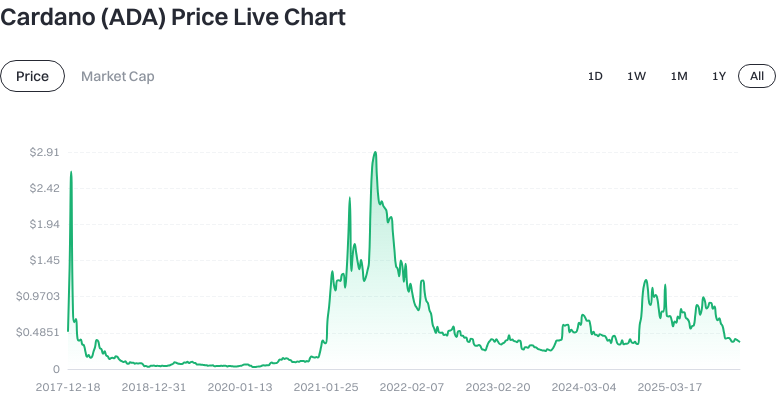
Click to view ADA Latest Price Chart
- 24-hour trading volume: $3,819,823.73
- Max supply: 45,000,000,000 ADA; Total supply: 45,000,000,000 ADA
Note: Market cap is calculated as price multiplied by circulating supply; FDV is based on maximum supply; price changes reflect different periods and short-term volatility does not indicate long-term trends.
Who Created ADA and When?
Cardano’s development is driven by three organizations: IOG (formerly IOHK – responsible for R&D), the Cardano Foundation (standards and ecosystem coordination), and Emurgo (commercial applications and investment). The mainnet launched in 2017 alongside the issuance of ADA. Cardano’s roadmap is divided into phases: Byron (infrastructure), Shelley (decentralized staking), Goguen (smart contracts), Basho (scalability), and Voltaire (on-chain governance and funding mechanisms).
How Does ADA Work?
Cardano’s consensus mechanism is the Ouroboros protocol series—a PoS protocol rigorously reviewed through academic audits. The network divides time into epochs and slots; stake pools are probabilistically chosen to produce blocks. ADA holders can delegate to stake pools without transferring ownership and earn block rewards.
On the ledger side, Cardano uses EUTxO: each transaction consumes inputs and generates outputs. Smart contracts are implemented via Plutus scripts attached to outputs, enabling parallel execution and greater transaction predictability.
The network architecture features two layers:
- Settlement Layer (CSL): Handles ADA transfers and fee settlements.
- Computation Layer (CCL): Executes smart contract logic.
This layered approach enables independent upgrades and maintenance.
What Can You Do With ADA?
ADA can be used for on-chain payments and remittances, with transaction fees denominated in ADA. Holders can delegate their stake to earn rewards and enhance network security. Developers can deploy DeFi, NFT, decentralized identity, and credential applications. The community can participate in funding proposals and governance via voting mechanisms.
In real-world scenarios, ADA is used to pay decentralized exchange fees, participate in lending collateralization, or mint/trade digital collectibles on NFT marketplaces.
ADA Wallets and Scaling Solutions
Popular wallets include:
- Daedalus: Full-node desktop wallet that syncs the entire blockchain for users who want self-verification.
- Yoroi: Lightweight browser extension and mobile wallet designed for everyday use and staking delegation.
- Lace: A lightweight wallet from IOG supporting multi-account management and DApp connectivity.
- Hardware wallets: Ledger and Trezor can be integrated with these wallets for higher security with offline private key storage.
For scalability, Layer 2 solutions like Hydra are being developed to increase throughput and lower latency. Hydra creates off-chain channels atop the mainnet for high-frequency interactions.
Main Risks and Regulatory Considerations for ADA
Price Volatility: Crypto assets are subject to macroeconomic trends, liquidity shifts, and narrative changes—expect notable short-term volatility.
Technical & Smart Contract Risks: Vulnerabilities in smart contracts may arise; while EUTxO enables predictability and parallelization, poor application design may still cause congestion or failed transactions.
Staking & Centralization: Delegation depends on stake pool performance; excessive concentration in a few pools may pose decentralization risks. Changes in reward rules can affect yield.
Custody & Private Keys: Keeping assets on exchanges exposes platform/account risks. Self-custody requires careful backup of seed phrases/private keys to avoid loss or phishing attacks.
Regulatory Uncertainty: Token classification and compliance requirements vary across jurisdictions, potentially impacting trading, listings, or certain use cases.
Network & Ecosystem Risks: Mainnet upgrades or congestion, DApp security incidents, or cross-chain bridge vulnerabilities may affect user experience and asset safety.
How to Buy and Securely Store ADA on Gate
Step 1: Register & Complete KYC. Create an account at gate.com and follow identity verification steps to enhance limits and account security.
Step 2: Deposit or Buy USDT. Purchase USDT via fiat channels or transfer USDT/USDC from another wallet to your Gate account’s corresponding address.
Step 3: Place an Order for ADA. Go to spot trading, select the ADA/USDT pair, and place a limit or market order as needed.
Step 4: Enable Security Settings & Withdrawal Whitelist. Activate two-factor authentication (2FA), withdrawal whitelisting, and withdrawal protection to reduce theft risk.
Step 5: Withdraw to Self-Custody Wallet. Copy your self-custody Cardano mainnet address; on Gate’s withdrawal page select Cardano mainnet, test with a small amount first before transferring larger balances.
Step 6: Delegate Staking & Backup. Use Daedalus, Yoroi, or Lace to connect your wallet and choose a reputable stake pool for delegation. Record your seed phrase securely offline—never screenshot or store it in the cloud.
Tips: Ensure withdrawal networks match receiving address networks; split large withdrawals into batches; consider hardware wallets for long-term holding.
How Is ADA Different From Ethereum?
Consensus Mechanism: Both use PoS but Cardano’s Ouroboros protocol emphasizes formal verification; Ethereum uses its own PoS mechanism implemented through the Beacon Chain merge.
Ledger Model: Cardano employs EUTxO for more composable and parallelizable transactions; Ethereum uses an account model centered on balance updates.
Contract Languages & Tooling: Cardano uses Plutus/Haskell focusing on verifiability; Ethereum’s Solidity/VM ecosystem offers broader tools/resources.
Ecosystem Maturity: Ethereum has more DApps and developers with stronger network effects; Cardano prioritizes academic rigor and methodical upgrades with TVL concentrated in select sectors.
Fees & Scaling: Cardano typically maintains manageable fees and develops L2 solutions like Hydra; Ethereum relies on rollups to boost throughput and reduce costs.
Governance & Funding: Cardano plans on-chain governance/funding proposals; Ethereum primarily relies on improvement proposals and community collaboration—each suits different development/compliance needs.
Summary of ADA
ADA embodies Cardano’s approach to verifiability, layered architecture, and the EUTxO model. It functions as both a medium of exchange for network fees/value transfer and as a credential for staking/governance participation. As of 2026-01-21, ADA’s circulating supply, market cap, and volatility remain dynamic; long-term performance depends on real-world adoption, scaling progress, and ecosystem activity. For beginners, understanding the basics of PoS/EUTxO, safe account/private key management, and proper buy/withdraw procedures on Gate are key entry steps. Allocate investments according to risk tolerance, monitor protocol upgrades/regulatory developments, review portfolio goals regularly, and maintain disciplined processes to navigate market uncertainty.
FAQ
What Advantages Does ADA Have Over Bitcoin or Ethereum?
ADA uses a proof-of-stake consensus mechanism that is more energy-efficient than Bitcoin’s proof-of-work. Compared to Ethereum, ADA focuses on academic rigor and scalability via a layered architecture that supports higher transaction throughput. ADA aims to be a more efficient and sustainable smart contract platform—ideal for use cases requiring long-term stability.
How Can Beginners Start Buying and Holding ADA?
The simplest way is to register an account at a reputable exchange like Gate. Complete identity verification, then exchange fiat or other cryptocurrencies for ADA. It’s recommended to transfer ADA into a dedicated wallet like Daedalus or Yoroi for self-custody—ensuring you control your private keys. Start with small amounts as you learn the process before scaling up your holdings.
Can You Earn Passive Income by Holding ADA?
Yes. Since ADA uses PoS, holders can participate in staking (staking) to help validate the network and earn rewards—typically yielding an annual rate of 3–6%. You can stake directly in supported wallets or platforms like Gate. Your staked ADA remains yours at all times and can be unstaked at any time—making it an attractive passive income strategy.
What Are Some Popular Projects in the ADA Ecosystem?
The ADA ecosystem features DeFi protocols (such as Minswap and SundaeSwap), NFT platforms like CNFT, and GameFi applications—demonstrating real-world utility for ADA. Beginners can explore these projects via official resources or Gate’s project pages but should be mindful of higher risks associated with new projects.
Is ADA Highly Volatile? Is It Suitable for Long-Term Holding?
As a leading crypto asset, ADA does experience price fluctuations but tends to be more stable than other mainstream coins. Ongoing technical upgrades and ecosystem development support its long-term value proposition. Long-term investors might consider dollar-cost averaging strategies to mitigate risk; short-term traders should closely monitor market sentiment/technical indicators with clear stop-loss/take-profit plans.
Cardano (ADA) Key Terminology
- Ouroboros: Cardano’s unique PoS consensus protocol providing network security and transaction validation via proof of stake.
- Stake Pool: A pool where ADA holders delegate tokens to earn staking rewards.
- Smart Contract: Smart contracts are self-executing code that runs on Cardano’s blockchain.
- Plutus: Cardano’s smart contract language enabling complex decentralized applications.
- UTXO Model: Unspent Transaction Output model used by Cardano for secure/scalable transaction validation.
- Epoch: A fixed-length time period on Cardano during which rewards are distributed.
Cardano (ADA) References & Further Reading
-
Official / Whitepaper:
-
Development / Documentation:
-
Authoritative Media / Research:
Related Articles

The Future of Cross-Chain Bridges: Full-Chain Interoperability Becomes Inevitable, Liquidity Bridges Will Decline

Solana Need L2s And Appchains?
